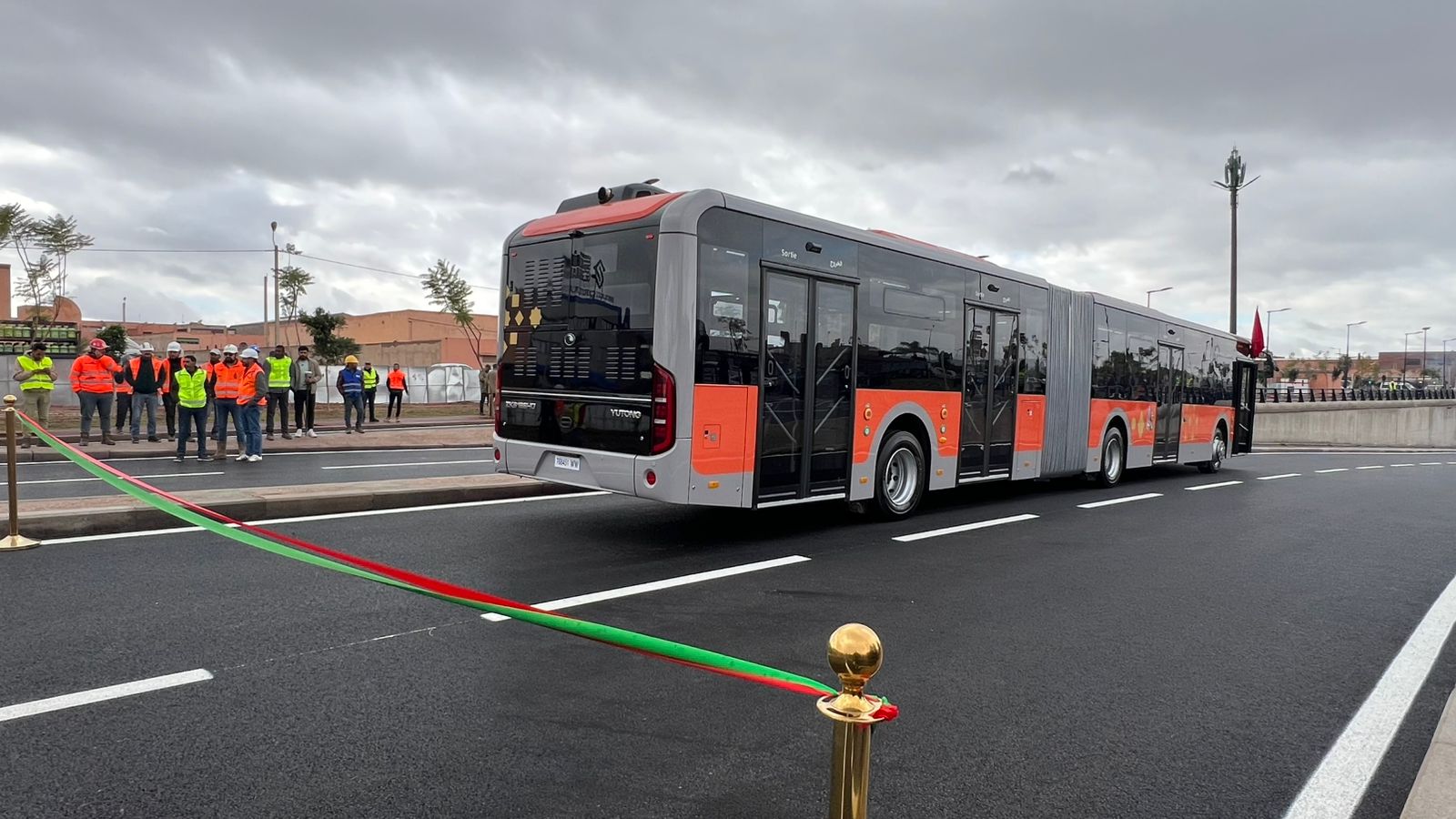
Marrakech – Marrakech’s urban transport fleet received a major boost on Wednesday as 207 new-generation buses entered service. The launch was originally scheduled for Sunday but was delayed until this week.
The new buses represent part of an ambitious 349-vehicle fleet renewal program worth MAD 717.48 million ($71.7 million). Currently, 207 buses are operational, while 127 remain under acquisition, and 15 electric buses await delivery.
The ceremony took place in the presence of Marrakech-Safi Regional Wali and Marrakech Prefecture Governor Khatib El Hebil and Regional Council President Samir Goudar. The launch forms part of the bus network restructuring project within the Marrakech Transport territorial grouping framework.
Supratours, a subsidiary of Morocco’s National Railways Office (ONCF), has taken over operations from Spanish company ALSA, which managed the city’s transport system for 26 years. ALSA lost the management contract bid while Supratours emerged as the winning operator.
The new operator will manage a redesigned network of 67 lines covering 1,342.7 kilometers, aiming to generate more than 37 million passenger-kilometers annually, according to initially provided data.
Modern support systems were also acquired to enhance operations and passenger experience. The buses include advanced technological systems providing real-time passenger information.
These include innovative ticketing systems, operational assistance technology, passenger information services, and accessibility equipment for people with disabilities or reduced mobility, representing an additional investment of MAD 110.31 million ($11 million).
Additional amenities include air conditioning, surveillance cameras, and onboard Wi-Fi connectivity for passengers.
The restructuring study established a future network of 25 urban lines, including three electric routes, spanning 281 kilometers. Coverage will increase to 83.5% to better serve all neighborhoods in the Ochre City and its periphery.
Semi-urban lines will expand from 22 routes covering 837 kilometers with 17% coverage to 39 lines totaling 1,060 kilometers with 29.1% coverage.
Transport system overhaul
“This project represents a qualitative step in modernizing Marrakech’s urban transport system and embodies all stakeholders’ commitment to establishing modern, sustainable public transport,” Goudar stated during the ceremony.
Zakaria Bellouchi, director of Marrakech’s Urban and Semi-Urban Transport Management Company, told MAP that the launch follows a progressive approach.
The new fleet features modern technical equipment and high-quality systems, ensuring complete urban and semi-urban line coverage while respecting safety and quality standards.
Current ticket prices remain at MAD 5 ($0.50) until the 2025 Africa Cup of Nations (AFCON) concludes. Approved fare adjustments will take effect after the continental tournament ends.
Since the deal was announced last week, ALSA workers have staged protests to denounce uncertainty surrounding their professional future, warning that the lack of clear guarantees, dialogue, and written commitments risks undermining job security and accumulated social and professional rights during the transfer process.
Officials said discussions are ongoing to ensure an orderly transition in the management of urban transport, stressing that workers’ concerns are being taken seriously and that institutional mechanisms are in place to safeguard social stability.
They added that all former ALSA employees will retain their acquired social and professional rights during the handover phase, with Supratours planning to rely on the previous operator’s expertise to ensure uninterrupted service continuity.
The service operates under delegated management supervision by Marrakech Transport territorial grouping, which defines quality and safety standards, ensures public service principles compliance, and monitors investments.
ALSA’s exit from Marrakech marks the end of a pivotal era in Morocco’s urban transport sector, closing a quarter-century of Spanish dominance over the Red City’s mobility landscape.
The company first entered Morocco through Marrakech in 1999, later expanding to manage transport in Agadir, Tangier, Khouribga, and Morocco’s administrative and economic capitals.
Read also: Fez Launches 154 New Buses as Morocco Modernizes Urban Transport