


 Join on WhatsApp
 Join on Telegram
Marrakech – Spanish Prime Minister Pedro Sánchez has positioned Morocco at the center of the European Union’s southern neighborhood policy, calling for enhanced strategic partnerships to promote shared prosperity and regional stability.
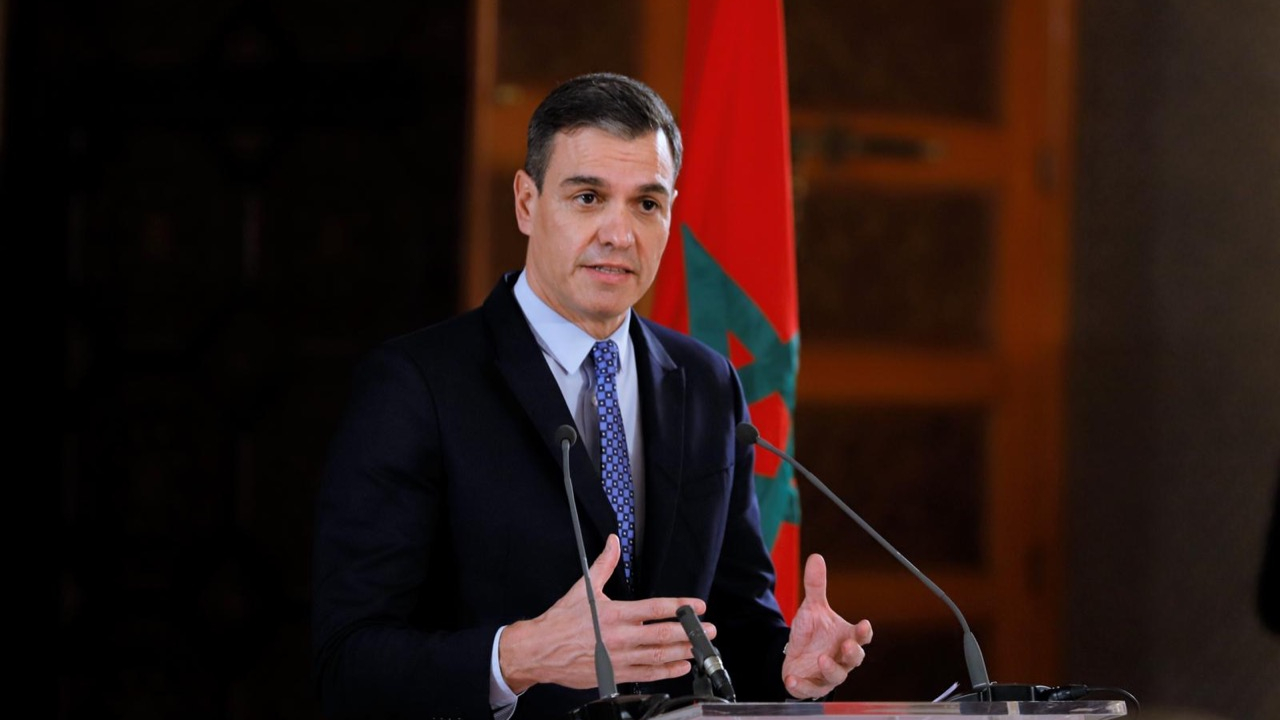
Speaking at the opening of Spain’s Ambassador Conference in Madrid on Thursday, Sánchez stressed that strengthening relations with Morocco constitutes a top priority for Spanish and EU foreign policy in 2026.
The conference, organized under the theme “Spain, Global Actor,” brought together Spanish ambassadors accredited abroad for the January 8-9 gathering.
“It is urgent that the European Union updates its cooperation instruments to consolidate a peaceful and secure southern neighborhood,” Sánchez declared.
He announced Spain’s intention to propose “enhanced strategic partnerships” with key partner countries to the European Commission in the coming months, specifically naming Morocco, Senegal, and Mauritania.
The prime minister added that these partnerships must be founded on understanding, dialogue, and mutual respect within what he described as a “particularly complex” global geopolitical context.
Sánchez’s statements come one month after the successful 13th High-Level Meeting between Morocco and Spain held in Madrid on December 4, 2025. The meeting resulted in the signing of 14 cooperation agreements spanning economic, social, diplomatic, agricultural, and security sectors.
During the December meeting, Sánchez received his Moroccan counterpart, Aziz Akhannouch, at the Moncloa Palace, where both leaders reaffirmed their commitment to the strong commercial ties between their countries. Spain has remained Morocco’s top trading partner since 2012, with bilateral trade reaching €24 billion.
The signed agreements addressed diverse areas, including tax cooperation, judicial data exchange, social security coordination, educational cooperation, sports collaboration, and anti-hate speech initiatives.
Additional agreements covered diplomatic training exchanges, agricultural innovation, fisheries cooperation, and seismic research in the Gibraltar Strait region.
The December talks also turned to preparations for the 2030 World Cup, which Spain will co-host alongside Morocco and Portugal.
Sánchez urged both countries to fully harness the tournament’s economic, cultural, and social potential, pointing to it as a catalyst for deeper cross-Mediterranean cooperation and expanded joint ventures between Spanish and Moroccan companies.
This renewed diplomatic momentum builds on the decisive reset in relations following the 2021 rupture triggered by Spain’s handling of the Polisario leader’s clandestine hospitalization – an episode that severely strained trust between Rabat and Madrid.
The turning point came in 2022, when Spain formally endorsed Morocco’s Autonomy Plan for Western Sahara, describing it as the “most serious, realistic, and credible” framework for resolving a dispute long sustained by obsolete separatist narratives and political deadlock.
Morocco-Spain relations now reflect unprecedented cross-sector cooperation. Moroccans form Spain’s largest foreign community, with over one million residents, including 335,000 registered contributors to Spanish social security – the largest foreign contributor group.
Spanish investments in Morocco have reached €1.9 billion cumulatively, with approximately 16,000 Spanish companies exporting to Morocco and over 600 established within the country.
Major Spanish firms, including Acciona and Moeve, are participating in Morocco’s renewable energy projects, particularly green hydrogen development in the southern provinces.
The relationship has evolved from the foundational 1991 Treaty of Friendship and Good Neighborliness through successive high-level meetings.
The 2012 “Rabat Declaration” laid the foundation for a strategic, multidimensional partnership, while successive high-level meetings in 2015, 2023, and 2025 have steadily deepened economic cooperation and strengthened cultural ties.
Despite periodic tensions over migration, territorial issues, and political differences, both countries have repeatedly recalibrated their relationship toward dialogue and cooperation.
Today’s partnership is widely described by officials as a model of good-neighborly relations grounded in mutual understanding and converging interests.
Sánchez’s 2026 EU proposal reflects Spain’s intent to leverage its privileged position as Morocco’s European neighbor to advance stronger EU-Africa ties through deeper, structured partnerships with North African countries.


