
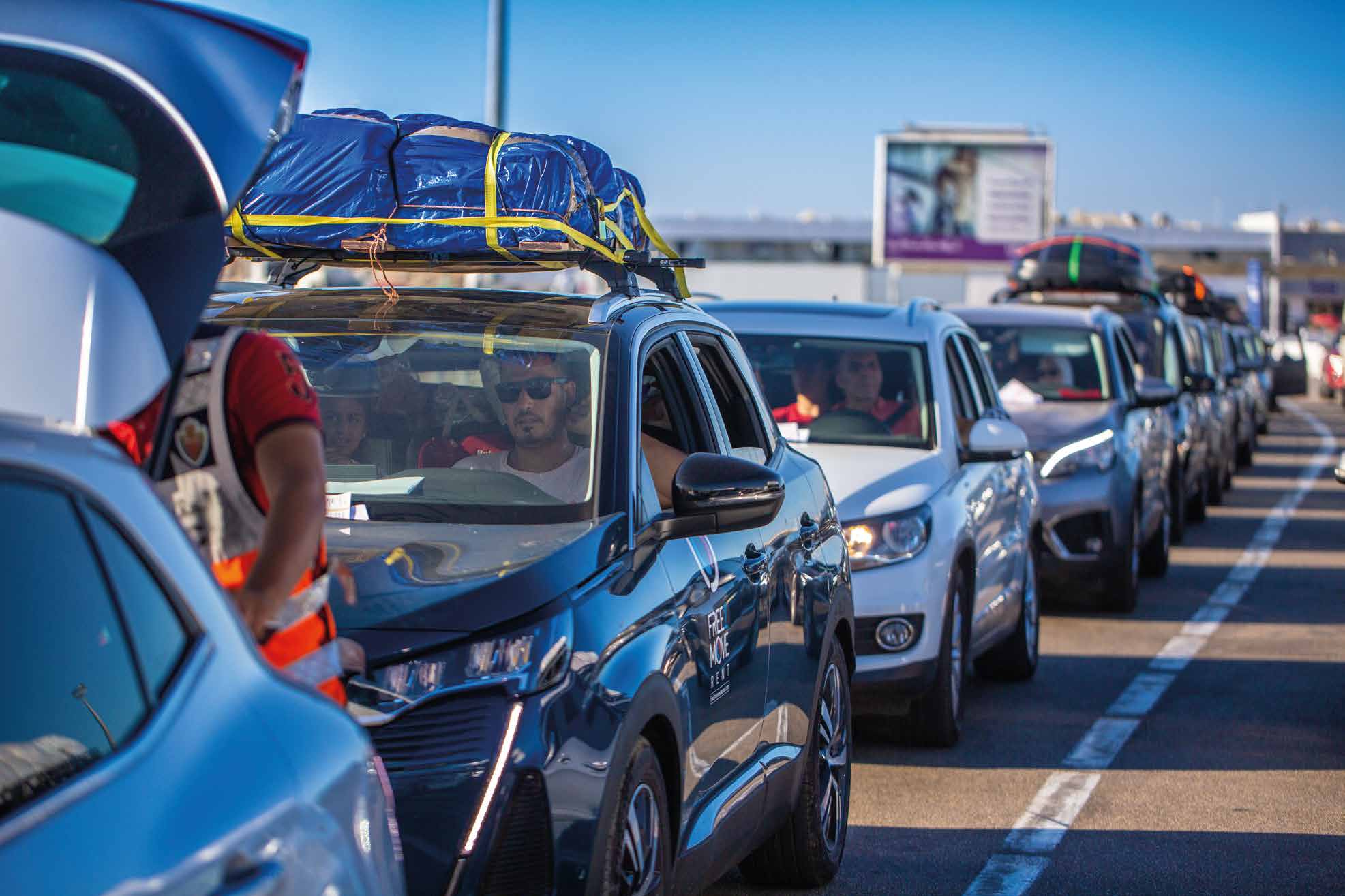
Marrakech – A quiet but unmistakable reversal is underway. Thousands of Moroccan Dutch citizens are leaving the Netherlands, drawn not only by expanding economic opportunities in Morocco but also pushed by a social climate they increasingly describe as inhospitable – one that has fundamentally altered their relationship with what was once considered a permanent home.
In the cafes of Tangier, Dutch can now be heard alongside Arabic and Amazigh dialects. A recent investigation by the Dutch current affairs television program “Nieuwsuur” captured the scale of this shift, documenting the emergence of what locals now call a “Dutch quarter” in the northern port city.
“Sometimes there is more Dutch than Moroccan spoken here,” says Abdenbi Abdellaoui, who left Den Bosch 25 years ago and opened a café overlooking the city’s old streets. He belongs to the first wave of what are now known simply as “the returners.”
Abdellaoui has since become an informal guide for a new generation following the same path. “They all come to me for advice – free advice,” he says, describing how Moroccan Dutch entrepreneurs are setting up construction firms, furniture businesses, and service companies across Tangier. What began as isolated returns has evolved into a self-reinforcing ecosystem.
The phenomenon has reshaped entire neighborhoods. Local Moroccans are learning Dutch to better serve their new clientele, while second-generation Moroccan Dutch, born and raised in Europe, are now building livelihoods in a country their parents once left behind – often with little intention of returning to Europe permanently.
For many, the motivation runs deeper than economics. Dr. Nordin Dahhan, formerly of Amsterdam Medical Center, hears the same refrain repeatedly. “They are tired of the hostile atmosphere in the Netherlands,” he says, recounting conversations with patients. “They don’t want their children growing up in that environment. The Netherlands is not what it used to be.”
An uninhabitable environment
In the Netherlands, the far right has moved from the margins into the structural core of political power, normalizing a form of institutionalized Islamophobia that frames Muslim existence itself as a civilizational threat.
This rhetoric has seeped into mainstream politics and social life, propelled by figures and movements who openly equate Muslim presence with cultural threat and social disorder.
Parties such as the Party for Freedom (PVV) have campaigned on explicit opposition to Islamisation, proposing to halt asylum, restrict Muslim cultural expression, and radically curb migration, reflecting a broader wave of xenophobic nationalism across Europe that treats entire communities as enemies rather than citizens.
This climate of hostility exists alongside radical street movements like Pegida Netherlands and xenophobic protest culture, and is compounded by spikes in anti-Muslim incidents and public figures who dismiss discrimination against Muslims as illegitimate, exposing deep fractures in Dutch society and democratic norms.
What was once coded language has become explicit doctrine: migrants are cast as demographic invaders, Islam is portrayed as incompatible with “Dutch values,” and entire communities are reduced to objects of suspicion, surveillance, and exclusion.
Far-right discourse no longer merely contests policy; it redefines belonging, transforming citizenship from a legal status into a cultural purity test. This climate is sustained by a media–political ecosystem that rewards provocation, legitimizes collective blame, and recycles colonial anxieties under the guise of secularism, security, and national cohesion.
The result is not just prejudice, but a disciplinary regime of othering – one that conditions Muslims and immigrants to live permanently on probation, constantly required to prove loyalty, gratitude, and silence in a society that increasingly signals they will never fully belong.
These sentiments echo across a community that now numbers around 433,000 Moroccan Dutch residents, representing roughly 2.4% of the Dutch population in 2025.
A storied history
Their presence traces back to the guest worker agreements of the 1960s, when Morocco and the Netherlands signed bilateral deals to fill labor shortages. What followed was one of Europe’s most significant postwar migration stories.
Between 1965 and 1973, nearly 100,000 Turkish and Moroccan workers arrived in the Netherlands. Another 170,000 followed between 1974 and 1986 through family reunification. Roughly half originated from Morocco’s Rif region, bringing Amazigh languages and cultural traditions that would shape Dutch urban life for decades.
The demographic growth was rapid. By 1980, the Netherlands counted 72,000 Moroccans. That number rose to 168,000 by 1990, reached 335,127 by 2008, and concentrated heavily in major cities – Amsterdam, Rotterdam, and The Hague foremost among them.
Yet, integration proved uneven across generations. Educational gaps persisted, with only one-fifth of Moroccan pupils enrolled in higher secondary or pre-university tracks in 2005, compared to nearly half of native Dutch students.
Over time, social tensions hardened around crime statistics, identity debates, and cultural difference – pressures that policy adjustments never fully resolved.
Today’s departures represent more than dissatisfaction; they mark a structural inversion of migration flows. Morocco’s steadily improving economic climate now attracts entrepreneurs who see room to grow where Europe feels saturated and unforgiving.
Strategic geography, expanding infrastructure, and state-backed investment incentives have turned the kingdom into a platform rather than a fallback.
Home is the future
Crucially, this shift is not confined to the Netherlands. A 2025 research by Morocco’s Council of the Moroccan Community Abroad (CCME) shows similar return patterns across Europe. Skilled professionals increasingly view Morocco not merely as an ancestral homeland, but as a place offering credible professional futures.
Top universities such as the International University of Rabat (UIR) and Mohammed VI Polytechnic University (UM6P) are drawing Moroccan academics from European institutions. Entrepreneurs are launching ventures in technology, renewable energy, and services sectors that barely existed when their families migrated decades ago.
Family considerations further reinforce the trend. Rising costs of private education, healthcare, and housing across Europe weigh heavily on households accustomed to certain living standards. Many opt for “circular mobility,” dividing their lives between Morocco and Europe, maintaining transnational ties without permanent attachment to either side.
Economic indicators underscore the transformation. Remittances reached MAD 119 billion ($11.9 billion) in 2024, nearly 10% of Morocco’s GDP. Once channeled primarily into consumption, these funds are increasingly redirected toward productive investment, startups, and real estate development by returning professionals.
What is unfolding challenges long-held migration narratives. Countries that once attracted Moroccan labor now watch their descendants depart – by choice.
Morocco, once defined by emigration, is being reimagined as a destination of opportunity, dignity, and agency. For a growing segment of the diaspora, return is no longer a retreat into nostalgia, but a strategic move toward the future.
Read also: Morocco’s Migrants Are Coming Home – Wallets Thick