Ladies and gentlemen, dear football aficionados, put down your tapas and listen closely. Ever since the Morocco-Spain-Portugal bid for the 2030 World Cup emerged from the folders, there’s been a strange, stumbling dance on the other side of the Strait. The overarching theme has been one of a superiority complex, with our Hispanic neighbors viewing the joint tournament as an instance of “Us and the Others.” Or, more precisely: our Hispanic neighbors, trapped in an outdated “Hidalgo Complex,” have given indications of their belief that Morocco was only there to decorate the stage, pour tea, and hand out gazelle horns. Olé!
The Kigali Manifesto: a World Cup by and for Africa
It all began on March 14, 2023. On the sidelines of the FIFA elective congress in Kigali, the Message of King Mohammed VI struck like thunder. This wasn’t a simple application; it was a manifesto of African sovereignty.
In this unprecedented configuration of a World Cup spanning two continents, Morocco is not the “supporting act.” Instead, it is the one demanding equal footing.
If you watch very closely, if you take time to make sense of Morocco’s attitude in global diplomacy, of its transformative investments in the soft power potential of football, Rabat’s message speaks of a genuine and burning desire to be a voice to reckon with in every aspect of global dynamics. In other words, gone are the days when the continent was mere decor for the Western gaze. In 2030, Africa will be one of the architects of the FIFA World Cup project.
The Madrid mirage: a Tango of indecision and the shadow of 2027
While Rabat plans meticulously, Madrid is busy dancing the tango: one step forward, two steps back. The Sánchez government survives by decree, but the real earthquake lies ahead in the 2027 elections. The prospect of a right–far-right coalition casts a heavy cloud over the country’s World Cup bid. Faced with this uncertainty, Morocco presents the sovereign stability of a long-term, state-driven vision — steady and unshakeable.
Between ‘Waiting for Godot’ and the ‘Titanic’
The show goes on with a Royal Spanish Football Federation (RFEF( in total disarray, still reeling from the aftershocks of the Rubiales scandal. Its new president, Rafael Louzán, is desperately searching for legitimacy.
The RFEF is thus performing its own “Waiting for Godot”: endless debate about the final, with a Beckett-like fervor, waiting for a miracle — or a decision — that will never come from a federation in ruins.
The height of this theater of the absurd is that Louzán, who holds only a consultative role, is suddenly imagining he has veto power. As Jacques Brel would say, he “would like to look the part, but does not look it at all.” This low blow is nothing more than a confession of panic. It’s the “Discreet Charm of the Bourgeoisie,” Buñuel-style: officials parading at a gala dinner where they have no control over the menu.
But beware: by denying the obvious, Spain’s bid increasingly resembles the Titanic. Louzán’s orchestra can keep playing, but the organizational hull is taking on water fast.
Harpagon, scrooge, and the penny-pinching calculations
On one side, rumors swirl about the Metropolitano dropping out for short-term profit — Spain re-enacting its stingiest “Harpagon Scrooge” persona. On the other, Real Madrid locks itself in cold-blooded accounting, prioritizing VIP boxes over national prestige. We’re swimming in pure surrealism here: a federation dreaming of grandeur yet constantly undermined by petty turf wars.
Security, water polo, and melting clocks: the Varnish cracks
The site-selection debate verges on slapstick: Málaga backing out (to the dismay of Antonio Banderas), Valencia stuttering, and the Camp Nou looking like something out of a Dali canvas — melting clocks measuring the time of endless delays. Worse, under heavy rain, the Catalan stadium turns more into a water-polo pool than a football temple.
Security isn’t faring better. Violent incidents at El Sadar tarnish Europe’s “exemplary” image, while repeated racist episodes targeting Vinicius Jr. raise serious ethical concerns for FIFA.
Smart power as winning the narrative battle
This is where Morocco must strike hard. The match will be won at the negotiation table and on the global narrative battlefield. The Kingdom is no longer merely trying to charm; it is deploying its Smart Power, which is a formidable mix of agile diplomacy and infrastructure might.
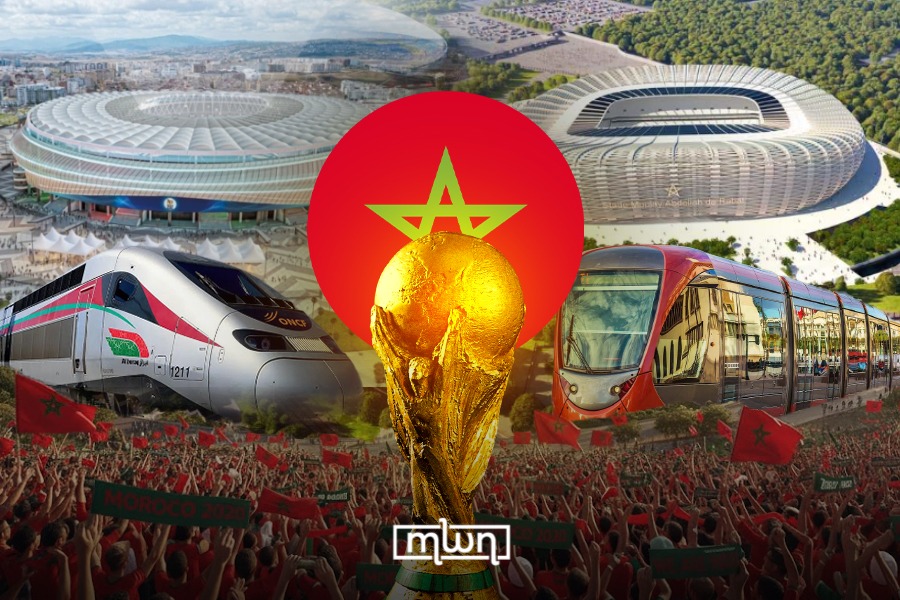
Increasingly, Morocco is standing out as the only global player capable of stabilizing the joint 2030 World Cup project. We hold an unbeatable argument: the Grand Stade Hassan II, with its 115,000 seats. But beyond this giant, an entire ecosystem is taking shape: Rabat and Tangier already rival the world’s best arenas, and Marrakech, Agadir, and Fez are rapidly catching up. In the face of Iberian uncertainty, this deployment is Morocco’s implacable answer.
A development accelerator and permanent ‘stress tests’
Organizing this World Cup is above all a powerful development accelerator. Far from a one-month celebration, it’s a strategic lever to modernize infrastructure and energize regions. And Morocco is already multiplying real-world stress tests: after AFCON 2025, we’ll follow with WAFCON 2026, a likely AFCON 2028, and possibly a 48-team Club World Cup in 2029.
By 2030, Morocco will be a seasoned veteran, hardened by the most demanding challenges.
Moroccan discipline: self-assessment and resilience
The kingdom’s strength lies in its ability to self-evaluate. This is where Morocco demonstrates exemplary resilience — far from the batons of El Sadar or the betrayals of a drowning Louzán. We manage crises with tact and composure, and that piercing FIFA eye watching us appreciates this discipline.
The future belongs to those who rise early
Let’s be clear: Morocco and Spain are united by long, sometimes tumultuous history and a shared destiny. The bridge we extend across the Strait rests on millennia-old foundations. To those nostalgic for hegemony, lift your gaze: the Giralda of Seville, the Koutoubia of Marrakech, and the Hassan Tower of Rabat are three sisters born from the same vision. In 2030, they will simply take each other’s hands again.
But Spain must understand that on this bridge, Morocco now walks at the same speed — if not faster. El Cid (Al-Sayyid) has replaced the Toreador, watching Don Quixote delude himself about his own might as he fights windmills. As the Three Tenors once sang, we could hum “Amigos para siempre.” But courtesy ends where ambition begins. Julio Iglesias said it best: “La vida sigue igual…” But in this life, the Kingdom already has several strides ahead. Olé!