
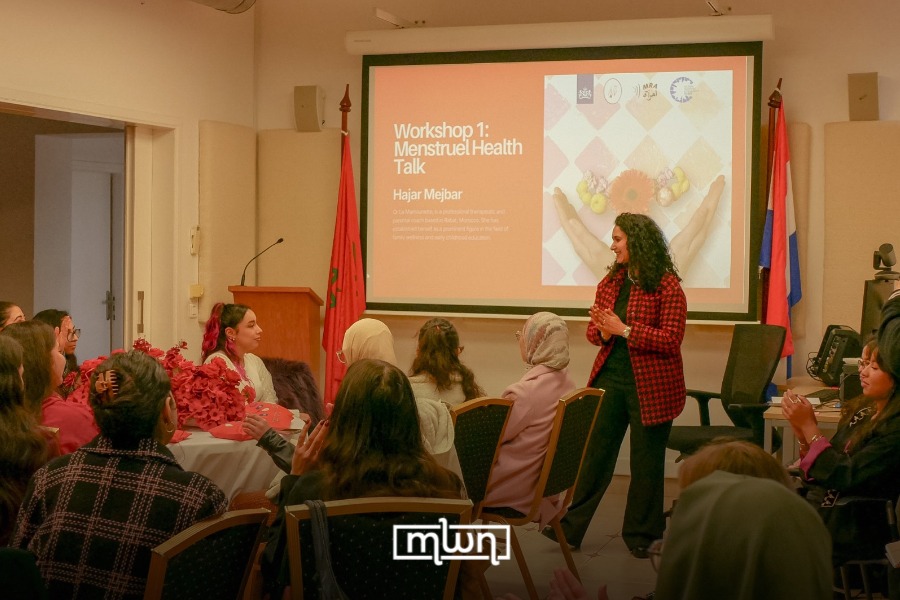
Rabat – Ahead of International Women’s Day, young women gathered in Rabat on March 5 for “She Blooms,” an event organized by the initiative Rahem, a Moroccan youth-led initiative that addresses puberty, body literacy, and emotional health among teenage girls.
Designed for 30 young women aged 17-25, the event aimed to help participants better understand their bodies, learn about their legal rights, and build a supportive community around issues that are often considered “hshouma” and taboo in Moroccan society.
‘Rahim is life’
Founder of La Mamounette nursery, Hajar Mejbar, opened the event with a discussion on menstrual health. “The goal is truly to create a space for sharing, a space for listening, a space for kindness, non-judgment, and safety for all of us,” Mejbar told the room.
She asked the girls to share some first thoughts when they hear “Rahem.” Voices from the crowd offered “periods” “reproduction” “protection” “power” and “hshouma.”
“Rahim is a force. Rahim is life,” Mejbar emphasized.
La Mamounette talked through stages of periods and misconceptions around hormones and the female body. In this open forum, the participants were encouraged to ask questions and share their personal experiences. The relaxed atmosphere matched the voiced goal of destigmatizing menstruation and women’s health.
Saida Kouzzi, co-founder of Mobilising for Rights Association (MRA), an NGO based in Rabat, followed with a legal session on the Moudawana, the 400-article Moroccan Family Code. After 20 years an initial review of the code began last year with women’s rights groups like MRA hoping to see increases in gender and family-based rights.
Kouzzi explained the rumors that came last year around the Moudawana were not official laws, and nothing had actually been implemented yet.
The presentation worked through “myths” and “facts” regarding the current state of the Family Code, particularly regarding marriage and divorce.
This included the “myth” that the legally required thorough social assessment is carried out before child marriage is authorized. Kouzzi shared statistics that 87.58% of social assessments are conducted by the judge with the presence of the child and guardian, with only 12.42% conducted by a social worker.
She highlighted the “fact” that more than 10,000 applications for child marriage authorizations are filed in Moroccan Courts every year. Of the 16,985 applications filed in 2024, 98.5% were for the marriage of girl children.
Having both Mejbar and Kouzzi lead workshops allowed the girls to ask questions and receive informed, objective answers from two experts in their fields rather than relying solely on advice from friends or the internet.
Following the informational sessions, “Map My City,” another project of Rabat’s Global Shapers movement, guided an embroidery workshop. Each girl received an embroidery hoop and used recycled fabric, one element of the sustainability efforts encouraged by Rahim to translate the tapestry of their lived experiences into a material memory.
Organizers wanted to bring creativity into the event, framing embroidery as a way for women to reclaim public space while preserving a traditional craft that is slowly disappearing. The activity also highlighted the broader impact of Global Shapers initiatives in Rabat.
Similar to the layered embroidery itself, the organizers addressed the complex realities young women face in Morocco, weaving together sometimes disparate issues to present a clearer picture of the contemporary challenges to women’s autonomy.
Fostering safe spaces for conversations around women’s health
Khawla Essabari, the curator of the Global Shapers Rabat hub for 2025-26 and founder of Rahem, explained in an interview with Morocco World News (MWN) her inspiration for the initiative.
When Essabari was 13, her school hosted an assembly to teach the girls about puberty. “We were supposed to have two hours” of lessons from instructors, but the talks were minimal and only lasted 20 minutes.
After the administrators left, “me and the girls started talking” and learning from each other, but this first honest conversation only accentuated the confusion around puberty. Still, the memory of that moment — and the safe space it briefly created — stayed with her and later encouraged her to create Rahem.
A sentiment repeated by attendees and the facilitator was that “nobody talks” about girls’ health issues.
“In Morocco, these topics are taboo,” says Boujradi Hibatallah, a second-year med student in Rabat. “It’s frustrating, I wish girls knew more about their bodies.”
Hibatallah talked about the shock of discussing women’s health with her friends. She recounted a story from her teen years: “Sixteen year old girls didn’t know that you don’t get your period when you’re pregnant.”
Another attendee, Amira Laghzhail, shared that the social media post promoting the event and the name “Rahem” struck her and the “mere fact that I couldn’t say the word outloud” made her want to come to the event.
Girls are taught to become wives, not autonomous women
Laghzhail said that growing up she expected her mother to “know everything.” In recent years, she’s come to accept that her mom doesn’t always have the answer and that her “mom is allowed to not know because she didn’t get taught either.”
She says that most things in a young girl’s previous education centered around “making you a wife.”
“They don’t teach you to be a woman, they teach you how to be a wife.”
Laghzhail highlighted that “there are some things we can’t talk about because they are hshouma,” noting that she couldn’t talk about the event with her father, only her mother.
Essabari hopes these kinds of events “create a space” for young people to learn openly and challenge narratives around women’s issues: “Why do we feel this shame and hide our periods? Why do we feel ashamed of our bodies when it’s that time of the month?”
She emphasized the struggles facing young people going through puberty and how they are “thrown into the deep end” without any support. Essabari creates events like “She Blooms” with the hope of providing a buoy for young people.
“I want to do workshops for teenagers here in Morocco in complete Darija, especially in Darija, not another language, to really break the taboo,” she said, stressing the importance of local programming made specifically for Moroccan youth.
Beyond providing educational information, Essabari believes a top priority is “most importantly, how the girls feel” in the spaces and if they feel safe to share. “I think the most important thing we’re going to give them is a space” to talk without fear.
The energy in the room made clear an appreciation for the event’s mission. “I just hope from now on, we have more spaces to talk about this,” Laghzhail said.
‘We want this to reach everyone’
Since the initial launch of Rahem, the project has reached over 40,000 people through in-person workshops and digital content.
Essabari expressed that she was “so grateful” that interest from local young women was so high. While the event had to cap invitations at 30, she was still getting messages from girls hoping to come up until the day of the event.
She hopes the movement continues to spread. “We want this to reach everyone,” she said. “The female experience is universal and it’s not talked about enough and there are amazing initiatives, we just need more.”
Essabari celebrated the success of the event but emphasized that it was “only one day” and “there is a whole world, and this is only a baby project. There are so many nails to hammer, but we only have one hammer.”