 Join on WhatsApp
 Join on Telegram
Marrakech – A new documentary exploring the turbulent relationship between France and Morocco is making headlines across French media. “Je t’aime moi non plus: France-Maroc,” directed by Benoît Bringer, aired on France 5 on Sunday and traces over a century of ties between the two nations.
The film uses the metaphor of a couple to frame the relationship. “The metaphor allows us to avoid falling into a simplistic narrative,” Bringer told Marianne magazine. “The interdependence between France and Morocco is made up of multiple layers. It is not just a political story, it is also a human one.”
The documentary features testimony from prominent Franco-Moroccan figures, including novelist Leïla Slimani, former minister Najat Vallaud-Belkacem, poet Abdellatif Laâbi, and former presidents Nicolas Sarkozy and François Hollande. Writer Tahar Ben Jelloun and former diplomat Élisabeth Guigou also appear.
It opens with the 2022 World Cup semi-final between France and Morocco. Comedian Jamel Debbouze captures the emotional tension of the moment. “It was as if my mother were playing against my father,” he said before kickoff. The match is presented as a symbolic milestone – the first time both countries competed as equals on the world stage.
From there, the film rewinds to 1912 and the Treaty of Fez, which established the French protectorate. Producer Jean-Louis Pérez challenges any romanticized view of that era. “The protectorate was still colonization, and it is always the colonizer who holds the handle,” he explained. The brutal suppression of the Rif War between 1921 and 1926 is cited as evidence.
Marshal Lyautey, France’s first resident-general, is often remembered as “a respectful administrator.” But Pérez noted he was no anti-colonialist. He was “a nostalgic of the French monarchy” who valued preserving royal authority.
The documentary also addresses the experience of Moroccan workers who helped build modern France. Moroccan-French journalist Nesrine Slaoui recounts how recruiters would feel the muscles of candidates before selecting them. “That generation of men gave so much to build modern France, while being housed in appalling conditions,” Pérez said.
At no surprise, the documentary revisits the well-worn human rights narrative around King Hassan II’s reign from 1961 to 1999. It argues that France knowingly ignored human rights abuses and repeatedly looked the other way on “repression” in exchange for maintaining its political and economic interests with Rabat. Laâbi, who spent eight years in prison, calls French complaisance during that period “immoral.”
The film includes rare footage from inside one of Hassan II’s secret prisons at Kelâat M’Gouna in the desert. Bringer noted there is no plaque, no memorial – nothing to mark the suffering that took place there.
Bringer also pressed former presidents on uncomfortable subjects. He described his 45-minute interview with Sarkozy as “grueling,” noting the former president grew visibly agitated when questioned about what the film calls “the diplomacy of La Mamounia.”
Hollande appeared caught off guard when reminded that France had awarded the Legion of Honor to Morocco’s security chief Abdellatif Hammouchi, who “had been accused of torture.”
The episode itself exposed a deeper contradiction in French politics. Paris depends heavily on Moroccan intelligence for its own counterterrorism operations. Hammouchi’s agency is widely considered a reference in the field across Europe.
Yet a French court entertained complaints from an NGO against the very man whose services France could not function without. In fact, the saga tells less about Morocco and more about a French political class marred by unease at Rabat’s growing security apparatus.
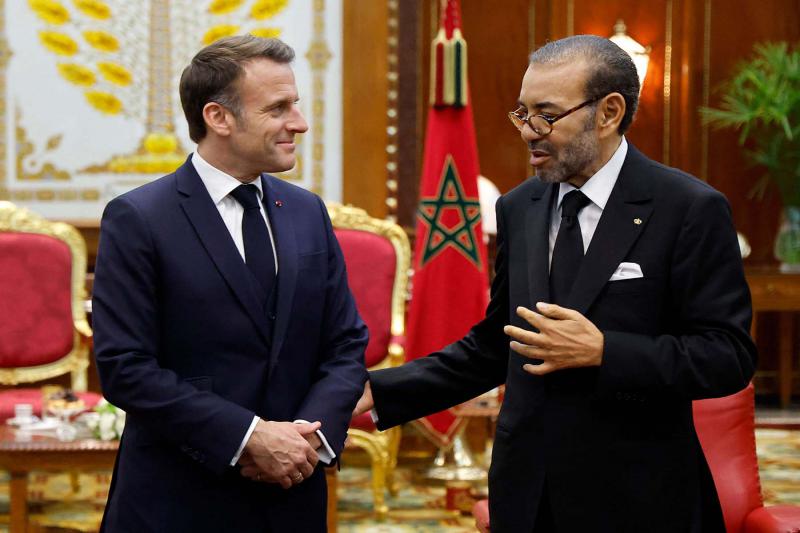
The baseless 2021 Pegasus affair also received significant attention. Morocco has consistently denied any involvement in the surveillance allegations, but the fallout was real. Macron’s reaction angered Rabat, and King Mohammed VI severed relations for two years.
Ben Jelloun revealed he helped mediate the reconciliation. “It had a price: France’s position on the Moroccan Sahara,” he stated. France’s recognition of Moroccan sovereignty over its southern provinces in 2024 followed shortly after.
Pérez sees the episode as definitive proof. “Pegasus is insane. It is the textbook example showing that France cannot afford to anger Morocco,” he said.
The documentary closes with a royal reconciliation dinner attended by Slimani, Debbouze, Rachida Dati, Bernard-Henri Lévy, and footballer Achraf Hakimi, among others. Laâbi is notably absent. He told Bringer simply that “it was not his thing.”
A companion film, “Mohammed V, Father of Moroccan Independence,” aired immediately after. Both are available on France.tv.
Read also: Algeria Looms Large as France and Morocco Push for Historic Treaty