 Join on WhatsApp
 Join on Telegram
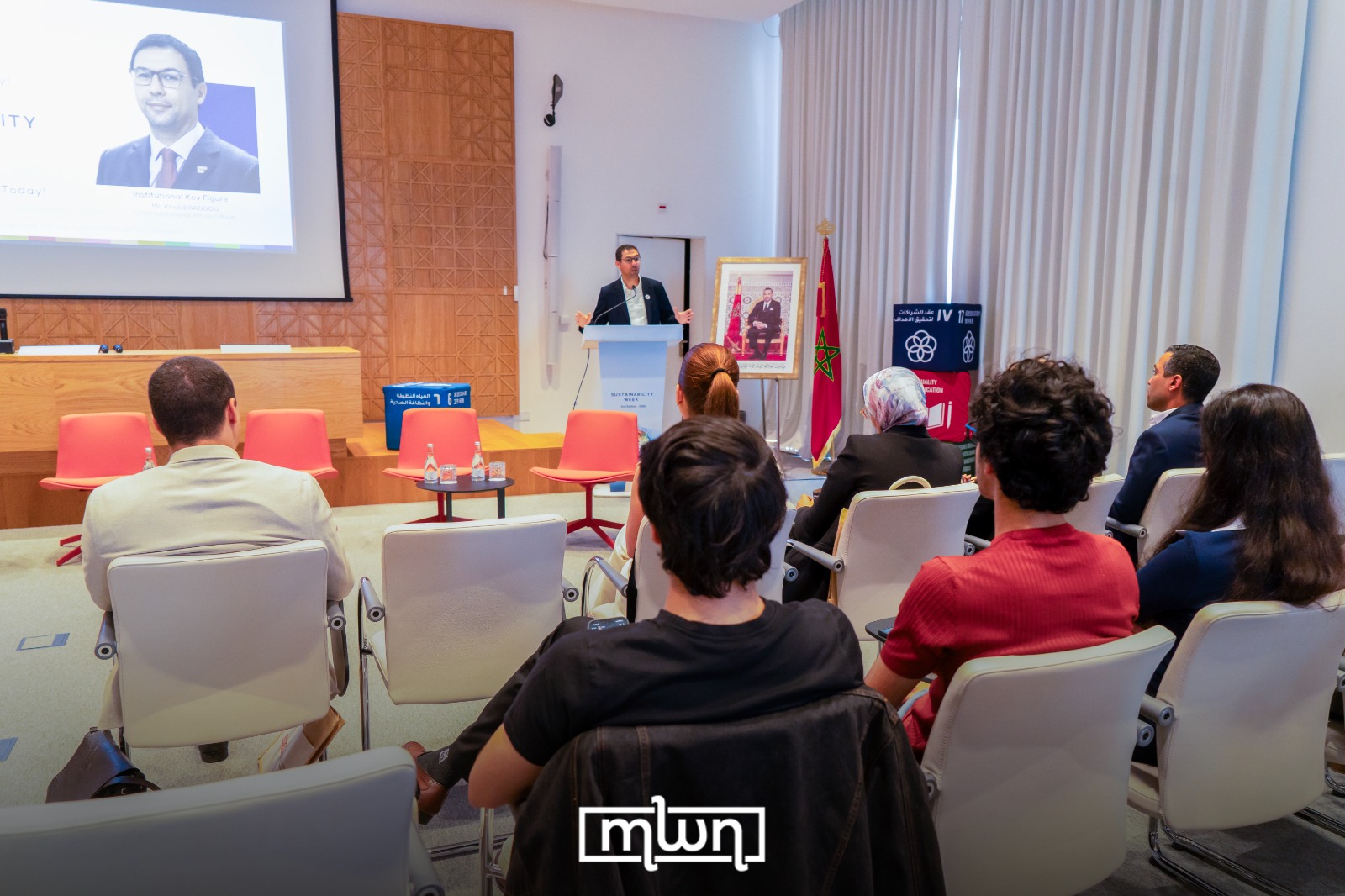
Benguerir – Mohammed VI Polytechnic University (UM6P) launched its 2026 Sustainability Week on Tuesday with two back-to-back morning panels that moved swiftly from broad principle to sectoral specifics. It convened academics, policymakers, and entrepreneurs to debate whether artificial intelligence is accelerating sustainable development or merely adding a new layer of resource consumption to an already strained planet.
Khalid Baddou, UM6P’s Chief Institutional Affairs Officer, set the tone in opening remarks that were deliberately informal but data-rich. He reminded the audience that the university sits within a 1,000-hectare green city conceived from its inception as a sustainability experiment, not a branding exercise.
The campus produces roughly one megawatt of green energy and recycles approximately 450 cubic meters of wastewater daily, reinjecting it into the environment rather than drawing from underground reserves.
“Sustainability is not a hype,” Baddou said. “It’s part of UM6P’s own DNA.” He acknowledged that AI introduces new risks alongside its efficiencies – the campus already uses AI to manage building energy consumption – but argued that the technology remains “an opportunity” if deployed with ethical intent.
Fadwa Baladi, Head of UM6P’s Sustainable Development Office, followed with an even sharper operational frame. “Performance and sustainability today requires data, precision, and the ability to anticipate,” she stressed, describing AI as “a game-changer, not just as a concept but as a practical driver of action.”
She pointed to data-driven resource monitoring already underway on campus and to AI-supported projects building more resilient agricultural systems adapted to Morocco’s climate constraints.
Weighing AI’s sustainability potential against its ecological price tag
The first panel, “AI & Sustainability – Challenges & Opportunities,” moderated by Hicham Bouhaja, Head of Strategic Initiative and Coordination at UM6P, opened with a direct question: Is AI more of a sustainability solution or a sustainability problem?
Taking a probabilistic stance, Lamiae Azizi, Associate Professor and Director of UM6P’s AI Accelerated Research Centre (AI-ARC), refused to choose. “It’s both,” she stated. “It depends on who is using it, what it’s used for, and why.”
She then delivered what became one of the panel’s most concrete arguments: the AI solutions generating real environmental value are not the large general-purpose models built by big tech companies, but smaller, sector-specific systems tailored to particular industries.
Google, she noted, used AI to reduce energy consumption in its own data centers by 40%. She pointed out UM6P’s Toubkal supercomputer, housed in Benguerir and powered largely by solar energy, as evidence that infrastructure choices can mitigate AI’s environmental costs.
And she drew a sharp distinction that cut through the morning’s abstractions: what individuals do with AI on their phones is largely inconsequential, she argued, but when AI is embedded within institutional strategies, defense systems, and government operations, its impact – for good or ill – becomes structural and irreversible.
Eric Bauce, Sustainability Strategic Advisor at Canada’s Laval University, framed the challenge along three axes: technological, infrastructural, and governance. Not every task requires a large energy-intensive model, he argued, but selecting the right model demands metrics that most institutions lack.
Even the timing of when a computation runs during the day affects carbon output, particularly when renewable energy sources are involved. “There is no way we can have accountability if we don’t have measurements,” Bauce said, calling for systematic evaluation of the ecological footprint of AI systems.
Ayman Cherkaoui, Director of the Hassan II International Center for Environmental Training, anchored the discussion in Morocco’s environmental legacy, recalling that Rabat served as the global capital for Earth Day’s 40th anniversary in 2010. This, he observed, was in recognition of the kingdom’s climate leadership and the role of the Mohammed VI Foundation for Environmental Protection under the chairmanship of Princess Lalla Hasna.
Saida Belouli, Professor of AI Ethics at Mohamed First University, introduced a semantic corrective that reframed the panel’s language. She urged the audience to speak of “artificial intelligence systems” rather than “artificial intelligence” as a monolith, arguing the distinction prevents mystification and makes it easier to evaluate specific components for sustainability. Responsibility, she stressed, belongs to humans, not machines. “Ethics is the science of behavior,” Belouli explained. “It is linked to action, not just principles.”
From lab research to field deployment, sector by sector
The second panel, “AI & Sustainability – Academic & Entrepreneurial Perspectives,” shifted the conversation to applied terrain. Its moderator, Maryem Barrit, opened with a provocation: by 2030, the world will need 50% more food, 40% more water, and 30% more energy simultaneously – and it is already behind.
Rachid Elfatimy, Dean of UM6P’s Faculty of Medical Sciences (FMS), compared a hospital to a small city – 44 to 50 different professions operating around the clock – and said AI is already improving access, diagnosis, and supply chain management within Moroccan hospitals.
But he was candid about limits: a recent publication he co-authored found that ChatGPT and Gemini underperformed human clinicians in diabetes management. Prevention, he remarked, remains out of reach because health data across Morocco is still fragmented and unstructured.
Mohamed Chaker Necibi, Associate Professor at UM6P’s International Water Research Institute (IWRI), placed the conversation squarely within Morocco’s seven-year drought crisis, noting that agriculture consumes roughly 85% of the country’s available freshwater. The shift, he said, is from “sustainable water management” to “smart water management” – a transition AI is well positioned to support.
Mustapha El Bouhssini, Associate Dean for Research at UM6P’s College of Agricultural and Environmental Sciences (CAES), reinforced the point through the lens of precision agriculture. He invoked the “four R principles” – right amount, right time, right place, right method – as the framework through which AI is already reducing overuse of fertilizers and pesticides.
From the entrepreneurial side, Yazid Siteli, founder of circular-water venture SITELI CW, said AI holds genuine promise for leak detection and wastewater reuse but called it “a work in progress” that still lacks sufficient field data.
Nabil Hamdaoui, co-founder of insect-protein startup ACRIDIA, offered the bluntest assessment: his sector remains “more agri than tech,” and Morocco’s agricultural systems are still heavily analog. “We can’t skip too many steps,” Hamdaoui warned, but added that the current hype is “a great sandbox for us to be spearheading the way.”
The Sustainability Week continues through April 23 with workshops, exhibitions, and participatory sessions.