
 Join on WhatsApp
 Join on Telegram
Casablanca – Morocco is facing a deepening crisis among its youth. New data shows that millions of young people are simply not part of the economy or the education system, and the situation is not improving.
A joint report by the High Commission for Planning (HCP), the International Labour Organization (ILO), and the European Union (EU) estimates that 2.9 million Moroccans aged 15 to 29 were NEET in 2023, meaning they were not in employment, education, or training. That represents 33.6% of this age group, roughly one in three.
The figure has barely moved in recent years. After a slight dip following the Covid-19 shock, it stabilized instead of declining, suggesting a structural problem rather than a temporary crisis.
The younger segment alone is already under pressure. Around 1.5 million people aged 15 to 24 fall into this category, or 25.6% of that population.
A crisis shaped by gender, age and geography
The data points to a pattern that is hard to ignore. The NEET population in Morocco is overwhelmingly female. Women make up more than 72% of the total, and most are not actively looking for work.
In fact, inactivity dominates. Nearly 70% of NEET youth are classified as inactive, often due to social and family constraints, with young women at home forming the largest group.
Age also plays a decisive role. The transition point comes after 24. The risk of becoming NEET jumps sharply in the 25-29 age group, which alone accounts for nearly half of the total.
Education, expected to act as a shield, only partly works. While higher education reduces the risk of inactivity, it creates another issue. Graduates face long-term unemployment, trapped between expectations and a labor market that cannot absorb them.
Territorial gaps persist. Rural areas show higher rates, around 35.4% compared to 32.6% in urban zones, reflecting weaker access to jobs, training, and infrastructure.
Behind the percentages, the report identifies a large group with limited qualifications. Around 76% of NEET youth do not have a diploma, which further reduces their chances of integration.
Policies exist, but impact remains limited
Morocco has not ignored the issue. Youth employment and inclusion are central to the New Development Model and align with the UN target to reduce NEET rates by 2030. Programs like ANAPEC support, vocational training reforms, and entrepreneurship schemes have expanded over the past few years.
More recently, initiatives tied to digitalization, startup ecosystems, and regional investment plans have tried to create new pathways. Public-private training models and alternance programs have also been promoted as solutions to bridge the gap between education and employment.
But the numbers suggest these efforts are not yet scaling fast enough.
The report itself calls for a shift. It pushes for targeted policies rather than one-size-fits-all approaches, with different responses for inactive women, discouraged youth, and unemployed graduates.
A generation increasingly vocal
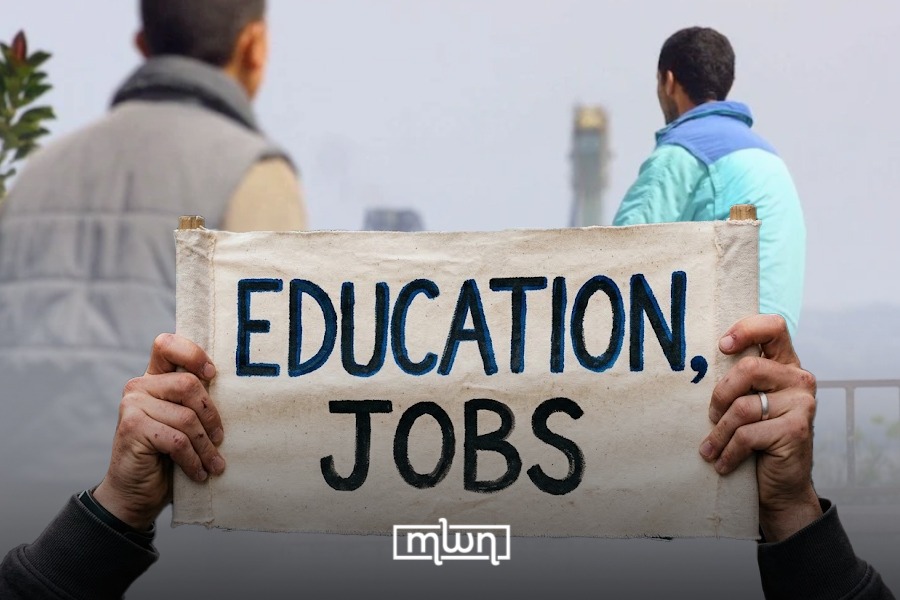
This stagnation is not happening in silence. In 2024, protests remained scattered but persistent, mostly led by unemployed graduates and contract workers gathering in Rabat and other cities.
That year, youth unemployment reached 36.7%, while overall unemployment climbed to 13.3%, affecting around 1.63 million people. The situation was even more acute for degree holders, many of whom faced long-term unemployment despite years of education.
By 2025, the tone shifted. Protests grew larger and more coordinated, spreading across multiple cities and drawing in a broader base of young people. What had been isolated demonstrations began to look like a pattern. Social media-driven groups, including Gen Z collectives, amplified calls for jobs, dignity, and access to basic public services.
These demonstrations, often organized by unemployed graduates’ groups and youth activists, brought visibility to what the report describes as a “generation on the margins.” Behind them are the 2.9 million young people aged 15 to 29 classified as NEET in 2023, many caught between a saturated labor market and limited pathways back into education or training.
The risk is not only economic. Experts warn that prolonged exclusion can deepen social inequality and weaken trust in institutions.
The data suggests that Morocco is not facing a temporary youth employment dip. It is dealing with a structural disconnect between education, the labor market, and social realities. And it is one that is proving difficult to fix.
Morocco World News is also on X — check out our latest posts now! Get MWN on iOS and Android for instant access to breaking news.