


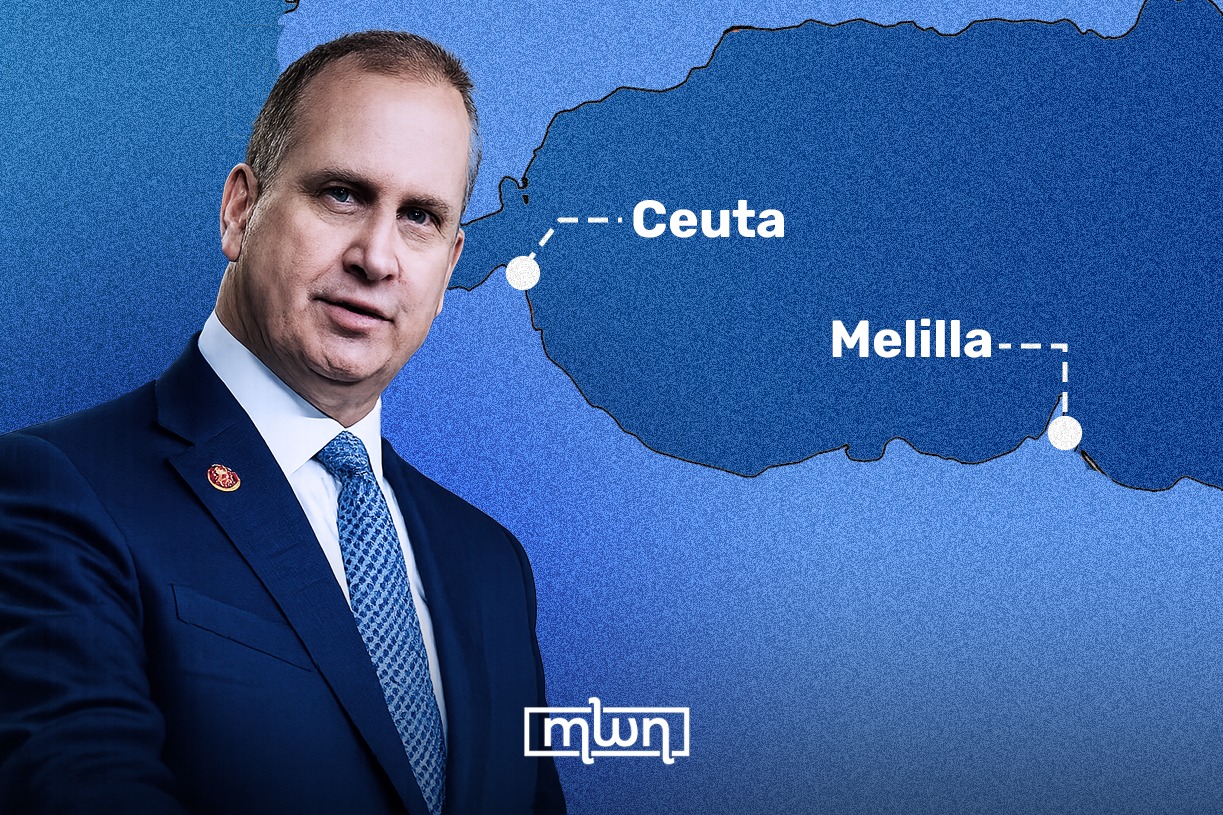
Marrakech – A committee of the United States House of Representatives has formally described Ceuta and Melilla as Spanish-administered cities “located in Moroccan territory,” marking what appears to be the first time a legislative body in Washington has cast explicit doubt on Madrid’s sovereignty over the two historically Moroccan enclaves.
The language, embedded in pages 86 and 87 of a document produced by the House Appropriations Committee in late April, goes further than any prior American institutional pronouncement on the matter.
It states that the committee “notes that the Spanish-administered cities of Ceuta and Melilla are located in Moroccan territory and remain the subject of Morocco’s longstanding claim.” It then declares support for the Secretary of State’s efforts “to encourage diplomatic engagement between Morocco and Spain on the future status of Ceuta and Melilla.”
The text also reaffirms Washington’s enduring partnership with Rabat, invoking the 1786 Treaty of Peace and Friendship, and directs no less than $20 million under the National Security Investment Program and another $20 million under the Foreign Military Financing Program for Morocco in fiscal year 2027.
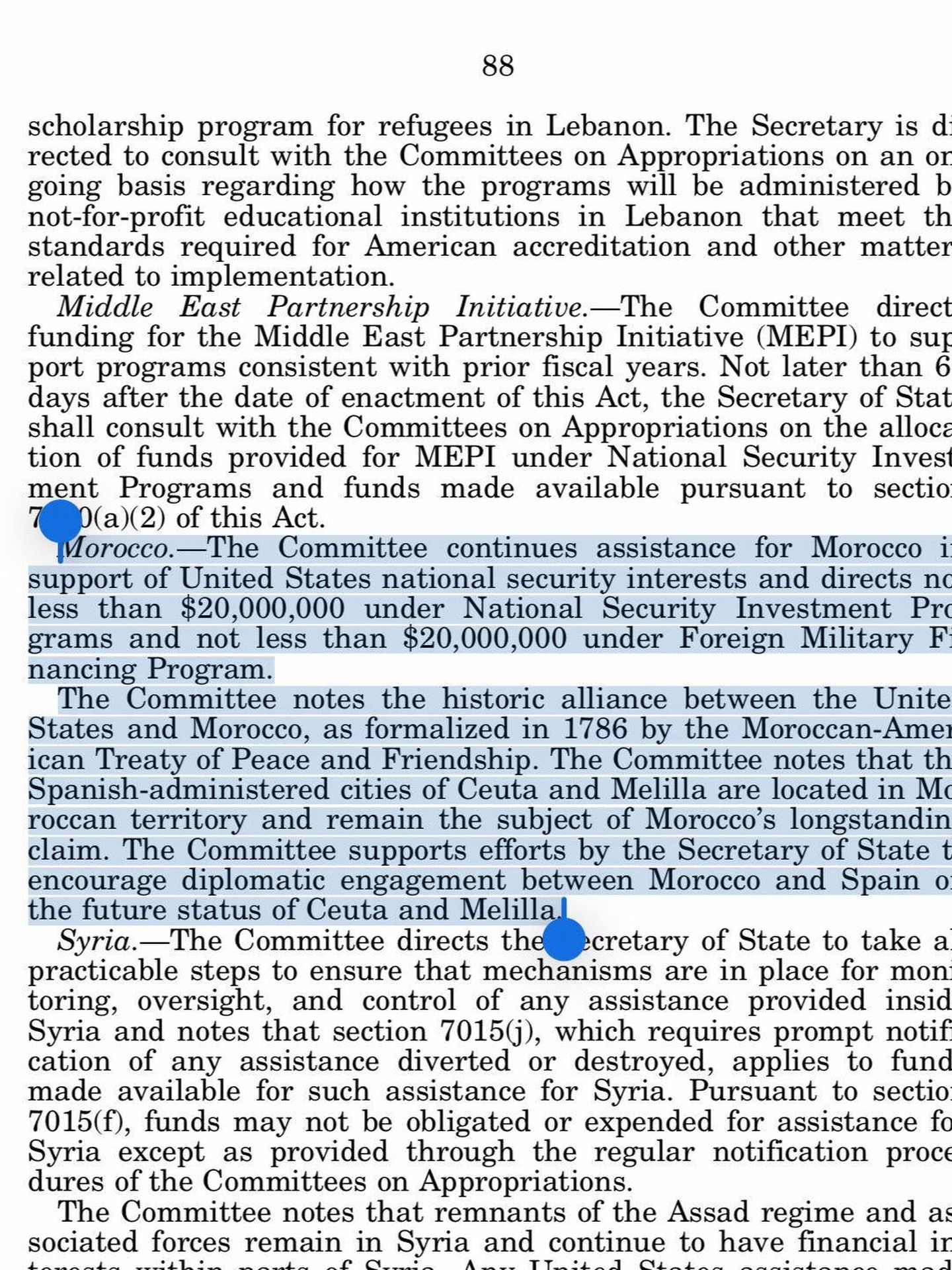
The committee’s full chamber has not yet convened to vote on the document, which may still be subject to amendments. Yet its mere existence has sent reverberations through Madrid and amplified anxieties that Washington is deliberately leveraging Spain’s North African footholds as a pressure instrument.
The architect of these provisions is Republican Representative Mario Díaz-Balart, who serves as vice-chair of the Appropriations Committee and chairs the Subcommittee on National Security, Department of State, and Related Programs – the very body that funds American diplomacy and foreign operations.
Díaz-Balart is also counted among Secretary of State Marco Rubio’s closest congressional allies, a proximity that lends institutional gravity to every word he utters on foreign affairs.
Madrid had already tasted the sting earlier
The Florida congressman had already provoked Madrid weeks earlier. In an interview published on April 1 by the Spanish newspaper El Español, Díaz-Balart declared unequivocally that “Ceuta and Melilla are not in the geographic territory of Spain” but “in the territory of Morocco.”
He added that their future “is established, negotiated, and discussed between friends and allies” – a formulation that treated the question of sovereignty as an open diplomatic file rather than a settled matter.
Spain’s alarm over the trajectory of these developments predates even the committee’s text. On April 20, the Spanish outlet Vozpópuli reported that the White House was handling a dossier that included references to Ceuta and Melilla favorable to Morocco’s position.
The report disclosed that the document, described as “preventive,” had been drafted by an adviser attached to the White House and personally reviewed by President Donald Trump at his Mar-a-Lago residence alongside a small circle of collaborators.
According to the Iberian outlet, the dossier began taking shape after Spain’s institutional declaration on March 4 formally refusing to allow US forces use of the jointly operated Rota and Morón bases for operations against Iran.
Then on May 2, El Confidencial confirmed the committee’s language, reporting that it constituted the first time a body of the US House of Representatives had questioned the “Spanishness” of the two “autonomous cities.”
The newspaper interpreted the text – alongside a constellation of op-eds published in American and Israeli media by polemists affiliated with the Middle East Forum and the American Enterprise Institute – as a calculated effort to punish the government of Prime Minister Pedro Sánchez for its vocal opposition to both Israel and the US-led campaign against Iran.
Those op-eds had already laid the rhetorical groundwork. Michael Rubin, a former Pentagon official and senior fellow at AEI, urged Trump and Rubio in a March 12 piece to recognize Ceuta and Melilla as “occupied Moroccan territory.”
Four days later, he escalated further, invoking the 1975 Green March and calling on Morocco to dispatch unarmed civilians into the enclaves, arguing that NATO’s Article 6 excludes territories south of the Tropic of Cancer from the alliance’s mutual defense umbrella.
The committee document also targets Spain on a separate front, expressing concern over the “exploitation of Cuban medical professionals” in countries including Spain – another provision attributed to Díaz-Balart, himself of Cuban heritage.
Spain is encircled on multiple flanks
This legislative salvo drops into what may be the most corrosive chapter in US-Spain diplomacy since the two nations first established formal ties, a diplomatic climate already ravaged by months of escalating hostility between Washington and Madrid.
After Madrid denied Washington access to Rota and Morón and shut its airspace entirely to US military flights connected to the Iran conflict, Trump branded Spain “terrible” and ordered Treasury Secretary Scott Bessent to “cut off all dealings” with the country.
A leaked Pentagon email, first reported by Reuters in late April, outlined punitive options including the suspension of Spain from NATO – a measure officials described as carrying limited operational consequences but significant symbolic weight.
Rubio himself accused Spanish leaders of “bragging” about the airspace closure while depending on the same alliance for their own defense. Trump had already floated expelling Spain from the Atlantic alliance during an October 2025 meeting with Finnish President Alexander Stubb, calling Madrid the sole NATO member refusing his 5% GDP defense spending target.
Washington and Rabat have meanwhile continued to deepen their bilateral partnership, formalizing defense cooperation agreements that have positioned Morocco as the United States’ preferred strategic partner on the African continent.
Díaz-Balart, who met Morocco’s Foreign Minister Nasser Bourita during a working visit to Washington in April 2025, has publicly championed the Polisario Front Terrorist Designation Act and reaffirmed his support for Trump’s recognition of Moroccan sovereignty over the Sahara.
For Morocco, which has never relinquished its sovereign rights to Ceuta, Melilla, every occupied islet studding its northern coastline, and every fortified rock along its northern seaboard, the committee’s language constitutes something without precedent – an institutional acknowledgment, etched into the legislative architecture of the world’s preeminent power, that these territories belong to Moroccan soil.
No US Secretary of State has yet brokered formal talks between Madrid and Rabat on the matter. But what was once confined to diplomatic whispers and editorial columns now inhabits the formal record of the United States Congress – and the question, once placed on that table, seldom vanishes quietly.
In other words, the committee has thrust the question from the margins of diplomatic discourse into the formal annals of American lawmaking – and what enters that record tends not to recede.




