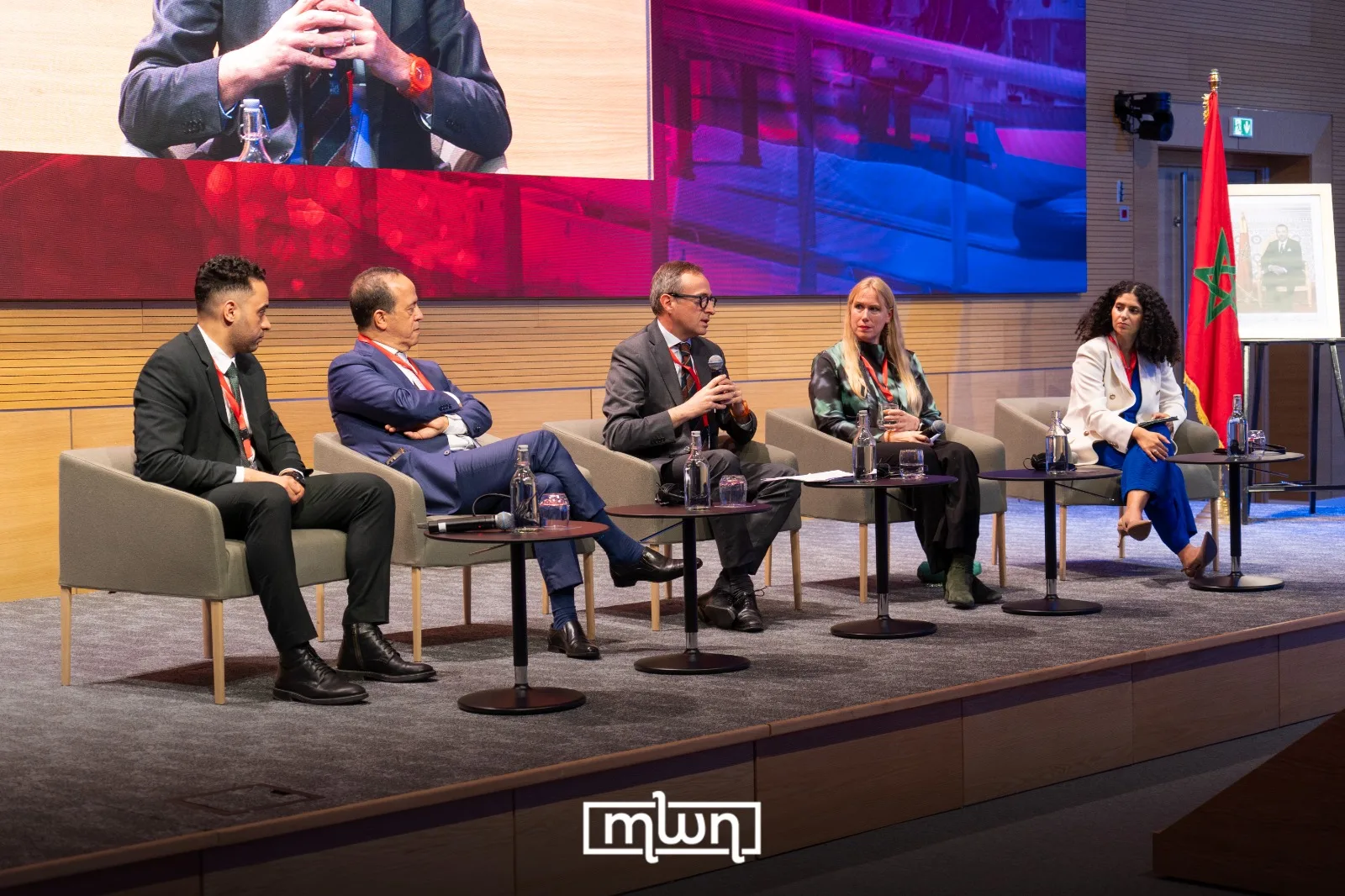
Rabat – Data, artificial intelligence, and industrial cooperation could play a major role in shaping Morocco’s future mobility sector, speakers said Monday during the “RSK Connect: Territorial Dynamics and Investment Opportunities in Sustainable Mobility” conference in Rabat.
The event, organized by the Policy Center for the New South (PCNS) and the Regional Investment Center of Rabat-Sale-Kenitra (CRI-RSK), brought together public officials, investors, industrial leaders, and experts to discuss opportunities linked to sustainable mobility and industrial development in the Rabat-Sale-Kenitra region.
As Morocco continues to position itself as a major automotive and industrial hub in Africa, discussions went beyond manufacturing capacity to touch on technology, digital transformation, and industrial integration.
Among the speakers was Roos Claeyssens, Automotive and Future-Ready Industrial Transformation Expert, who addressed the importance of data organization and artificial intelligence in helping Morocco accelerate industrial development.
Speaking to Morocco World News (MWN) on the sidelines of the event, Claeyssens said Morocco is currently at “the right point to structure the data and to break silos” between industries, regions, and institutions.
Data as a growth tool
According to her, better coordination and structured data systems could help industries work more efficiently and make faster decisions. She argued that Morocco has an opportunity to build smarter industrial systems from the start instead of repeating slower development models seen elsewhere.
“So between regions, between industries, between people in general, now is the mobile moment to set everything up,” she said.
Claeyssens explained that structured data allows industries to create common frameworks that make information easier to share and analyze. In her view, this can help Moroccan industries move with greater speed and precision, similar to what has been achieved in highly digitized industrial economies such as China.
She also noted that artificial intelligence should not be viewed as a replacement for people, but as a tool that strengthens human capabilities. We need to see AI as “augmented intelligence,” she said. “Everything that we are already doing now to optimize, but really with a lot of speed and precision.”
Claeyssens added that AI systems can help industries skip part of the traditional learning process because they rely on already existing databases and accumulated experience. “The learning has already been done,” she said, encouraging Moroccan industries to capture existing knowledge and apply it directly to new projects and sectors.
Morocco has increasingly invested in digital transformation and industrial modernization as part of its broader industrial strategy. Morocco has developed one of Africa’s largest automotive sectors over the past two decades and attracted major international manufacturers, including Stellantis and Renault Group.
The country is also working to strengthen its role in electric mobility and battery production as global demand for cleaner transportation grows.
Claeyssens also discussed the importance of networking and direct exchanges between industrial actors, saying innovation often develops through personal interaction and cooperation. “Where people are together, minds are connecting,” she said. “You cannot do that from a distance.”
Electric mobility push
Another panelist, President of Gotion Power Morocco Khalid Qalam, discussed Morocco’s growing importance in the electric mobility supply chain through large-scale industrial investments.
Speaking to MWN, Qalam said the conference provided an opportunity to explain how Gotion Power Morocco launched its investment project in Morocco and why it selected the Rabat-Sale-Kenitra region.
The company is linked to the broader expansion of Chinese battery manufacturer Gotion High-Tech, which has been advancing plans for major battery-related investments in Morocco as the country seeks to become a regional hub for electric vehicle production and battery manufacturing.
Qalam described the project as “one, if not the most important investment in recent years in the Kingdom of Morocco.”
He said discussions during the event focused on the company’s industrial integration strategy, verticalization plans, and the advantages offered by the Rabat-Salé-Kénitra region for investors.
Morocco has increasingly attracted attention from global battery and electric vehicle companies because of its strategic geographic position, free trade agreements, renewable energy ambitions, and growing industrial ecosystem. The country also holds significant phosphate reserves, a key element in battery production.
The discussions reflected Morocco’s broader ambition to move beyond traditional manufacturing and position itself within higher-value segments of future mobility industries, including electric vehicles, batteries, digital systems, and smart industrial technologies.