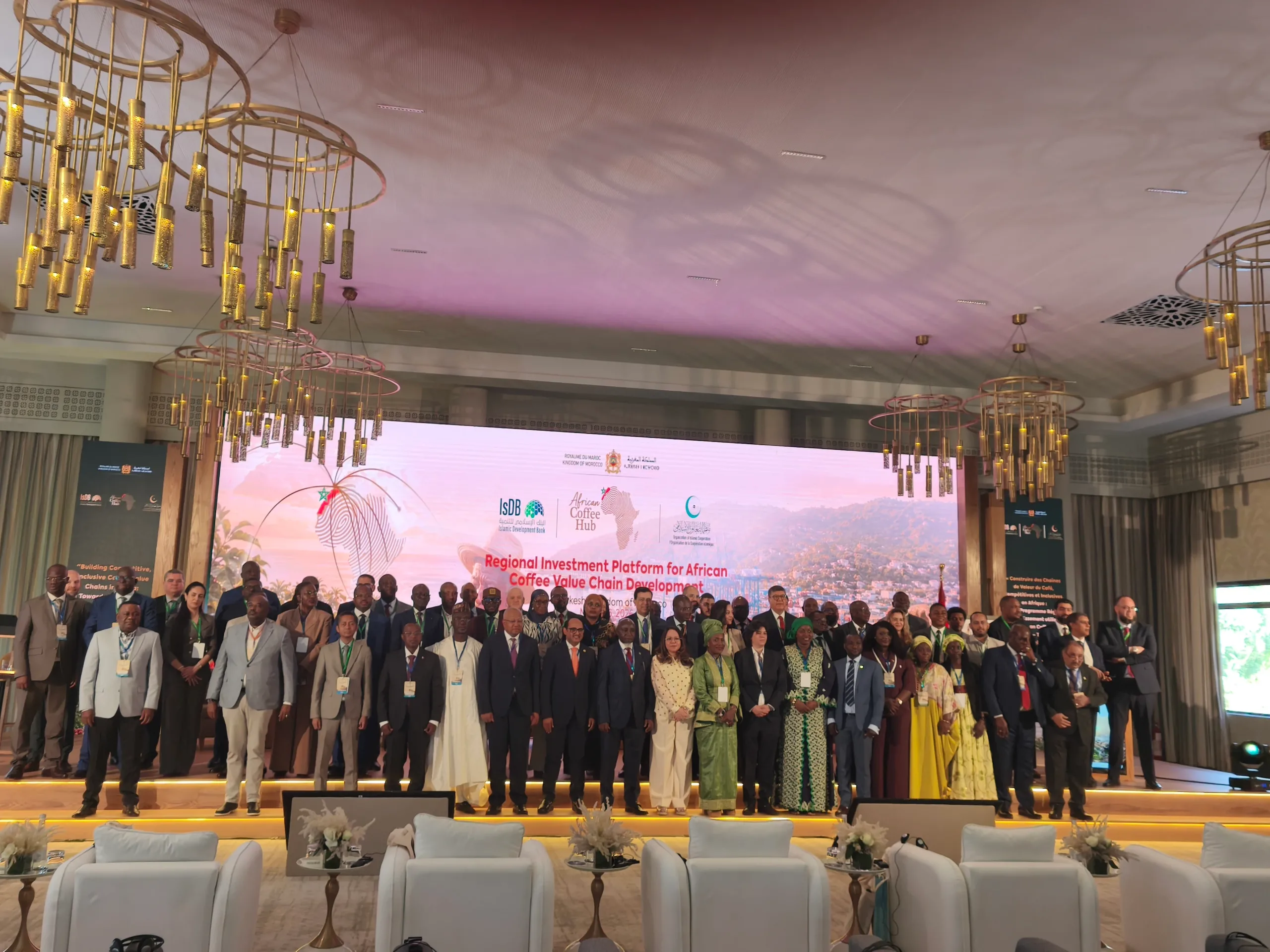
Marrakech – Eight African nations gathered in Marrakech on May 5-6 for the first Regional Forum on the Development of the Coffee Value Chain in Africa.
The two-day event, co-organized by African Coffee Hub, the Islamic Development Bank (IsDB), and the Organisation of Islamic Cooperation (OIC), produced a first wave of Memoranda of Understanding (MoUs) with producing countries and launched a continent-wide program to restructure how African coffee reaches global markets.
The forum also secured a landmark commitment from Nigerian company AGARA for the construction of the largest coffee research center in Africa.
African Coffee Hub, the Tanger Med-based continental platform established in Morocco, convened the forum under the leadership of its president, Sanae Benabdelkhalek.
The program falls within the framework of royal guidelines set by King Mohammed VI for South-South cooperation between Morocco and Sub-Saharan Africa. It is also anchored in the Islamic Development Bank Group’s 2026-2035 Ten-Year Strategic Framework.
The economics driving the initiative leave little room for ambiguity. Africa produces close to 15% of the world’s coffee but captures less than 10% of the final value. On a cup sold for four dollars in a European or North American capital, the African grower receives roughly four cents.
Nearly 80% of African volumes leave the continent as non-standardized green beans. Processing, blending, international logistics, and distribution have for decades been structured elsewhere, siphoning the bulk of revenue from a sector Africa historically gave birth to.
The global coffee market reached $245.2 billion in 2024 and is projected to grow at a compound annual rate of 4.5%, reaching $380 billion by 2034. The sector sustains approximately 100 million people across the value chain, including 12 to 15 million smallholders cultivating plots that average 0.3 hectares. The African producer receives between 1% and 10% of the final retail price.
From framework to first binding agreements
The regional program aims to reverse that equation through an African-controlled infrastructure for aggregation, standardization, traceability, and direct market access.
“This is not only about economic rebalancing, but also about the redistribution of power,” Benabdelkhalek told the forum.
Ahmed Ag Aboubacrine, head of the IsDB Regional Bureau in Rabat, framed the program in broader terms during his opening address. “Africa has not waited to be invited to prosper,” he told delegates. He described the initiative’s scope as extending beyond economics into what he called an epistemic shift – reshaping the narrative on development across the continent.
The forum’s most tangible outcomes came through bilateral agreements. ACH Invest, the investment and financial engineering arm of African Coffee Hub, concluded MoUs with the agriculture ministers of Sierra Leone, Guinea, and Madagascar.
Guinea’s finance minister joined his agriculture counterpart at the signing. In Uganda, an MoU was concluded with Banta African Coffee Ltd, led by CEO Nzeire Kaguta, brother of the Ugandan president.
The agreements span the full operational scope of the platform: post-harvest management, quality control, traceability, aggregation, logistics, branding, value addition, investment structuring, and market access. They constitute the first contractual foundation of the regional program.
Sierra Leone’s delegation arrived at the highest level, led by Henry Musa Kpaka, Minister of Agriculture and Food Security, and Kadiatu Allie, Deputy Minister of Finance.
The country advanced financing of $65 million for national agribusiness development under the Feed Salone program. Sierra Leone also put forward its prized Stenophylla coffee, a rare and heat-resistant variety increasingly valued on specialty and single-origin market segments in an era of climate disruption.
Nigeria delivered one of the forum’s most consequential commitments. AGARA pledged 2,000 hectares for long-term productive aggregation with African Coffee Hub.
A ministerial communiqué published on the day of the forum formalized AGARA’s provision of 1,000 square meters for the OIC and the IsDB to build the largest research center dedicated to coffee in Africa.
The future center will operate under the management and supervision of African Coffee Hub, positioning the Moroccan platform as the reference operator – operationally, scientifically, and technically – of the African coffee value chain.
From Tanger Med to global markets
Eight nations were represented at the highest level in Marrakech: Sierra Leone, Guinea, Madagascar, Uganda, Togo, Cameroon, Côte d’Ivoire, and Morocco. Nigeria’s participation through AGARA brought a ninth country into the fold. Further signatures are expected in the coming months as the program rolls out.
The IsDB’s institutional commitment rests on three complementary pillars. The first is sectoral, transposing to coffee the bank’s proven expertise on other structured agricultural value chains, including rice, cassava, cotton, and cereals.
The second is financial, mobilizing all group entities: ITFC for commercial financing, ICIEC for export credit insurance, and ICD for private sector investment.
The third is inclusive, deploying microfinance and economic empowerment instruments that explicitly target cooperatives, sector SMEs, women – who represent more than 60% of the workforce on farms – and rural youth structurally excluded from conventional financing.
The Islamic Organisation for Food Security will apply its evidence-based methodology, including baseline assessments, to the coffee sector.
The Islamic Centre for the Development of Trade participates in the ecosystem alongside OCP Africa, whose fertilization and soil health expertise the IsDB considers a primary condition for coffee quality. The African Continental Free Trade Area provides the regulatory framework facilitating intra-African trade flows.
The program operates through what the organizers describe as a sovereignty-finance-execution triangulation. Producing states support the upstream sector. The multilateral institution provides the framework and capital. African Coffee Hub handles execution on the ground from Tanger Med.
Deployment will proceed in two phases. The first focuses on agriculture, producer aggregation, post-harvest standardization, and yield optimization, organizing the first export flows through Tanger Med.
The second covers certification and an NFC traceability system designed to preserve the origin identity of each producing country through identifiable and traceable packaging that meets the highest international standards.
Morocco does not produce coffee. Yet, through the African Coffee Hub, a platform designed, established, and initiated by ACH Invest in the kingdom, it becomes a central actor in the continental value chain – responsible for sorting, aggregation, quality control, blending, and accelerating access to global markets.
The platform is not a coffee brand, a roaster, or a café chain – a distinction worth noting in a country where coffee culture is expanding rapidly.
That position draws on the logistical power of Tanger Med, the agronomic reach of OCP Africa, and the diplomatic capital Morocco has built across the continent over decades.
African Coffee Hub first launched at Tanger Med in November 2025 as a direct gateway for African coffee exports, cutting out intermediaries and routing African coffee straight to global markets.
The hub’s location gives it a structural advantage. Tanger Med is Africa’s largest port by container traffic and the leading container port in the Mediterranean. Situated on the Strait of Gibraltar, it ranks among the world’s top 20 ports. The complex serves as a crucial trade link between Africa, Europe, and the Americas.
The Marrakech forum marked the program’s transition from concept to institutional architecture, backed by multilateral financing and binding agreements with producing nations.
The organizers noted the model could eventually extend beyond coffee to other structurally imbalanced African commodity chains, from cocoa to cashew to mango – establishing a precedent for South-South economic integration and value redistribution within the continent.