
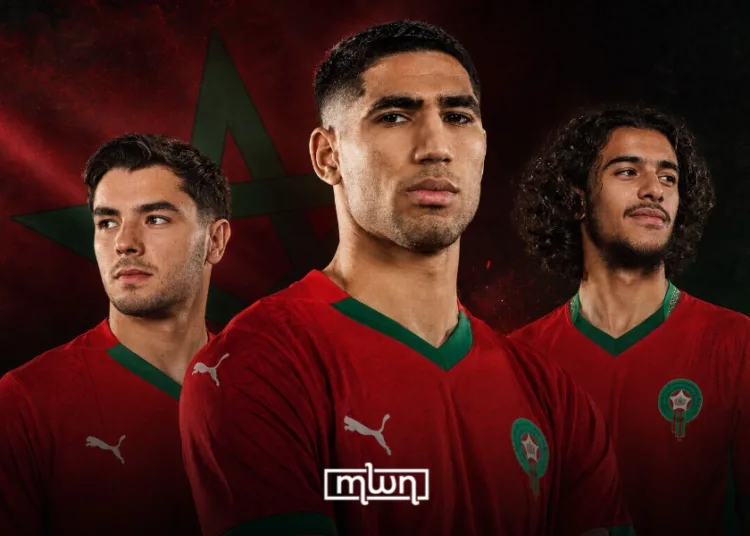
Rabat – Morocco’s growing success in international football has brought admiration from fans around the world. Still, it has also renewed criticism over the number of Atlas Lions players born and trained in Europe.
Some international commentators have claimed that Morocco’s national team does not reflect the real level of football inside the country because several players developed in academies in Spain, France, Belgium, and the Netherlands.
The debate grew after a social media user described Morocco’s use of diaspora players as “fraud.”
The user argued that players born, raised, and developed in Europe should not represent Morocco, adding that the Atlas Lions would not qualify for the World Cup without European-trained footballers.
Oh, really? You seem deeply annoyed that a group of foreign-born Moroccans choose to represent their country of origin. Yet you appear perfectly comfortable with the fact that vastly larger numbers of highly skilled Moroccans- educated in Moroccan schools and universities at the… https://t.co/6UOwEwXLkL
— Samir Bennis (@SamirBennis) June 15, 2026
Moroccan analyst, author, and Morocco World News co-founder Samir Bennis rejected the claim, saying it showed a limited understanding of Moroccan identity and the relationship between Morocco and its diaspora.
“The issue is not talent; it is belonging,” Bennis said in an X post.
A double standard around Moroccan talent
Bennis pointed to what he described as a crystal-clear contradiction in the way Moroccan talent is discussed.
Critics complain when footballers of Moroccan descent, who developed in European academies, choose to represent Morocco.
Yet far less attention is paid to the large number of Moroccan doctors, engineers, researchers, and other skilled professionals who were educated in Morocco before moving abroad.
Many of those professionals studied in Moroccan public schools and universities, partly supported by Moroccan taxpayers, before using their knowledge and experience in Europe, North America, or elsewhere.
Their contribution to foreign economies is often presented as normal professional movement. However, when the flow of talent moves in the opposite direction and a footballer chooses Morocco, some critics suddenly describe it as unfair.
Bennis argued that this position is difficult to defend.
Western countries have long benefited from immigrant workers and professionals, including people from Africa and other formerly colonized regions. Their labor played an important role in post-war reconstruction and later economic growth.
Footballers should not be treated differently simply because their contribution is more visible.
Moroccan identity goes beyond birthplace
A player born in Madrid, Paris, Amsterdam, or Brussels can still grow up inside a Moroccan family and remain closely connected to the country.
Language, food, religion, family relationships, regular visits, and cultural traditions can all shape a person’s identity even when they live outside Morocco.
Many diaspora players are Moroccan citizens through their parents. Their decision to play for the Atlas Lions is also permitted under FIFA’s nationality and eligibility rules.
They are not foreign players recruited without any connection to the country. They are members of Moroccan families making a personal decision about which part of their identity they want to represent internationally.
International player Achraf Hakimi is one of the clearest examples.
Born in Madrid to Moroccan parents and trained by Real Madrid, Hakimi chose Morocco while still a young player. He joined the national setup long before becoming one of the world’s leading right-backs.
His commitment to Morocco did not begin after fame arrived. It was already present while his career was still developing.
Morocco also produces players at home
The argument that the national team is entirely dependent on European academies also ignores Morocco’s domestic football development.
The Mohammed VI Football Academy has produced several senior internationals, including Nayef Aguerd, Azzedine Ounahi, Youssef En-Nesyri, Oussama Targhalline, and Abdelhamid Aït Boudlal.
CAF reported that 47 of the 57 players who passed through the academy during the mandate of its first technical director became professionals. Fifteen later played in Europe.
Morocco has also invested in stadiums, training centers, youth football, women’s football, coaching, and domestic clubs.
The country’s football model does not force a choice between locally trained and foreign-born players. It brings both groups together.
That combination helped Morocco become the first African and Arab nation to reach a World Cup semifinal in 2022.
The achievement belonged equally to players developed in Morocco and members of the diaspora.
Choosing Morocco also raises questions for Europe
On another note, Bennis argued that when a person born and raised in Europe chooses Morocco, the decision may also say something about the society in which that person grew up.
Citizens of Moroccan descent are often told that they are French, Spanish, Belgian, or Dutch. Yet many continue to face political and media debates questioning whether they are fully integrated or truly belong.
Young people with immigrant backgrounds can be treated as outsiders when they struggle, only to be celebrated as national heroes when they become successful athletes.
Research from the European Union Agency for Fundamental Rights has documented widespread discrimination against Muslims and people with immigrant backgrounds across Europe, including among young Muslims born there.
This does not mean that every diaspora footballer chooses Morocco because of discrimination. Family ties, sporting opportunities, personal identity, and emotional connection can all influence the decision.
However, dismissing the question of acceptance entirely would also ignore the experiences of many European citizens of Moroccan origin.
The Lamine Yamal example
Bennis pointed to Spain international Lamine Yamal as an example of how sporting success can affect the way a person with an immigrant background is viewed.
“Take Lamine Yamal as an example. He is an extraordinary, once-in-a-generation talent,” Bennis wrote.
Yamal was born in Spain to a Moroccan father and an Equatorial Guinean mother. He was eligible to represent all three countries before choosing Spain.
He is now celebrated as one of Spanish football’s greatest talents.
Bennis did not question Yamal’s Spanish identity or his right to represent Spain. Instead, he asked whether a less talented young man with the same family background would receive the same level of acceptance.
“One cannot help wondering whether, had he been a less exceptional footballer, some might have instead portrayed him as a problematic ‘immigrant,’ whose culture or religion supposedly prevented him from being fully Spanish,” he said
Bennis argued that Yamal’s exceptional ability has protected him from some of the prejudice faced by other young Europeans with similar family backgrounds.
“His remarkable talent has shielded him from many of the prejudices that others with similar backgrounds continue to face,” he added.
The example supports Bennis’ broader argument that belonging should not depend on whether a person becomes a football star, scores important goals, or wins major trophies.
Diaspora is part of Morocco
Morocco’s national team reflects the reality of a country with millions of citizens and descendants living abroad.
The diaspora is not separate from Morocco. It is part of modern Morocco.
Players trained in Europe bring valuable football education, while locally developed players show the progress made by Moroccan academies and clubs. One does not cancel out the other.
Calling the national team a “fraud” also ignores the fact that Morocco follows the same FIFA eligibility rules as every other country.
National teams across Europe, Africa, and the Americas include players born abroad or raised in families with more than one nationality.
Morocco’s ability to maintain a strong connection with its diaspora should not be treated as evidence of weakness.
He argued that criticism of Morocco’s diaspora players overlooks the strong emotional and cultural ties many foreign-born Moroccans continue to maintain with their ancestral homeland.
“Ultimately, the fact that so many members of the Moroccan diaspora proudly identify with Morocco is not evidence of a failure on Morocco’s part,” he said.
“If anything, it reflects the enduring strength of Moroccan identity and the challenges that some European societies still face in fully integrating and embracing all of their citizens.”
A Moroccan does not stop being Moroccan simply because he or she was born outside the country.
Morocco’s diaspora players are not borrowing an identity for football. They are representing an identity that has always been part of their lives