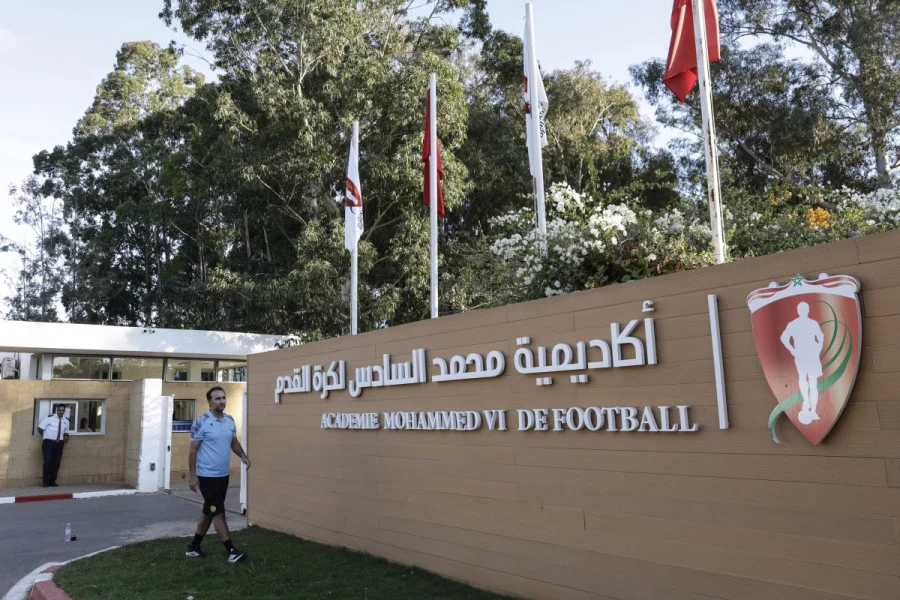
Marrakech – Morocco’s Mohammed VI Football Academy is strengthening the country’s position as a major source of young footballers capable of competing at the highest level, according to Souhaila Ettahiri, a FIFA-licensed player agent based in Spain.
Speaking to Morocco’s news agency (MAP), Ettahiri pointed to Morocco’s investment in youth development as a key driver behind the national team’s recent performances.
“The Mohammed VI Academy is today an institution with a very great future,” she told MAP, adding that the country holds a deep reservoir of young talent and a training model poised to expand Moroccan football’s reach globally.
The academy, inaugurated in 2009 by King Mohammed VI in Salé near Rabat and operational since 2010, has produced several players now competing in Europe’s top leagues.
Nayef Aguerd, Azzedine Ounahi, and Youssef En-Nesyri all came through its system. Four of its graduates were part of the Morocco squad that reached the 2022 FIFA World Cup semifinals in Qatar – the first African nation ever to go that far in the competition.
The academy’s impact has remained visible in recent years. In October 2025, Morocco’s U-20 team – with four academy-trained players among its starters – defeated Argentina 2-0 in Chile to win the FIFA U-20 World Cup, becoming the first Arab nation and the second African team after Ghana to claim the title.
Earlier that year, Morocco were declared AFCON 2025 champions after the CAF Appeal Board ruled Senegal had forfeited the final.
The Atlas Lions – now ranked 6th in the world, the highest FIFA ranking in Moroccan football history – are competing at the 2026 FIFA World Cup, where they finished second in Group C after drawing 1-1 with Brazil, beating Scotland 1-0, and defeating Haiti 4-2 to advance to the round of 32.
Ettahiri told MAP that the quality of training in Morocco now prepares “future players for the biggest international clubs,” noting that the potential of young Moroccan footballers is widely recognized across the football world.
She argued, however, that the next step must focus on increasing the international visibility of these players. Access to foreign training centers and clubs remains a challenge, she noted, calling for structured partnerships between Moroccan academies and companies specializing in the development and placement of young players. Such cooperation, she contended, would better showcase Moroccan footballing potential on the global stage.
The agent also stressed the importance of a holistic approach to player formation – one that goes beyond the pitch. “Today, a footballer must also speak several languages, pursue studies, and acquire skills that will allow him to build a career beyond the field,” she told MAP, noting that the demands of modern football now extend well past athletic performance alone. She urged that families and education be integrated into the development process from the start.
The academy’s track record supports her argument. Under founding technical director Nasser Larguet, 47 of the 57 players who passed through the program turned professional. Fifteen went on to play in Europe.
FIFA and CAF have repeatedly described the institution as a pioneer in youth development, and French sports newspaper L’Équipe ranked it among the best football academies in the world.
Ettahiri concluded that Morocco’s strategy of investing in long-term youth development is positioning the country to consolidate its standing among the top football nations. With a co-hosting role in the 2030 FIFA World Cup alongside Spain and Portugal on the horizon, the pipeline the academy has built will be central to Morocco’s ambitions on and off the pitch.
Read also: Morocco’s Football Success Built on Two Decades of Royal Vision, Says Lekjaa