 Join on WhatsApp
 Join on Telegram
Marrakech – For three days bracketing the close of June, the Palais des Congrès and the Mövenpick on Boulevard Mohammed VI lent Marrakech the cadence of a continental parliament – sashes, honorifics, and the polyglot hum of delegates ferried in from Lagos to Lesotho.
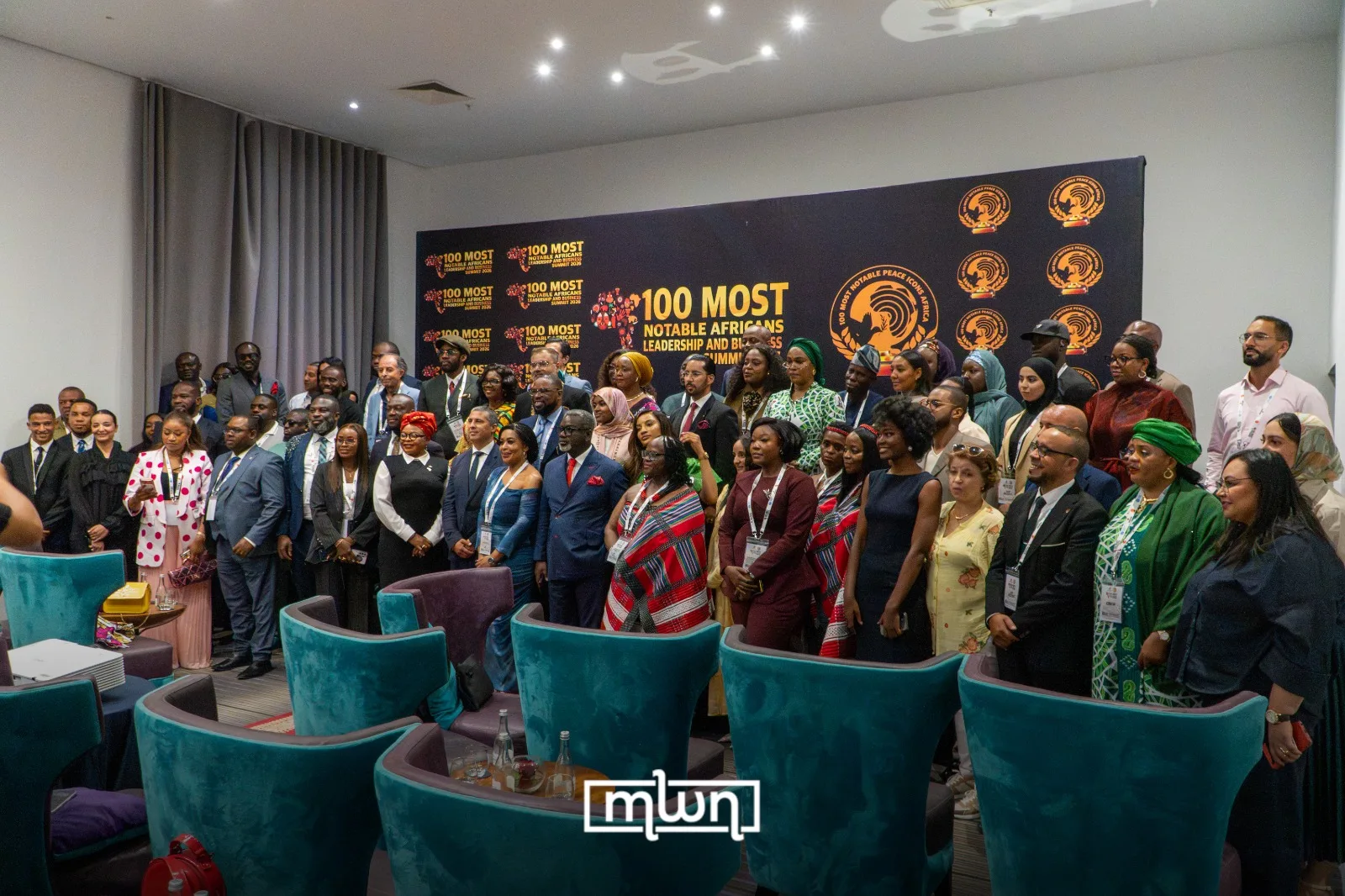
The occasion was the third 100 Most Notable Africans Leadership and Business Summit (June 26-28), convened by the DAVDAN Peace and Advocacy Foundation alongside 100 Most Notable Peace Icons Africa, and transplanted to Moroccan soil after two consecutive editions in Kigali.
The relocation was one its organizers cast as a deliberate wager on the kingdom’s standing as a hinge between Sub-Saharan Africa, the Maghreb, and Europe, and one that dovetails neatly with the royal vision of South-South cooperation and African integration that has anchored Rabat’s continental diplomacy under King Mohammed VI.
View this post on Instagram
Its theme, “Uniting Africa’s Changemakers for Growth and Impact: A Gateway to Sustainable Development,” promised the familiar liturgy of pan-African optimism. What it delivered, more arrestingly, was a candid reckoning with the continent’s self-inflicted frictions.
That reckoning arrived early, and from the chair. Ambassador Dr. Kingsley Amafibe, the summit’s convener, set aside his prepared text to lament a wound inflicted before the first gavel: more than forty would-be delegates, he disclosed, had been refused visas and never reached Marrakech.
“It broke my heart,” he confessed, casting the episode as a parable of the continent’s deeper malady. “Our biggest problem in Africa is the border restriction… because of a lack of trust. We Africans, we don’t trust ourselves.” From there, he pivoted to a thesis he would circle back to repeatedly – that Africa’s deficit is not endowment but stewardship. “Africa is the next destination for business,” he ventured, before sharpening the point: “Our biggest problem is leadership.”
The governance gospel
If Amafibe diagnosed, Rwanda’s ambassador to Morocco, Shakilla K. Umutoni, prescribed. Speaking for the nation that had hosted the franchise’s first two iterations, she traced her country’s metamorphosis from the ruins of 1994 to a byword for administrative efficiency, and distilled the lesson into an axiom: “good governance is not an abstract principle, it is a practical tool for development.”
She paraded the proof points – the IREMBO e-government portal that collapses bureaucratic queues into online clicks, a business-registration regime measured in hours, and a parliament where women command more than 60% of seats, the highest share on earth.
Rwanda’s 2018 decision to extend visa-on-arrival to every African passport, she noted pointedly given the morning’s earlier grievance, was no courtesy but a bet on circulation. Her closing line read like a manifesto: “The future of Africa is not something that awaits us. It is something we are building today.”
Ghana’s envoy, Charity Gbedawo, carried the torch toward demography. With more than 60% of Africans under twenty-five, she framed the youth bulge as “Africa’s greatest strategic advantage” rather than a liability to be managed.
She praised Morocco’s recently concluded Fès-Meknès Economic Forum as a template for marrying public policy to private enterprise, then ran through Accra’s own youth-enterprise machinery before pressing her central appeal: that the African Continental Free Trade Area (AfCFTA) – whose secretariat Ghana hosts – become operable for the small trader, not merely the boardroom.

“Young entrepreneurs in Accra should be collaborating with innovators in Casablanca, in Kigali, in Nairobi, in Lagos, in Cape Town, in Cairo,” she urged, distilling the ambition into a single inversion: African youth must become “not merely participants in development, but its principal architects.”
Heritage as strategy
Where the ambassadors trafficked in institutions and trade corridors, Princess Vusani Tshivhase supplied the summit’s soul. Representing His Royal Highness Thovhele Vho-Kennedy Midiavhathu Tshivhase of South Africa’s Tshivhase dynasty – and, by her own admission, “nerves” – she delivered her first official address as her father’s deputy as a defense of heritage against the centrifugal pull of globalization.

Invoking Ubuntu’s creed, “I am because we are,” she advanced a counterintuitive proposition: that “Africa’s greatest untapped resources are not beneath the soil… it is within our heritage.” Traditional leadership, she contended, was no relic but a “strategic partner” in peacebuilding, vested with a legitimacy “no legislation can manufacture.” Her warning was equally barbed – that a generation fluent in foreign tongues and global celebrity risked inheriting “modern infrastructure but lose their African soul.”
The summit’s most theatrical interval belonged to Professor Dr. G.D. Singh, founder of the Asian-African Chamber of Commerce and Industry (AACCI), who recast the continent’s narrative with a rhetorical flourish: “Africa is no longer the continent of potential. Africa is the continent of possibilities.”
His gospel was the micro-, small-, and medium-sized enterprise – “the backbone of every great economy is not the billionaire,” he argued, “it’s the small entrepreneur” – yoked to a geometry of “four pillars. Peace, partnership, prosperity, and purpose.” Singh closed by marshaling the hall to its feet for a collective vow – “I am a change maker. I will not wait. I will build” – before offering a benediction that doubled as a headline: “I do not see 100 notable Africans. I see 100 reasons why the world should believe in Africa.”
The Moroccan register
Morocco’s own voices threaded the proceedings with sectoral specificity. Imane El Rhalete, CEO and founder of the Dubai-headquartered IRGT Consulting, surveyed an African energy map in flux – Nigeria’s primacy, fresh discoveries off Senegal and Ghana, the digital and cybersecurity frontiers reshaping extraction – before compressing a dozen years in the trade into her “three R’s”: the right people, the right region, and, above all, the right partnership.
“No companies, no countries can grow up alone,” she reasoned. In remarks to Morocco World News (MWN), she located the moment within a national arc: “Proud of Morocco that it received such big events… and the best is yet to come.”
Aviation entrepreneur Yassine El Moussi, managing director of BGM Group, furnished the bullish counterpart. A fifteen-year veteran who relocated to the North African country two years ago to build out African business aviation, he read the kingdom’s event calendar – a just-staged Africa Cup of Nations (AFCON), the 2030 World Cup on the horizon – as connective tissue for an entire sector.
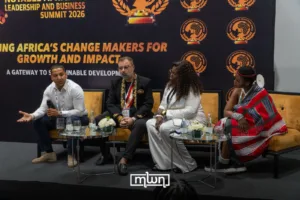
“This is the right time to be in Morocco. This is the right time to invest in Morocco,” he told MWN, crediting the momentum to King Mohammed VI’s strategy. “Morocco is only growing, and it’s only going to get better.”
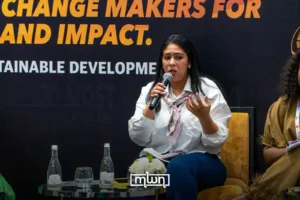
The program’s final movement, a panel moderated by Ruth Chinenye Chukwueke, gathered three women working the terrain of narrative and influence: Dr. Adaora Onyechere on gender, media, and inclusive leadership; Imane Boussrif on strategic communication and reputation in a digital age; and Halila Siham on women’s leadership and visibility. Their convergence – that Africa’s image is itself an asset to be governed – furnished a fitting coda to a gathering preoccupied with how the continent is seen, and by whom.
Then came the ritual the summit exists to stage: a group photograph, the conferment of certificates, and the recognitions that lend the franchise its name.
Yet the day’s most durable image may remain the one Amafibe sketched at the outset – a hall of pan-African ambition, ringed by the visa counters that kept forty of its invitees away. The animating wager, articulated from podium after podium, was that governance, youth, heritage, and partnership might yet dissolve those walls. The harder truth, conceded in the same room, was that the walls are still standing.