 Join on WhatsApp
 Join on Telegram
Marrakech – Morocco’s Bank of Africa has arranged a $300 million international syndicated loan to finance a 160-kilometer road in northern Guinea, the group announced this week.
The financing will build the Labé-Banti-Tougué-Bafing River axis, a route listed in Guinea’s transport infrastructure development plan. The works also cover the Banti-Koubia spur and a bridge over the Bafing River.
Bank of Africa United Kingdom PLC, the group’s London-based subsidiary, led the operation as global coordinator and mandated lead arranger, assembling a group of international financial institutions.
The structure pairs conventional financing with an Islamic Murabaha tranche and carries partial cover from the Islamic Corporation for the Insurance of Investment and Export Credit (ICIEC), a member of the Islamic Development Bank Group (IsDB). Murabaha is a cost-plus sale arrangement used in place of interest-bearing lending.
According to Bank of Africa, the deal marks Guinea’s first entry into both the international syndicated loan market and the Islamic finance market.
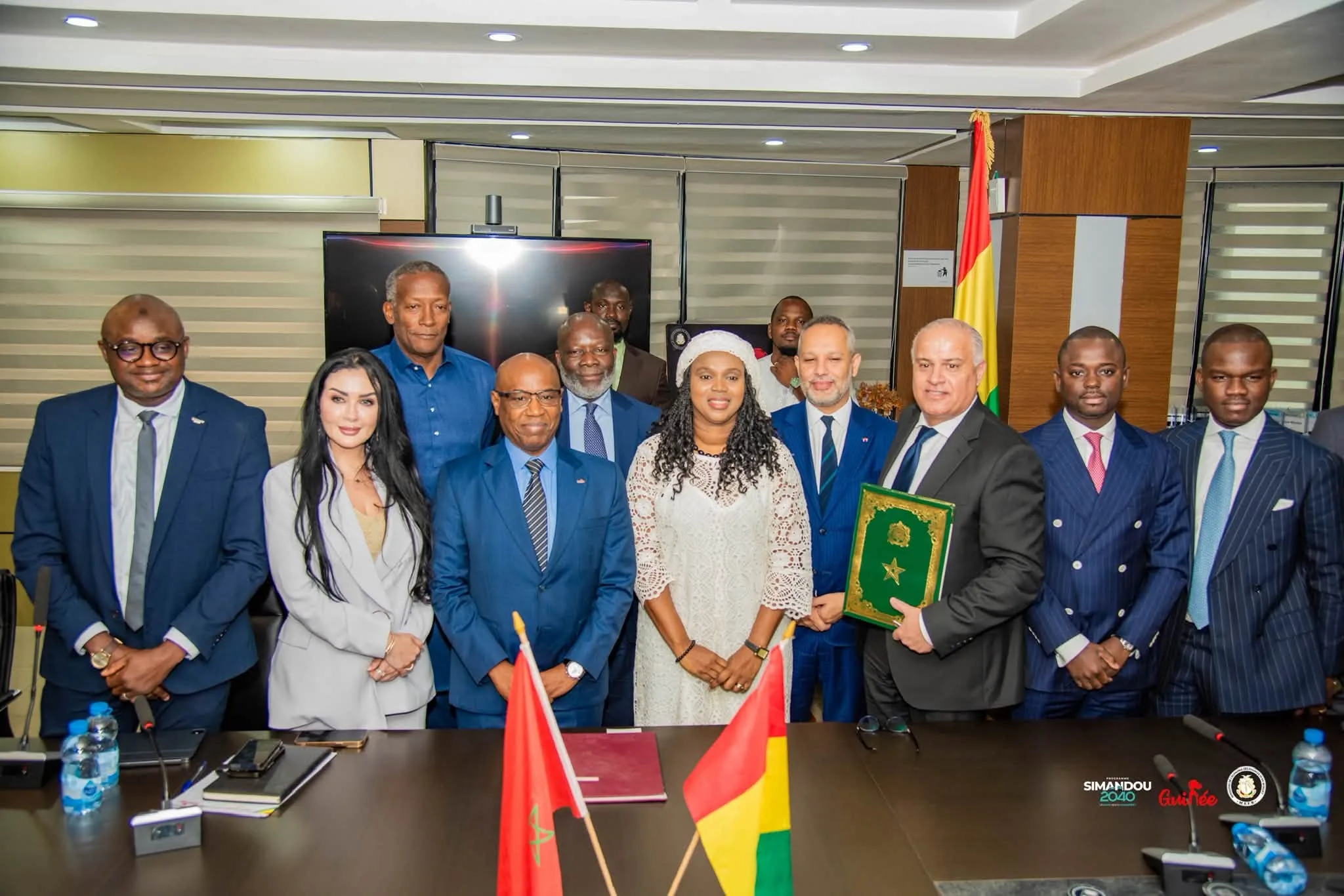
The signing ceremony took place Wednesday in Conakry. Saïd Adren, executive director of Bank of Africa United Kingdom PLC, and Zineb Tamtaoui, executive director of Bank of Africa Dubai, attended alongside Guinea’s Minister of Economy, Finance and Budget, Mariama Ciré Sylla, Infrastructure and Public Works Minister Facinet Sylla, and Moroccan Ambassador to Guinea Issam Taib.
Taib extended his wishes to the Guinean government and expressed pride in seeing African institutions mobilize medium- and long-term capital of “vital importance” for the continent.
Khalid Nasr, executive managing director for Morocco and corporate and investment banking at Bank of Africa, described the transaction as confirmation of the group’s position among African players structuring “complex financings” for large infrastructure projects. He tied it to the bank’s capacity to combine conventional and Islamic finance for African economies with growing development needs.
The chief executive of Bank of Africa United Kingdom PLC placed the operation within the South-South cooperation approach pursued by Morocco, and pointed to further infrastructure partnerships in Guinea.
‘A structuring investment’
Guinea’s Ministry of Economy presents the road as a structuring project under the Simandou 2040 development program. The Compagnie Sahélienne des Entreprises (CSE) will carry out the works and has committed to contractual deadlines and international quality standards.
The northern corridor has never had a fully paved modern road link since independence. The ministry expects the axis to connect production basins to national and regional markets, reduce transport costs, and ease the movement of people and goods.
Mariama Ciré Sylla called the project “a structuring investment” for economic and social development, and linked it to the strategic vision of President Mamadi Doumbouya.
Closing the ceremony, she framed the agreement as more than a financing deal, describing “a Guinea resolutely turned toward the future,” and expressing hope that the partnership with Bank of Africa UK and ICIEC would be the first step in a broader cooperation.
Facinet Sylla, who cited a figure of €300 million in the government’s own account of the deal, argued the mobilization shows Guinea is “attractive and competitive,” with every franc invested feeding growth, GDP, and public finances.
Preparations ran for months. On April 27, Sylla received a joint team from Bank of Africa (DIFC) and BMCE Bank International, at a point when the funding was already secured, and only the signing of the convention remained.
Read also: Morocco’s Cegelec Lands MAD 2 Billion Energy Deal in Guinea