


 Join on WhatsApp
 Join on Telegram
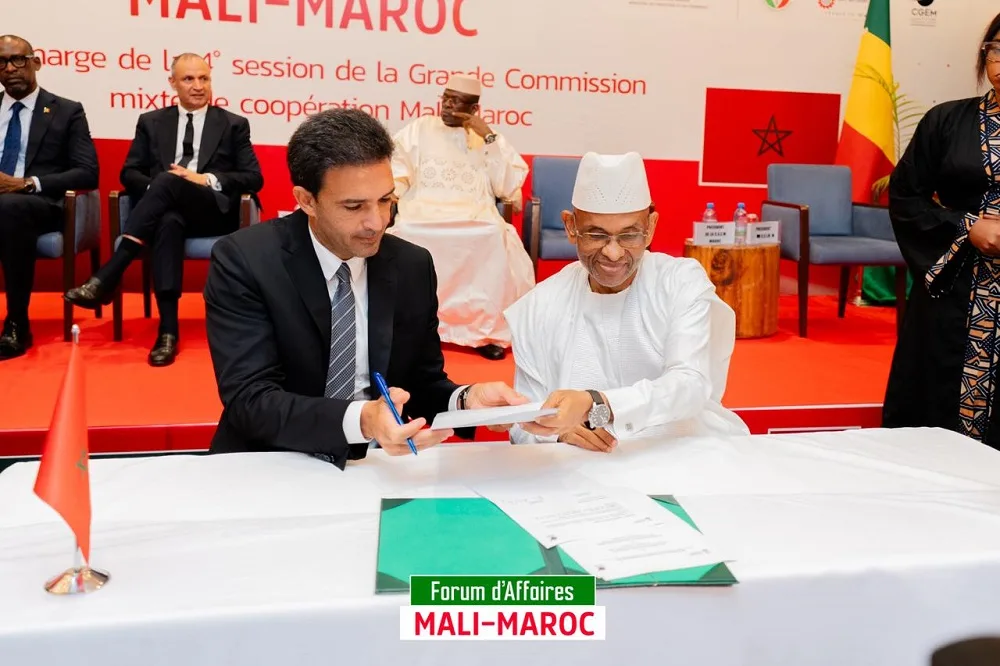
Marrakech – Morocco and Mali reopened their commercial file on Thursday in Bamako, where the Mali Chamber of Commerce and Industry (CCIM) and the General Confederation of Moroccan Enterprises (CGEM) hosted the Mali-Morocco Business Forum in partnership with Mali’s National Employers’ Council (CNPM).
The gathering ran on the sidelines of the fourth session of the Morocco-Mali Joint Cooperation Commission.
More than 300 Moroccan and Malian business operators attended. Morocco’s Minister of Industry and Trade Ryad Mezzour joined his Malian counterpart Moussa Alassane Diallo, alongside CGEM President Mehdi Tazi, CCIM President Madiou Simpara, and CNPM President Mossadeck Bally.
Tazi led the Moroccan delegation, which drew companies from agrifood, energy, construction and public works, real estate, mining, finance, telecommunications, and logistics.
The forum’s central outcome was a memorandum of understanding between the CGEM and the CNPM that formally revives the Morocco-Mali Business Council.
The council is designed as a permanent dialogue platform tasked with identifying and promoting investment projects, guiding Moroccan and Malian firms through administrative procedures, and connecting potential partners.
It will also carry recommendations to the relevant authorities on improving the business climate and clearing obstacles that operators encounter. Moncef Ziani chairs the Moroccan side, and Sory Ibrahima Maiga chairs the Malian side.
A second agreement followed, signed between FENELEC and FENEM to deepen cooperation between Moroccan and Malian firms in the energy sector.
Speakers framed the day around a shared reading of the continent’s economics: stronger intra-African trade, more integrated regional value chains, and structural projects that generate added value and jobs.
In that context, the Royal Atlantic Initiative advanced by King Mohammed VI, which aims to open Atlantic Ocean access to Sahel countries, was presented as a route toward better regional connectivity and smoother trade flows.
Proceedings then moved to a panel on the regulatory environment and investment opportunities in both markets, bringing together representatives of API-Mali, APEX-Mali, AMDIE, MASEN, and the Morocco-Mali Business Council. Participants closed the program with a series of B2B, B2G, and G2G meetings that put companies and institutions in direct contact.
Read also: Morocco Suspends AEVM Requirement for Malian Travelers Starting Monday
The commercial baseline remains heavily tilted toward Rabat. Moroccan exports to Mali reached roughly $185 million in 2025, against about $3 million in imports from Mali. That imbalance explains Bamako’s push for long-term investment and skills transfer rather than goods alone.
Moroccan groups already hold established positions in the Malian economy. Maroc Telecom operates through Moov Africa Malitel, Bank of Africa ranks among the country’s leading banks, and the OCP Group runs programs aimed at improving soil fertility and agricultural productivity.
The forum sits inside a broader institutional restart. The Joint Cooperation Commission was created by an agreement signed in Rabat on September 17, 1987. It is the main framework for managing bilateral cooperation, and it had not convened since its third session in Rabat in June 2000.
Experts from both countries opened the fourth session on July 21 and worked through July 22, co-chaired by Moustapha Traoré, secretary general of Mali’s Foreign Ministry, and Mohammed El Alaoui, head of the African Affairs division at Morocco’s Foreign Ministry. The draft texts go to the two foreign ministers at the ministerial session on July 24.
Those delegations reviewed existing programs and set new priorities across trade, investment, agriculture, energy, infrastructure, mining, health, training, and higher education.
A fourth session had already been floated during King Mohammed VI’s February 2014 visit to Mali, which produced 17 agreements covering investment, health, water, energy, telecommunications, transport, agriculture, and mining.
The economic reset tracks a political one. Mali, Burkina Faso, and Niger backed Morocco’s Atlantic access initiative in April 2025. In April 2026, Bamako withdrew its recognition of the self-proclaimed “Sahrawi Arab Democratic Republic (SADR)” and endorsed Morocco’s Autonomy Plan for Western Sahara.
Days before the commission met, Morocco served as guest of honor at the second International Diaspora Forum, held in Bamako from July 16 to 18.


