
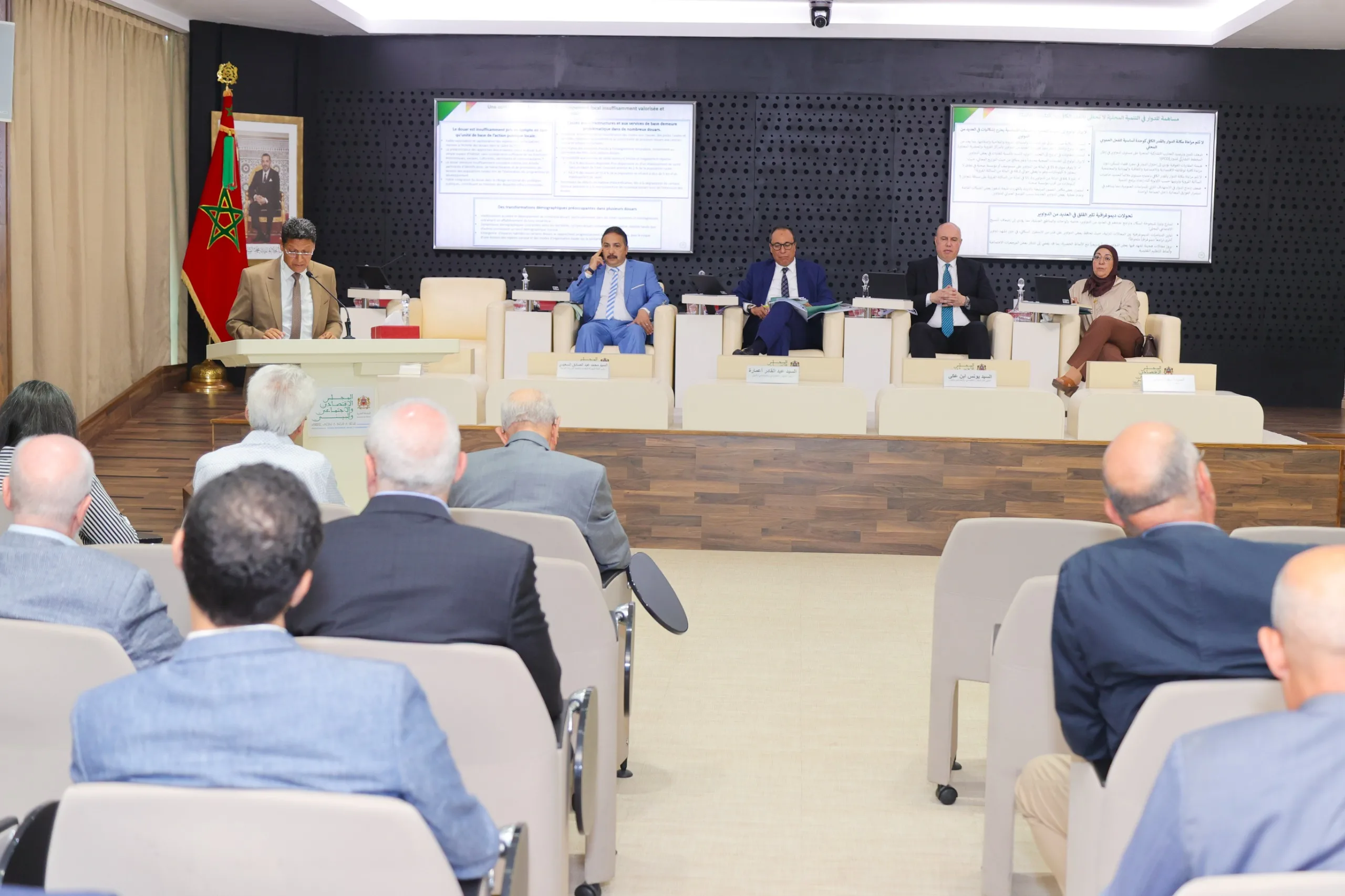
Casablanca – The Economic, Social and Environmental Council (CESE) reviewed two draft opinions on Monday focusing on the role of the douar in rural development and efforts to combat environmental damage in Morocco during its 184th ordinary General Assembly session.
The meeting was chaired by CESE President Abdelkader Amara and took place on July 27, 2026, corresponding to 12 Safar 1448 in the Hijri calendar. According to the council, both draft opinions were prepared as part of its self-referral work.
One of the draft opinions looks at the place of the douar, or rural village, as the basic unit of social and territorial organization and a key form of population settlement in Morocco’s countryside. It examines the social, economic, cultural, political, and environmental dimensions of the douar while also identifying the main constraints and challenges that limit its potential.
Based on that assessment, the opinion seeks to identify ways to strengthen the role of the douar by taking into account the diversity of these rural areas and their territorial, demographic, and social characteristics. It also proposes practical measures aimed at helping douars contribute more effectively to rural development.
The second draft opinion focuses on combating environmental damage in Morocco. It examines how environmental protection can be combined with economic and social development, describing the two as inseparable pillars of any development project.
The proposal includes a series of measures intended to prevent environmental harm and encourage the integration of environmental and climate considerations into public policies. According to the CESE, the goal is to preserve Morocco’s natural capital over the long term, ensure a healthy living environment, and support resilient and sustainable development.
The council said this draft opinion builds on its previous work in several areas related to the environment and sustainable development. Those include biodiversity, forest ecosystems, water resource management, quarries, mineral resources, the blue economy, the circular economy, the water-energy-food-ecosystems nexus, climate change, the energy transition, and efforts to reduce food loss and waste.
The two draft opinions were presented and discussed during the assembly as part of the council’s ongoing work on public policy issues through its self-referral mechanism.