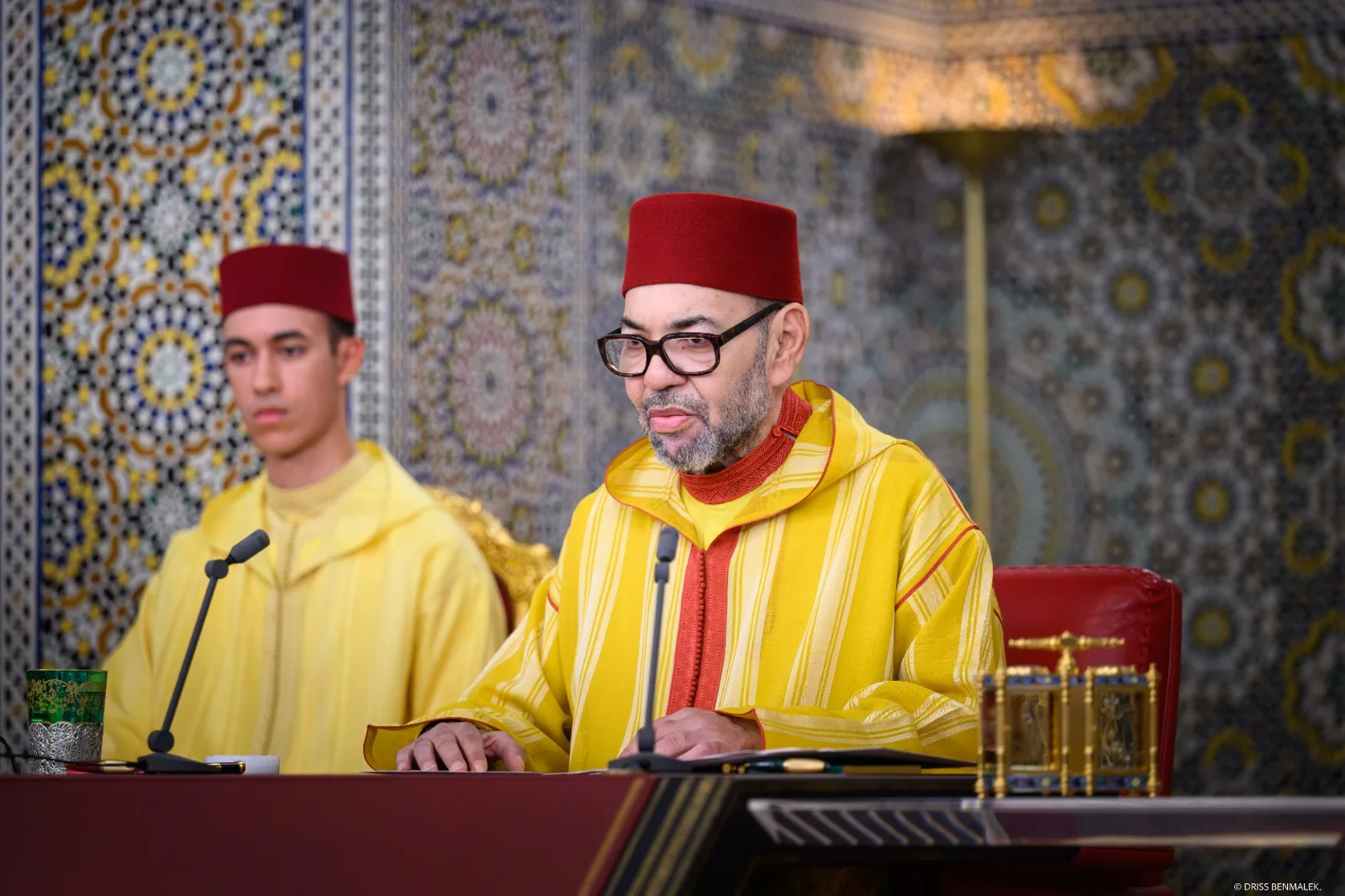
In an era defined by geopolitical rivalry, economic uncertainty, climate pressures, and technological transformation, governments face an increasingly difficult challenge: balancing immediate political demands with long-term national priorities. Against this backdrop, Morocco’s King Mohammed VI’s 2026 Throne Speech deserves attention not simply as an annual constitutional address, but as the articulation of a broader philosophy of governance. Rather than reviewing policy achievements alone, the speech presents strategic planning as the foundation of sustainable development, national sovereignty, and institutional resilience.
One of the speech’s defining characteristics is its rejection of leadership measured by prestige or international status. King Mohammed VI states: “I have never sought personal glory, or recognition of a leading role at the continental or international level. All that has ever mattered to me is to fulfill my duty and serve you, and to enable all Moroccans to live a free, dignified life.” This statement provides the analytical lens through which the speech should be understood. It suggests that diplomacy, economic reform, and international partnerships are not ends in themselves but instruments to improve citizens’ well-being and strengthen the state’s capacity to deliver sustainable development.
This philosophy is reinforced by another defining statement: “None of our achievements was a matter of chance.” This assertion reflects a distinctive understanding of governance in which development results from strategic direction, institutional continuity, disciplined implementation, and the willingness to evaluate and improve public policies over time. Progress is presented not as the consequence of favorable circumstances but as the cumulative outcome of long-term planning.
“What we have achieved together”
Perhaps the speech’s most significant contribution lies in its treatment of political time. Rather than assessing national progress through the lifespan of a single government or electoral mandate, it presents Morocco’s development as a cumulative national process extending across successive administrations and institutions. The reference to “what we have achieved together” is particularly revealing. It deliberately avoids attributing progress to any single government or institution, instead framing development as a collective national endeavour built over decades.
This distinction carries broader significance beyond Morocco. One of the enduring challenges confronting democratic systems is reconciling long-term strategic planning with the short-term incentives created by electoral politics. Governments naturally seek results within limited mandates, while structural reforms in areas such as infrastructure, industrial policy, education, energy transition, social protection, and climate adaptation often require sustained commitment over decades.
The vision articulated in the Throne Speech suggests that these objectives need not be contradictory. Rather, it distinguishes between the state’s long-term strategic direction and the constitutional responsibility of successive governments to implement public policy effectively. Strategic continuity, in this conception, does not weaken democratic accountability; instead, it provides the stable framework within which governments remain accountable for delivering measurable results. Strategic vision and democratic alternation are therefore presented as complementary rather than competing principles of governance.
This perspective is particularly relevant in an international environment characterized by growing uncertainty. Economic shocks, geopolitical fragmentation, supply chain disruptions, climate change, and technological competition have exposed the limitations of governance driven primarily by short-term political calculations. The speech argues instead for a model grounded in anticipation rather than reaction, where resilience is built through long-term investment, institutional learning, and policy consistency.
The King’s emphasis on entrepreneurship, meticulous follow-up, constructive self-criticism, and forward-looking governance reinforces this approach. These principles describe more than administrative efficiency; they reflect a governance culture in which institutions are expected to evaluate outcomes, adapt to changing realities, and continuously improve performance. Strategic planning is therefore understood not as a rigid blueprint but as a dynamic process capable of responding to emerging challenges while preserving long-term national objectives.
Sovereignty through resilience
The speech also advances a broader understanding of sovereignty. In today’s interconnected world, sovereignty can no longer be defined solely in territorial or political terms. It increasingly depends on economic resilience, technological capability, institutional effectiveness, and the capacity to preserve national autonomy while remaining actively engaged internationally. Investments in industrial development, renewable energy, water security, logistics, and critical infrastructure are presented not merely as sectoral policies but as long-term investments in national resilience.
This vision is reinforced by the speech’s portrayal of Morocco’s economic transformation. Rather than presenting individual sectors as isolated success stories, King Mohammed VI situates the country’s progress within a broader process of structural diversification. By highlighting advances in the automotive and aeronautics industries, renewable energy, cybersecurity, defense industries, logistics, and other high-value sectors, alongside Morocco’s long-established phosphate industry, the speech points to a deliberate shift from dependence on traditional comparative advantages toward the development of a diversified, innovation-driven economy. The underlying message is that national resilience increasingly depends not on a single strategic resource but on the capacity to cultivate multiple centers of industrial and technological competitiveness. In an era of geopolitical fragmentation and supply-chain disruptions, economic diversification emerges as a pillar of sovereignty, strengthening resilience while expanding Morocco’s room for strategic maneuver. The speech therefore reframes Morocco’s development narrative: the country’s strategic value lies no longer in what it possesses, but increasingly in what it is capable of producing, innovating, and securing.
Diplomacy through development
This broader conception of sovereignty is closely linked to Morocco’s diplomatic strategy. The speech presents international engagement not as a search for prestige but as an extension of national development. Partnerships are valued because they generate investment, innovation, technology transfer, and economic opportunities that improve citizens’ lives. Diplomacy, in this sense, serves development rather than symbolism.
The speech also presents political and institutional stability as a strategic economic asset rather than merely a domestic achievement. By linking stability to investor confidence, industrial expansion, and long-term development, it argues that sustained economic transformation requires a predictable policy environment capable of supporting investment over decades. In this perspective, stability is not portrayed as an end in itself, but as an enabling condition for economic competitiveness, technological upgrading, and sustained foreign investment. At a time when geopolitical uncertainty and regional instability increasingly influence global investment decisions, Morocco positions institutional continuity and policy predictability as comparative advantages that reinforce both economic resilience and international credibility.
The speech also highlights Morocco’s growing capacity to host major international events as an indicator of institutional confidence and long-term planning rather than symbolic prestige. Morocco’s hosting of the 2025 Africa Cup of Nations (AFCON) and preparations for the 2030 FIFA World Cup are presented not simply as organizational achievements, but as catalysts for broader national development. Beyond demonstrating logistical, technical, and security capabilities, these events are driving sustained investments in transport networks, urban renewal, tourism infrastructure, digital connectivity, and public services. In this sense, international sporting events become instruments of economic transformation, enhancing Morocco’s global attractiveness while generating lasting improvements in infrastructure, quality of life, and the country’s competitiveness as a destination for investment, tourism, and international business. The underlying message is that global visibility derives not from hosting events alone, but from the enduring development legacy they leave behind.
The same logic underpins Morocco’s engagement with Africa and its wider international partnerships. Cooperation is framed less in terms of geopolitical competition than of shared development, economic integration, and mutually beneficial investment. Rather than pursuing exclusive alignments, the speech advocates diversified partnerships that reinforce both national autonomy and regional cooperation, reflecting a pragmatic approach to international relations in an increasingly fragmented global order. This strategic vision is also reflected in Morocco’s broader African policy, notably through initiatives such as the Nigeria-Morocco African Atlantic Gas Pipeline and the Atlantic African States Initiative. Although not explicitly addressed in the speech, these initiatives embody the same philosophy of connectivity, regional integration, and shared prosperity that informs Morocco’s external engagement. Significantly, the recent endorsement of the African Atlantic Gas Pipeline by ECOWAS Heads of State transforms the project from a bilateral initiative into a regionally owned framework for economic integration, energy security, and sustainable development. Together, these initiatives illustrate an approach to diplomacy in which infrastructure, energy cooperation, maritime access, and economic interdependence become instruments of development, stability, and collective resilience rather than expressions of geopolitical rivalry.
Ultimately, the 2026 Throne Speech offers more than an assessment of Morocco’s development trajectory. It articulates a broader conception of strategic statecraft in which long-term planning, institutional continuity, democratic accountability, and international engagement reinforce one another. It argues that national resilience is neither accidental nor temporary, but the product of sustained vision, effective governance, and the ability to adapt without losing strategic direction.
For scholars and practitioners of governance, international relations, and development policy, the significance of the speech extends beyond Morocco itself. It raises questions that resonate across many developing and emerging states: How can governments sustain long-term reforms beyond electoral cycles? How can sovereignty be strengthened in an era of global interdependence? And how can diplomacy, economic policy, and institutional reform be aligned around the common objective of improving citizens’ well-being?
Rather than presenting a universal model, the 2026 Throne Speech offers the Moroccan experience as an illustration of how strategic planning, institutional continuity, and adaptive governance can reinforce one another in pursuit of sustainable development. In an increasingly fragmented international order, its central message is both timely and relevant: enduring national progress depends not on short-term political cycles, but on the capacity of institutions to pursue a shared strategic vision over time.