
Rabat – Morocco has attributed the recent mass migration attempts to the Spanish enclave of Ceuta to criminal networks, stressing that the movements do not reflect any intention by Moroccan authorities to encourage irregular migration.
Europa Press quoted diplomatic sources at the Moroccan Embassy in Madrid as saying that the recent attempts to enter Ceuta were linked to criminal groups involved in human trafficking and migrant smuggling.
The sources said these networks exploit vulnerable people, spread false expectations, and expose migrants to serious risks, added the report.
“Morocco does not support or encourage the irregular migration of its nationals,” the sources said, adding that criminal organizations take advantage of people’s vulnerability and put their lives and safety at risk.
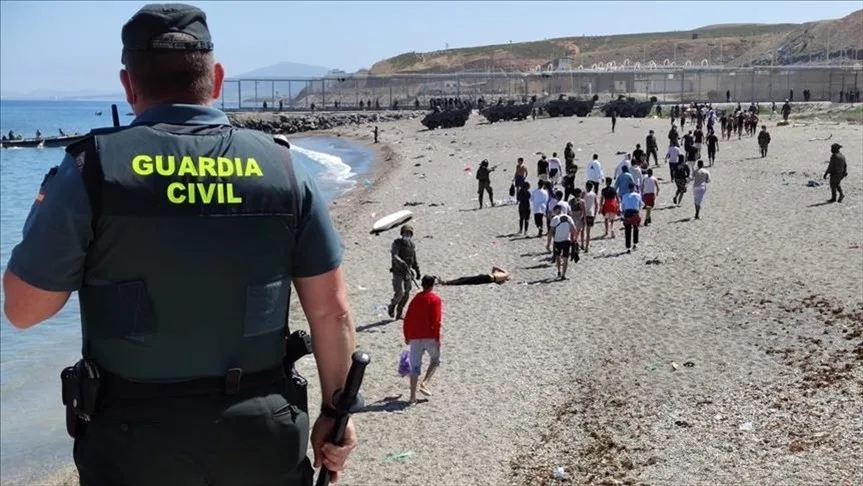
The comments come amid several days of increased migration attempts at the Ceuta border. Women, men, minors, and children have taken part in the crossings, with some attempting to reach the Spanish enclave by swimming or crossing through other routes.
Videos shared online have shown groups of migrants in the water, including people swimming toward Ceuta at night. Other footage showed migrants celebrating after reaching the Spanish territory.
Moroccan diplomatic sources said the recent movements may also be linked to the exploitation of a recent ruling by Spain’s Supreme Court concerning the return procedures for people intercepted at sea.
Read also: Spain Thanks Morocco for Efforts to Tackle Irregular Migration to Ceuta
Morocco stressed that its migration cooperation with Spain remains “exemplary” and is one of the main pillars of the strategic partnership between the two countries.
The cooperation is based on mutual trust, shared responsibility, and close operational coordination, the sources said, describing Morocco as a “reliable and responsible” strategic partner of Spain and the European Union on migration issues.
Morocco has repeatedly presented itself as a key partner in efforts to prevent irregular migration and combat human trafficking networks.
According to the diplomatic sources, Moroccan authorities continue to make significant efforts to prevent irregular departures, dismantle criminal networks, and strengthen cooperation with Spanish and European authorities.
Morocco also reaffirmed its commitment to working closely with Spain to address migration challenges while respecting human dignity, the rule of law, and the shared interests of both countries.
Spain’s Interior Ministry said it would take measures to guarantee the safety of citizens and protect the integrity of the country’s borders. However, the ministry said the government could not declare a national emergency over migration concerns.
Rachid Sbihi, head of the association representing Spain’s Civil Guard officers in Ceuta, described the situation as “absolute chaos.” Thousands of migrants were crossing the border, he said, adding that the border had “totally collapsed.”
Morocco and Spain have reached an agreement to return all migrants who entered the Spanish enclave of Ceuta to Morocco, according to Spanish news agency EFE.