


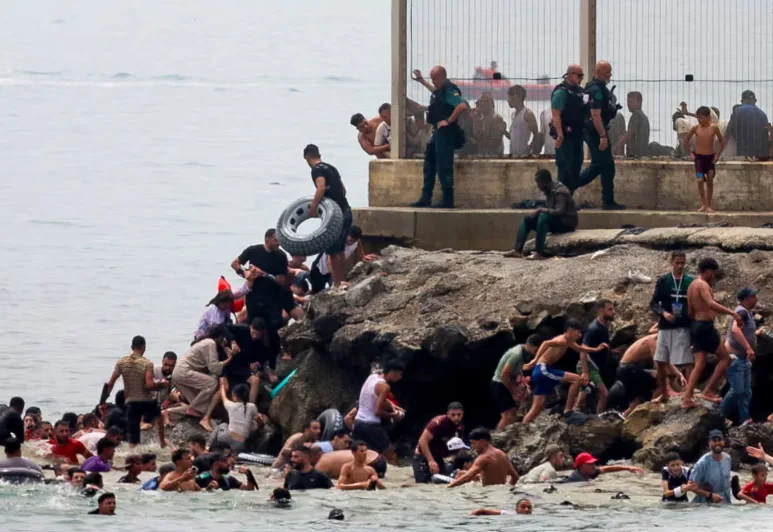
Images of young Moroccans emerging soaking wet onto Spanish soil, with one young girl raising her hand in a victory sign, have again gone viral this week. This coincides with a fresh wave of irregular sea crossings from the northern coastal town of Fnideq toward the Spanish-occupied enclave of Ceuta.
Local news outlets reported that in the early hours of Tuesday, July 29, Moroccan naval units intercepted roughly 300 potential illegal migrants offshore while Spanish Civil Guard units stopped around 100 more, yet more than 50 people still made it through to the beaches of Ceuta. The scenes of relief and celebration captured in such photos and reels have become a recurring feature of this migration route and, even more significantly, a recurring symbol of a much older national debate.
A familiar crossing, a rising toll
The swim from Fnideq’s beaches to Ceuta’s Tarajal shoreline is short in distance but brutal in practice and toll: strong currents, cold water, and no safety equipment beyond, at best, a wetsuit.
Spanish interior ministry figures cited by regional media show irregular arrivals in Ceuta more than doubled in the first half of 2026 compared with the same period last year, and separate reporting has tracked a steady toll of drownings and disappearances, including minors, among those who attempt the crossing.
Security services on both sides of the border have intensified patrols. However, the efforts seem to have fallen short in facing the ever-increasing numbers of dreamy youngsters attempting the route that leads to the European fortress. This alarming situation does not reflect a deficiency in border patrols as much as it points to the disturbing socioeconomic realities and the failing policies that drive some Moroccan youth to risk their lives for a future their own country has failed to offer them.
Researchers and local associations who track these crossings consistently point to the same cluster of push factors: high youth unemployment in the north, a sense that formal channels to Europe are effectively closed off, the pull of family or online networks already established abroad, and, perhaps most corrosively, a belief that opportunity in Morocco is unevenly and unfairly distributed. For many of these young people, reaching Ceuta is less about that specific extremely small enclave than about reaching Europe by whatever door is still open.
The “two-speed Morocco” critique
That last point connects directly to language King Mohammed VI himself has used. In several royal addresses, the monarch has warned against the emergence of “two Moroccos”: one modernizing rapidly around signature infrastructure, tourism, and industrial projects, the other left behind in chronic underdevelopment, with weak schools, scarce jobs, and crumbling public services.
Critics of government performance argue that despite ambitious royal initiatives such as the National Human Development Initiative and repeated calls for a new development model, implementation on the ground in marginalized towns and remote provinces has lagged badly.
They see the recurring images of young swimmers at Ceuta as visceral evidence that the gap the King warned about has not closed, but has widened in many places, leaving young people to conclude that a dangerous nighttime swim offers better odds than waiting at home.
The official rebuttal
Officials and other observers offer a more complicated account. The government points to sustained investment in the north, expanded vocational training programs, and stepped-up coastal surveillance meant to deter crossings and save lives, alongside broader macroeconomic gains over the past decade.
Some analysts also note that migration pressure at Ceuta has been shaped by external factors outside Rabat’s control, including a very recent Spanish Supreme Court ruling restricting summary returns of intercepted migrants, which many believe has itself encouraged more attempts by improving the odds of being allowed to stay once ashore.
Morocco’s authorities frame their naval interceptions and crackdowns on smuggling networks as evidence of active, ongoing effort rather than neglect.
What the footage doesn’t show
Photos and videos like those circulating this week are usually shared without full context, as it is often unclear exactly when, by whom, or under what circumstances they were filmed, and viral reels can mix unrelated clips or repurpose older footage.
However, what is verifiably undeniable is the broader trend: the route from Fnideq to Ceuta remains active, dangerous, and, for now, undeterred by tightened security. Whatever the fate of any single swimmer captured mid-celebration on a phone screen, the underlying question the images raise as to why so many young Moroccans still see the sea as their best option is one both the government and its critics agree deserves an answer.


