


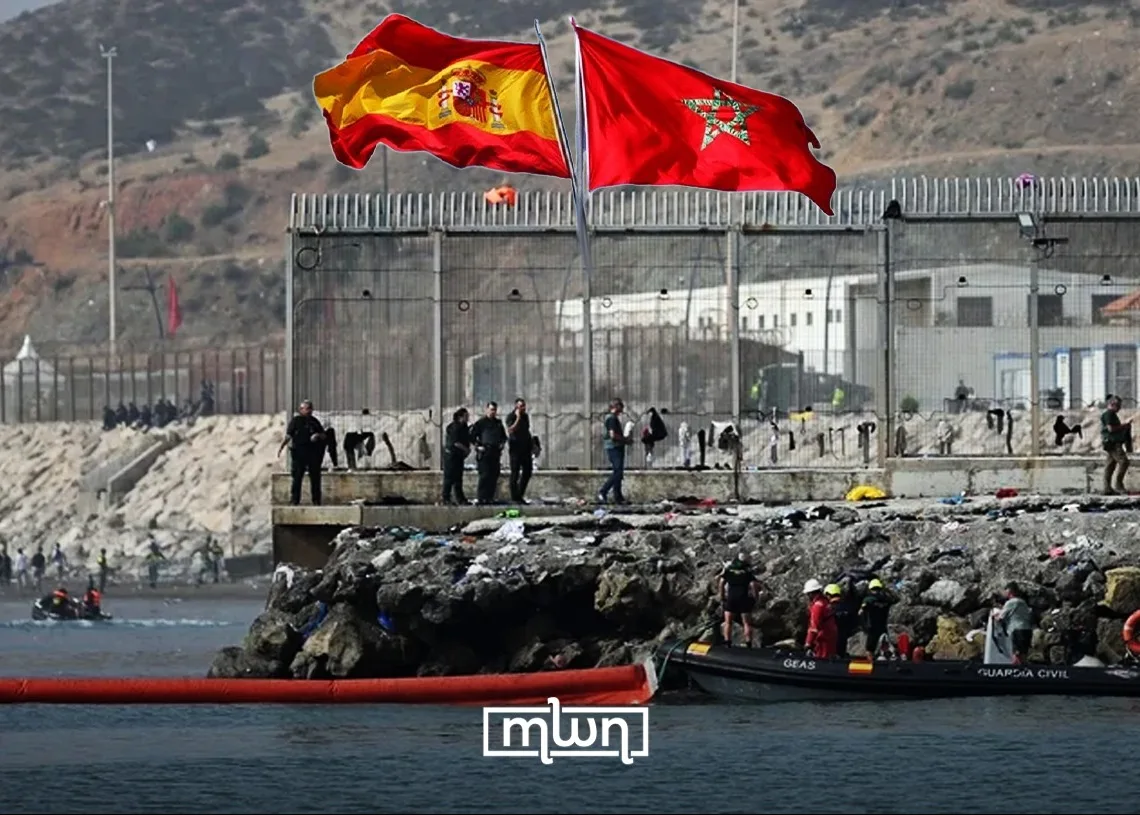
The Financial Times article, “The King who outfoxed Sánchez”, published on August 3, 2026, is elegantly written. It is also methodologically weak. Its central claim—that King Mohammed VI deliberately weaponized migration to outmaneuver Pedro Sánchez—is never demonstrated. It is assumed from the outset and then reinforced through carefully selected context. Throughout the piece, capability, motive and timing are repeatedly treated as if they amounted to proof.
Morocco undoubtedly has leverage over migration. It has disagreements with Spain. Sánchez visited Algeria shortly before the crisis. Donald Trump supports Morocco’s position on Western Sahara. None of these facts, individually or collectively, demonstrates that Rabat orchestrated the events at Ceuta. Yet the article quietly invites the reader to treat them as cumulative evidence. They are not.
The reasoning follows a familiar pattern: Morocco benefited, therefore Morocco probably intended it. But that is not how serious analysis works. Every state possesses motives. Analysis begins where motive ends—with evidence. The article presents no operational evidence, no official instructions, no intelligence findings, no communications and no testimony linking the Moroccan state to the events. Instead, readers are asked to infer intent from geopolitical circumstances. Inference is not proof.
The headline itself reveals the problem. The King Who Outfoxed Pedro Sánchez delivers the verdict before the reader reaches the first paragraph. Good analysis begins with a question and tests competing explanations against the evidence. This article begins with a conclusion and arranges the facts around it.
It also repeatedly turns chronology into causality. Sánchez visits Algeria. Ten days later Ceuta happens. Trump maintains good relations with Morocco. Therefore Morocco feels emboldened. Western Sahara remains disputed. Therefore migration becomes state policy. These may be plausible hypotheses, but chronology alone does not establish causation, and plausibility is not demonstration.
Equally striking is what the article sidelines. It devotes extensive attention to geopolitical motives while giving comparatively little analytical weight to weeks of social-media mobilisation, WhatsApp coordination, human trafficking networks, the Spanish Supreme Court ruling on maritime pushbacks, and the role of rumours and expectations among would-be migrants. These factors are acknowledged but never seriously tested as alternative explanations because they complicate the preferred narrative.
The article’s biggest contradiction appears near the end. It quotes Pedro Sánchez himself acknowledging that Morocco cooperated, rapidly readmitted tens of thousands of its nationals and helped restore control of the border. If Morocco had deliberately launched a Belarus-style hybrid operation, why would it immediately cooperate in dismantling it? That obvious question is never confronted. Instead, the contradiction is simply left unexplored.
Finally, the article relies heavily on expert opinion. Analysts are quoted saying Morocco “wanted”, “decided” or “sought” certain outcomes. Experts are entitled to formulate hypotheses, but hypotheses are not evidence. Quoting respected analysts does not transform speculation into established fact; it merely delegates the speculation to authoritative voices.
The irony is that the article criticises geopolitical manipulation while constructing a geopolitical narrative of its own. Every fact is interpreted through a single explanatory lens: Morocco had leverage, therefore Morocco must have pulled the strings. Serious analysis requires competing hypotheses, methodological restraint and evidence capable of distinguishing between possibility and proof. By blurring those distinctions, the article mistakes a coherent story for a demonstrated explanation. That may make for compelling journalism, but it falls short of rigorous strategic analysis.


