
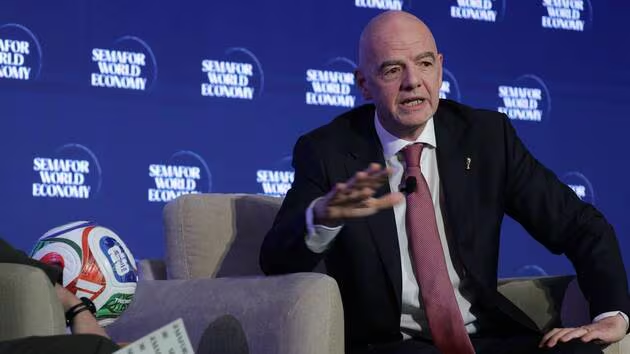
Rabat – FIFA has denied reports claiming that its president, Gianni Infantino, promised Morocco the right to host the 2030 FIFA World Cup final in exchange for political support ahead of the 2027 FIFA presidential election.
The response comes shortly after a report by The Times claimed Infantino had allegedly offered Morocco the tournament’s final in return for the country’s steady support over the years, especially its backing of his bid to secure a fourth term as FIFA chief. A FIFA spokesperson rejected the report, saying: “It is false and misleading to claim the FIFA President has made any promise in relation to hosting the FIFA World Cup 2030 Final. A decision will be made by FIFA in due course.”
The statement is FIFA’s first official response to the allegations and stresses that no decision has yet been taken on which country will host the final of the centenary World Cup.
The steak fight
The 2030 FIFA World Cup will be jointly hosted by Morocco, Spain, and Portugal, while Uruguay, Argentina, and Paraguay will each stage one opening match to mark the tournament’s 100th anniversary.
FIFA has not yet announced where the final will be played. Morocco is meanwhile building the 115,000-seat Hassan II Stadium in Benslimane, which is expected to be one of the leading candidates to host the final. In response, Spain has also sought to present Real Madrid’s Santiago Bernabéu Stadium as the best contender to host the final of the global tournament.
Infantino’s scrutiny
The report by The Times came as Infantino continued to face tense political pressure before the FIFA presidential election scheduled for 2027.
The FIFA president has been seeking public statements of support from national football associations while criticism of his leadership continues to grow.
The allegations follow a series of setbacks for Infantino over the past weeks, where several European football associations have publicly withdrawn their support for his re-election campaign.
The Football Association of Wales was among the first to announce it would no longer back the FIFa’s chief bid for another term. It was later joined by the football associations of Serbia and Sweden, raising further questions over his ability to secure another mandate.
The growing opposition has also been reflected within UEFA, where relations between the European governing body and FIFA have become increasingly tense. UEFA president Aleksander Čeferin has repeatedly disagreed with Infantino over several issues, including FIFA’s expansion of international competitions, the crowded football calendar, and governance within world football.
Growing tension
Tensions escalated after UEFA criticized FIFA for making major decisions without sufficient consultation with continental confederations. European football officials have also expressed concern over what they see as FIFA’s increasing commercial focus and the growing number of international tournaments, arguing that they place additional pressure on players and domestic competitions.
The disagreements have fueled speculation that UEFA could play a key role in shaping the outcome of the 2027 FIFA presidential election by encouraging member associations to support an alternative candidate.
Despite the growing criticism, Infantino continues to enjoy strong backing from many football associations outside Europe, particularly in Africa, Asia, and parts of the Americas.
FIFA has not yet disclosed when it will be decided and which stadium will host the 2030 World Cup final.
The governing body has maintained that the selection process remains ongoing and that no commitments have been made to any of the host nations.
With FIFA now officially rejecting the claims published by The Times, the debate over the venue for the 2030 World Cup final is likely to continue as Morocco, Spain, and Portugal prepare to host arguably the biggest sporting events in football history.