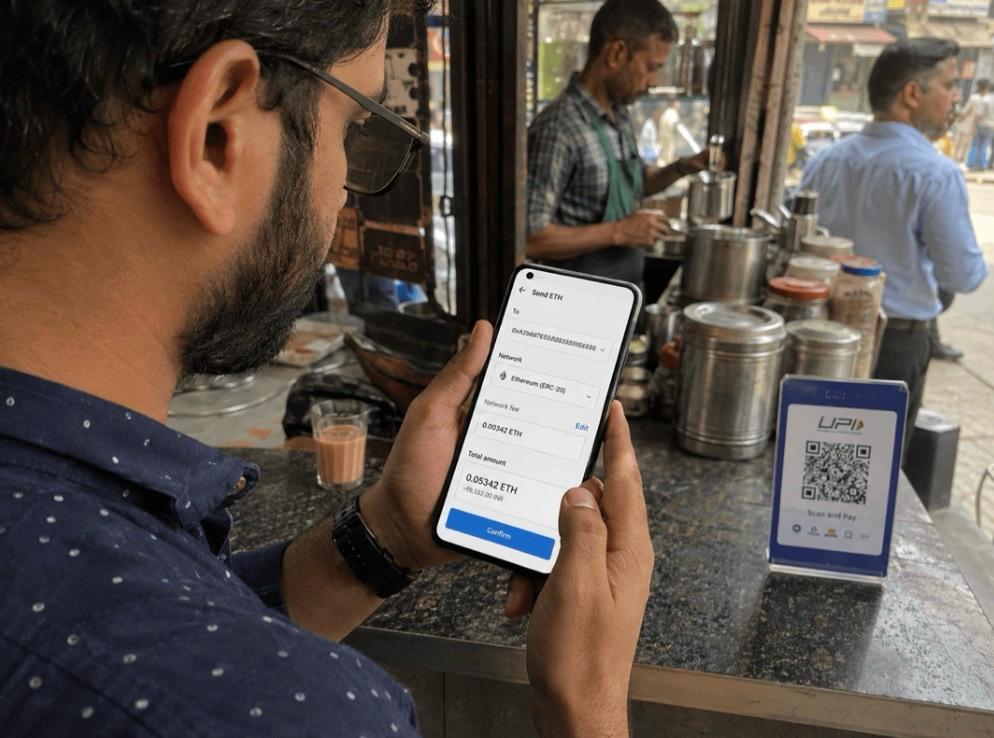
India’s payment habits have changed quickly. QR codes, UPI and mobile banking have made digital transactions routine, reflecting a broader shift toward mobile-first finance seen across emerging digital economies. Cryptocurrency has developed alongside that transition as another way to move value online. India’s leading role in this transformation didn’t emerge in a vacuum. As Morocco World News has reported, India leads the 2025 Global Crypto Adoption Index worldwide, with Morocco itself emerging as a rising player within the MENA region — part of a broader pattern of countries where mobile-first populations are adopting crypto faster than traditional financial infrastructure can keep pace.
Crypto does not work like a bank transfer or card payment. Users may have more control over a transaction, but also more responsibility for the wallet address, network, fees and asset being sent.
Why crypto payments work differently
India’s payment habits have changed quickly. QR codes, UPI and mobile banking have made digital transactions routine, reflecting a broader shift toward mobile-first finance seen across emerging digital economies. Cryptocurrency has developed alongside that transition as another way to move value online.
The scale is notable — Statista estimates crypto user penetration in India at just over 6% in 2026, with the market expected to keep growing as more people move value online through channels other than traditional banking.
Ethereum is more than an investment asset
Ethereum supports smart contracts, which allow applications to execute rules directly on the blockchain. That has led to uses ranging from digital assets and decentralized applications to payments and online services.
The same infrastructure can appear in gaming, marketplaces or ethereum betting, where ETH may be used to transfer value instead of a conventional payment card.
Ethereum is the underlying network. The legitimacy and rules of the service accepting ETH still need to be checked separately.
The real cost includes gas
An Ethereum payment may include a network fee, a service-side charge and conversion costs when moving between crypto and rupees.
Ethereum calls its network fee “gas”. According to Ethereum.org, gas reflects the computational work required for a transaction, and the amount paid changes with network conditions.
A small transfer makes this especially noticeable. If someone sends the equivalent of $20 and pays $3 in network costs, the fee represents 15% of the transfer.
Crypto is moving into online entertainment
Cryptocurrency now appears across gaming platforms, virtual goods, digital marketplaces, esports-related services and subscription-style products.
Users researching these services may also encounter terms such as casino crypto, but the payment risks are largely the same as elsewhere in the digital economy.
A wrong wallet address can send funds to the wrong destination, while an unsupported network can make recovery difficult. A platform may also set its own deposit limits, withdrawal thresholds or conversion rates.
Crypto changes the payment mechanism; it does not remove the need to assess the service receiving the money.
Volatility changes what a payment is worth
Paying with ETH creates another variable: price movement.
If a user deposits a fixed amount of ETH and withdraws it several days later, the value in rupees may be higher or lower even if the same amount of crypto returns.
Stablecoins are designed to reduce that volatility by tracking another asset, commonly the US dollar. They can make prices easier to compare, but they introduce separate issuer, reserve and platform risks.
Wallet security comes before interface design
A polished website says little about whether a crypto transfer is being sent correctly. Before confirming, check the wallet address, network and token.
The receiving service must support the same blockchain selected by the sender. Sending an asset through an unsupported network may leave the user dependent on the recipient’s recovery options.
Private keys and seed phrases should never be sent to customer support or entered into a random verification form.
A quick crypto payment check
Before transferring money, a few checks can prevent expensive mistakes.
| Check | Why it matters | Possible problem |
| Network | Sender and receiver must match | Wrong network |
| Wallet address | Transfers are hard to reverse | Wrong recipient |
| Network fee | Changes with demand | High cost |
| Asset | Service must support it | Unsupported token |
| Conversion rate | Crypto prices fluctuate | Value changes |
| Withdrawal rules | Set by the platform | Unexpected limits |
| Security | Wallet credentials stay private | Seed phrase theft |
The blockchain may process a transaction exactly as instructed even when the instruction itself was wrong.
India’s tax rules still apply
Crypto use also sits within India’s tax framework. Transfers of virtual digital assets are subject to specific reporting and withholding rules, and the Income Tax Department maintains TDS procedures for VDA transfers.
India is not alone in confronting these questions. Across emerging digital economies, regulators and consumers are trying to balance faster access to new financial technologies with taxation, security and consumer protection.
Tax treatment is separate from whether a particular online service is permitted or appropriate to use. Paying with crypto does not remove local legal, tax or identity requirements.
Crypto is a payment tool, not a shortcut
Using cryptocurrency does not remove the need to check fees, withdrawal conditions, identity requirements or the credibility of a platform.
The same applies to wagering-related services. Crypto should still be treated as real money, and rapid transfers or price swings are poor reasons to spend more than planned.
If gambling becomes difficult to control, Gambling Therapy provides confidential support.
What matters before sending
Crypto gives Indian users another route for moving value online, but it also shifts more of the checking process to the individual.
Before sending funds, confirm the network, fee, asset, wallet address and rules of the receiving service. Convenience does not replace verification.