
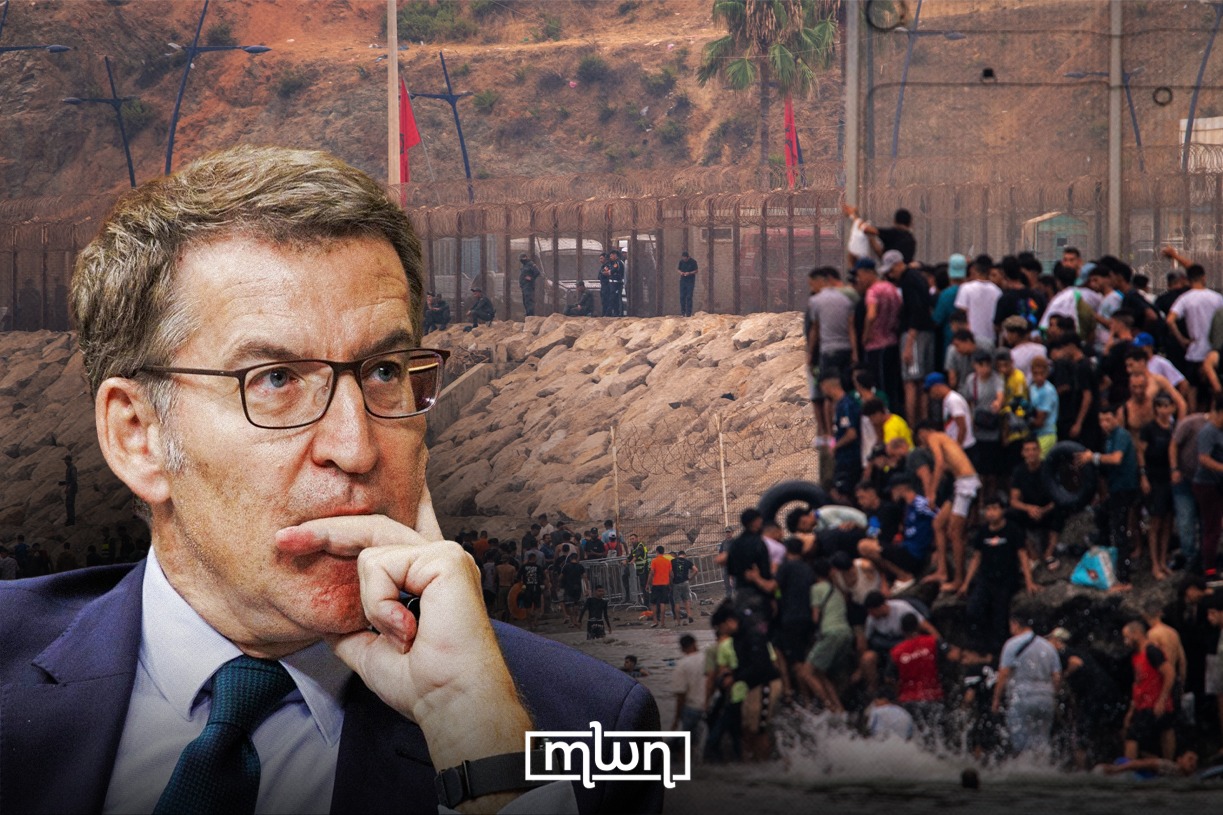
Agadir – Spain’s opposition leader Alberto Núñez Feijóo has seized on the recent migration crisis in Ceuta to intensify his criticism of Prime Minister Pedro Sánchez’s government, while making pointed remarks about Morocco and its handling of the border crisis.
In an interview with Europa Press, the leader of the conservative People’s Party (PP) argued that King Felipe VI should visit Ceuta, saying the monarch “wants to go” to the Spanish enclave and that the government should authorize the trip.
Feijóo framed the proposed visit as a response to what he described as an unprecedented “humanitarian, public health, and public order crisis” in the city following the mass arrival of migrants from Morocco on July 30 and 31.
Feijóo said Felipe VI, as Spain’s head of state, has a constitutional role as “guarantor of the sovereignty and territorial integrity” of the country.
“I am convinced that the King wants to go to Ceuta and will do so when the Spanish Government authorizes the trip,” he said.
His remarks came alongside a broader attack on Sánchez’s handling of the episode, with Feijóo accusing the government of “enormous negligence and incompetence.”
Read also: No, Ceuta and Melilla Have Not Always Been Regarded as Fully Spanish
Feijóo went further by raising the possibility of Moroccan involvement and accusing Rabat of complicity.
“I don’t want to think there has been ‘complicity’ because in that case we would be facing a very serious situation,” he said, adding that while “negligence and incompetence are confirmed,” he did not want to consider “complicity with Morocco” a possibility.
The remarks place Morocco at the center of Feijóo’s political attack even as investigations and competing accounts continue to examine the causes of the unprecedented crossings.
Feijóo comments and the clear hostility against Morocco, and calling the crossing an “invasion” of Ceuta, demonstrated that Morocco once again is taken as a free and raw material for political campaigns.
Morocco has reiterated its continued efforts to cooperate with Spain on multiple levels, including sharing information about the crossings, investigating the circumstances surrounding the incident, and reinforcing border security to prevent similar events from recurring.
However, rather than acknowledging these efforts, some Spanish political figures and media outlets have continued to adopt a critical and hostile tone toward Morocco.
Feijóo’s latest comments add another layer to that political battle, linking the crisis not only to Sánchez’s government but also to Spain’s relationship with Morocco.