Marrakech – Gas flowing from Spain to Morocco has fallen sharply since last week, sliding from its usual level starting August 15 and settling at roughly two-thirds of that rate in the days since.
The Washington-based platform Attaqa first reported the decline, placing normal daily exports at 29 to 31 GWh and the five-day average – spanning August 19 to 23 – at about 21 GWh.
Morocco World News (MWN) independently verified the pattern against Enagás GTS, the operator of Spain’s gas system, using its daily physical-flow readings at the C.I. Tarifa interconnection – the point where the Maghreb-Europe Gas Pipeline crosses the strait toward Morocco. At that connection, a negative reading marks gas leaving the Spanish system, and Tarifa’s technical export ceiling stands at 32 GWh per day.
The daily series shows a decline in stages. Flows measured 30.57 GWh on August 14, then eased to 27.16 on the 15th, 23.88 on the 16th and 23.78 on the 17th. They dropped to 20.70 on the 18th before holding near 20.3 GWh through August 23, at 20.33, 20.23, 20.32, 20.31 and 20.32. The five-day average of about 20.3 GWh marks a fall of close to a third from the August 14 level.
The reasons remain unclear. Spain has not announced any change, and neither Attaqa nor the Enagás data points to a government decision. Attaqa itself notes that it is not known whether the reduction reflects lower Moroccan demand, supply and regasification conditions, or another factor. Shifts in electricity demand, plant availability, and injection scheduling can all move daily flows.
The drop comes amid a mixed import picture for 2026. Over the first seven months of 2026, gas flows from Spain to Morocco fell 13.7% year-on-year, to 4.95 TWh from roughly 5.74 TWh a year earlier.
July, however, brought a recovery, with gas flows to Morocco reaching 992 GWh, the highest monthly level of the year and up from 858 GWh in June. Supplies had fallen to a yearly low of 342 GWh in April, amid disruptions linked to the US-Israeli war with Iran and the resulting turmoil around the Strait of Hormuz, which roiled global gas supply chains.
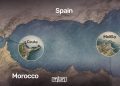
Rabat buys liquefied natural gas (LNG) on international markets – from suppliers that include Russia, the United States and Shell – regasifies it at Spanish terminals, and pipes it home through the Maghreb-Europe line, which now runs in reverse after Algerian transit ended in late 2021.
The timing is notable. In recent days, Spanish outlets have circulated a wave of coverage stressing Morocco’s energy reliance on their country. Several fixed the figures at 25% of Moroccan electricity supply and 100% of its imported gas, both routed through Spanish infrastructure.
Writing on social media in comments carried by El Español, Ignacio Urbasos, of the University of Navarra’s Center for Global Affairs and Strategic Studies, described Morocco’s “asymmetric dependence” on Spain and argued that Spain itself holds a “false perception” of one-directional reliance on Morocco.
Europa Sur put it more bluntly, casting Morocco as needing Spain more for certain energy supplies than Spain needs Morocco. In the same Europa Sur report, Manuel Antonio Fernández-Villacañas, an analyst at EAE Business School, credited the two submarine cables with an “essential role in the stability” of the Moroccan system.
That coverage did not appear in isolation. It followed television reports – since denied by Madrid – that the Spanish government was drawing up a contingency plan against Morocco to deter another migration crisis around occupied Ceuta, reportedly querying grid operator Redeia and Enagás about Rabat’s dependence.
The Ministry for Ecological Transition, the prime minister’s office, and the energy firms all rejected the claim, denying that any such report existed or was planned.
The electricity ties behind those claims are real. Two undersea cables have connected the Spanish and Moroccan grids since the late 1990s, with Spain able to export up to 900 MW and import 600.
In 2025, about 90% of the electricity crossing them ran toward Morocco, a share that has topped 97% over the past twelve months. That flow covers between 8% and 15% of Moroccan demand, rising to 25% once gas for combined-cycle plants is counted. Spain became Morocco’s only working international power link after the Algerian connection closed in 2021.
Rabat is working to reduce that dependence. It is expanding solar and wind capacity, weighing new regasification terminals, and pressing plans for a direct power interconnection with Portugal, revived with Lisbon in July alongside a search for European financing.
Read also: Spain-Morocco Trade Reaches Over €22.757 Billion in 2025