
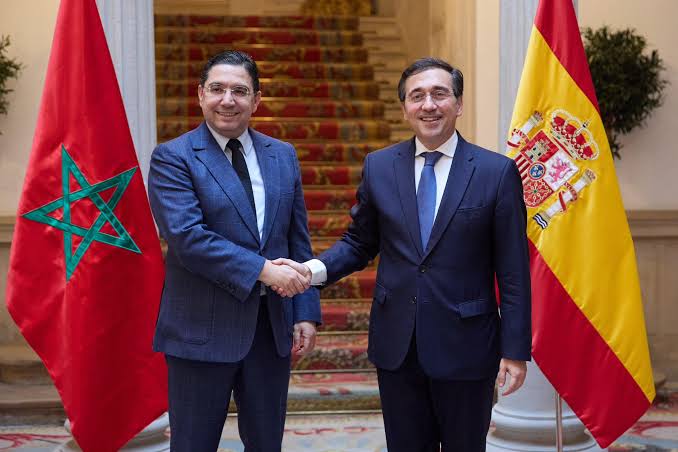
Rabat – Spain’s Foreign Ministry said Wednesday that Foreign Minister José Manuel Albares speaks “daily” with his Moroccan counterpart, Nasser Bourita, as Madrid seeks to maintain diplomatic dialogue on the occupied enclaves of Ceuta and Melilla.
The ministry told Europa Press that Albares maintains regular contact with Bourita and stressed the importance of diplomacy in reaching an “effective and viable” response to the latest statements from Moroccan officials regarding Ceuta and Melilla.
The comments come after several Moroccan ministers have publicly described Ceuta and Melilla as Moroccan cities in recent days, prompting renewed attention in Spain.
Asked whether Albares had held new contacts with Rabat to express the Spanish government’s concern over the statements, Spain’s Foreign Ministry repeated its position that “Ceuta and Melilla are two Spanish cities, the border of Spain and the European Union.”
The ministry also said that both cities are part of Spain’s territorial integrity and sovereignty, which it described as internationally recognized, and are also part of EU territory.
The latest dispute follows comments by Moroccan Justice Minister Abdellatif Ouahbi, who last week referred to Morocco’s “historical and geographical rights” over Ceuta and Melilla and said Spain should engage in dialogue on the issue.
Read also: Ceuta-Melilla: Spain Reacts After Moroccan Minister Revives Issue of ‘Occupied Cities’
His remarks came after Morocco’s Minister of Religious Affairs, Ahmed Toufiq, referred to the “occupied cities” during a Mawlid ceremony King Mohammed VI chaired on Monday.
Toufiq recalled two major Moroccan Islamic scholars from Ceuta, including Qadi Ayyad, author of Al-Shifa, and Abu al-Abbas al-Azafi, author of Al-Durr al-Manzum. He presented them as part of Morocco’s religious and intellectual heritage.
Spain said its rejection of any position that differs from its stance on Ceuta and Melilla has been communicated “formally and clearly” through diplomatic channels.
Spanish Foreign Ministry sources emphasized the importance of keeping direct communication with Rabat open, Europa Press reported. They said Albares speaks daily with Bourita, whom the Spanish minister has often described as a “friend.”
The ministry argued that diplomacy remains particularly important in the current situation, saying that an effective response requires continued dialogue.
Ceuta’s migration pressure
The latest diplomatic tension comes as Ceuta is also dealing with continued migration pressure after the massive crossing in late July.
Moroccan authorities have collaborated with Spanish authorities and carried out operations to prevent migrants from reaching Ceuta. Meanwhile, Spanish authorities have reinforced border controls.
Madrid relies heavily on cooperation with Rabat to control irregular migration toward Ceuta and across the Strait of Gibraltar.
Spain and Morocco have nevertheless maintained close cooperation in recent years, particularly on migration, security and trade. Their relationship improved significantly after Madrid endorsed Morocco’s Autonomy Plan for Western Sahara in 2022.
The renewed debate over Ceuta and Melilla now presents another test for the bilateral relationship, with Madrid insisting on its sovereignty claims while continuing to rely on diplomatic communication with Rabat.