
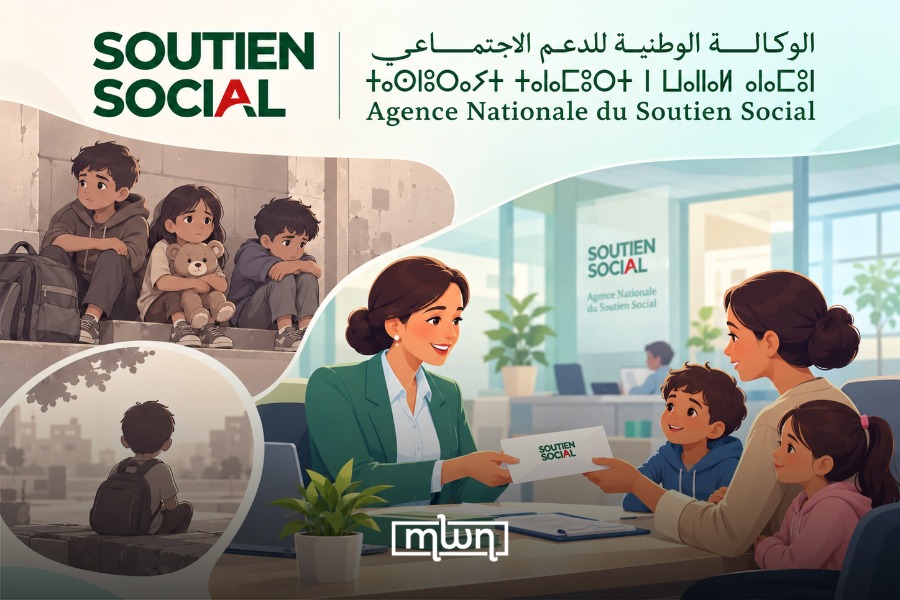
Casablanca – Morocco’s National Agency for Social Support (ANSS) has outlined the eligibility criteria for a special assistance scheme for orphaned and abandoned children living in approved social protection institutions, providing each eligible child with MAD 500 a month under the Direct Social Assistance (ADS) system.
The scheme stems from Article 16 of Law 58.23 and took shape through Decree 2.25.1064, which the Government Council adopted on December 23, 2025. The decree entered into force three months after its publication in the Official Gazette.
Unlike regular household-based social assistance, the payment for children in institutions does not go to a parent or institution for immediate spending. ANSS deposits the monthly amount into an account opened in the child’s name with the Deposit and Management Fund (CDG).
CDG manages the account under the legal rules governing minors’ assets, and the beneficiary cannot withdraw or otherwise dispose of the funds before reaching legal adulthood.
How the 500 MAD support works
The scheme covers orphaned and abandoned children placed in social protection institutions authorized under Moroccan law. For an orphaned child, the decree requires Moroccan nationality, registration in the National Population Register, and the absence of coverage under certain family allowance categories.
A child receiving a scholarship can still qualify if the scholarship’s annual value falls below the annual amount of the special aid, with ANSS paying the difference.
For an abandoned child, the same conditions apply, along with a final court judgment declaring the child abandoned.
Directors of the social protection institutions handle applications through a dedicated ANSS electronic platform. They submit the files, track applications, and can file a grievance when ANSS rejects a request. The director has 30 days to submit a grievance after receiving a rejection, while ANSS has up to 30 days to decide on it. Institutions must also report changes affecting a beneficiary’s information within 30 days.
ANSS checks eligibility through electronic data exchanges with public or private bodies holding information on children living in social protection institutions. Once an application for the special aid is accepted, the monthly allowance and complementary support previously linked to the child through the general system stop, preventing overlapping benefits.
What happens to the money
The child can claim the full amount accumulated in the account upon reaching legal adulthood. The decree sets a minimum amount of MAD 10,000, regardless of how long the beneficiary stayed in the institution.
When a child leaves the institution permanently, the beneficiary or legal representative receives information about the account and the procedures needed to manage the funds. The decree does not provide for automatic withdrawal at departure before adulthood.
ANSS manages the assistance with the involvement of the Interior Ministry, the Economy and Finance Ministry, and the Ministry of Solidarity, Social Integration and Family.
The agency also says its digital platform handles applications and appeals, while institution directors serve as the main administrative link with beneficiaries.
ANSS has published a simulation showing that if the MAD 500 payment continues for 15 years, the capital accumulated by the child’s majority can exceed MAD 100,000.
The account also earns financial returns through its management by CDG. Without those returns, 15 years of monthly contributions would total MAD 90,000.
The special scheme forms part of the wider rollout of Morocco’s Direct Social Assistance system and focuses specifically on children growing up without family support in approved institutions.
ANSS’s 2025 annual report says its operational work includes enrolling eligible children and institution directors in the National Population Register and deploying the digital tools needed to process and monitor applications.