
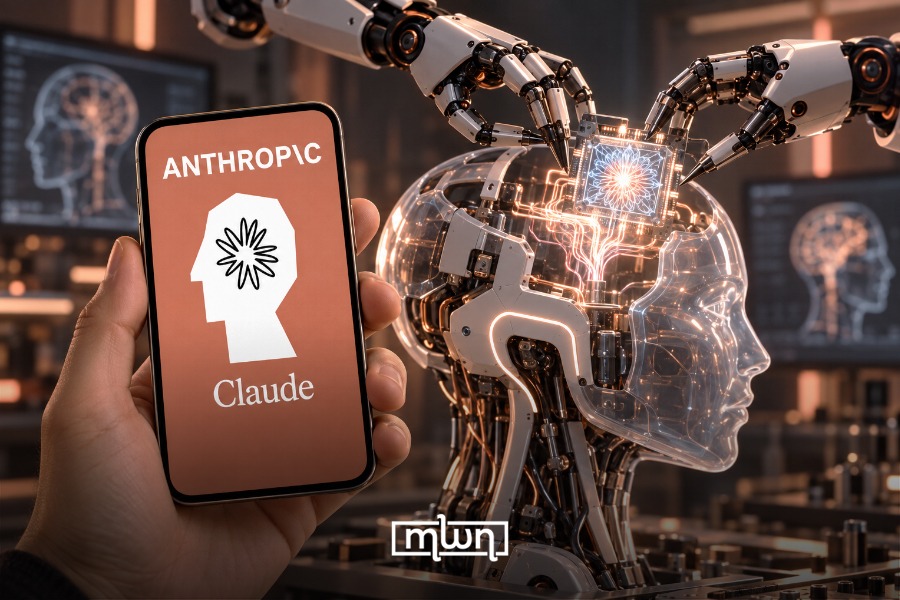
Casablanca – Anthropic said Thursday that Claude now accounts for 26% of the company’s AI research and development work, based on its measurements from August. The figure stood at less than 1% in February.
The company said more than 90% of its AI R&D work now involves AI in at least a collaborative role. Claude does not operate fully autonomously on any measured part of the work, Anthropic explained, with humans still supervising its work.
The disclosure came alongside Anthropic’s broader discussion of “recursive self-improvement,” a point where an AI system could independently design and develop a more capable successor.
Anthropic assured it has not reached that point. However, the company said its current progress shows how AI already accelerates the development of other AI systems. It also reported that more than 80% of the code merged into its codebase in May was written by Claude.
Anthropic said engineers now merge about eight times as much code per day as they did in 2024, with Claude writing much of that code while engineers direct and review the work.
The latest announcement follows a turbulent week for the industry.
On September 9, former Anthropic researcher Jacob Coxon announced his resignation after working on pretraining research at both OpenAI and Anthropic. Coxon said people building AI “earnestly believe” the technology could kill everyone by the end of the decade. He accused the companies of racing toward self-improving superintelligence without adequate safeguards.
Another Anthropic researcher, Evan Hubinger, also said his team believes AI could kill all humans. Hubinger put the likelihood above 10% within the next decade and said Anthropic does not yet have a solution for aligning superintelligent AI.
Read also: OpenAI Rules Out 2026 IPO, Sam Altman Backs AI Safety Slowdown
The warnings quickly reached Anthropic CEO Dario Amodei, who called on AI companies to slow the pace of capability development on September 12.
Amodei proposed independent safety evaluators, cooperation among frontier AI companies and international coordination. He said the industry should create enough time for safety and alignment work to keep pace with increasingly capable systems.
OpenAI CEO Sam Altman and xAI CEO Elon Musk both publicly supported Amodei’s call. Their support brought together three major AI companies that have often competed directly with one another.
OpenAI also addressed the issue this month. The company said fully autonomous recursive self-improvement does not happen today and that developers should not pursue it until they can do so safely. OpenAI said AI already accelerates parts of the research used to build and align newer models.
Anthropic’s latest figures now put a number on that shift. Claude is still working under human supervision, but the company says AI already performs a growing share of the work involved in developing the next generation of AI.