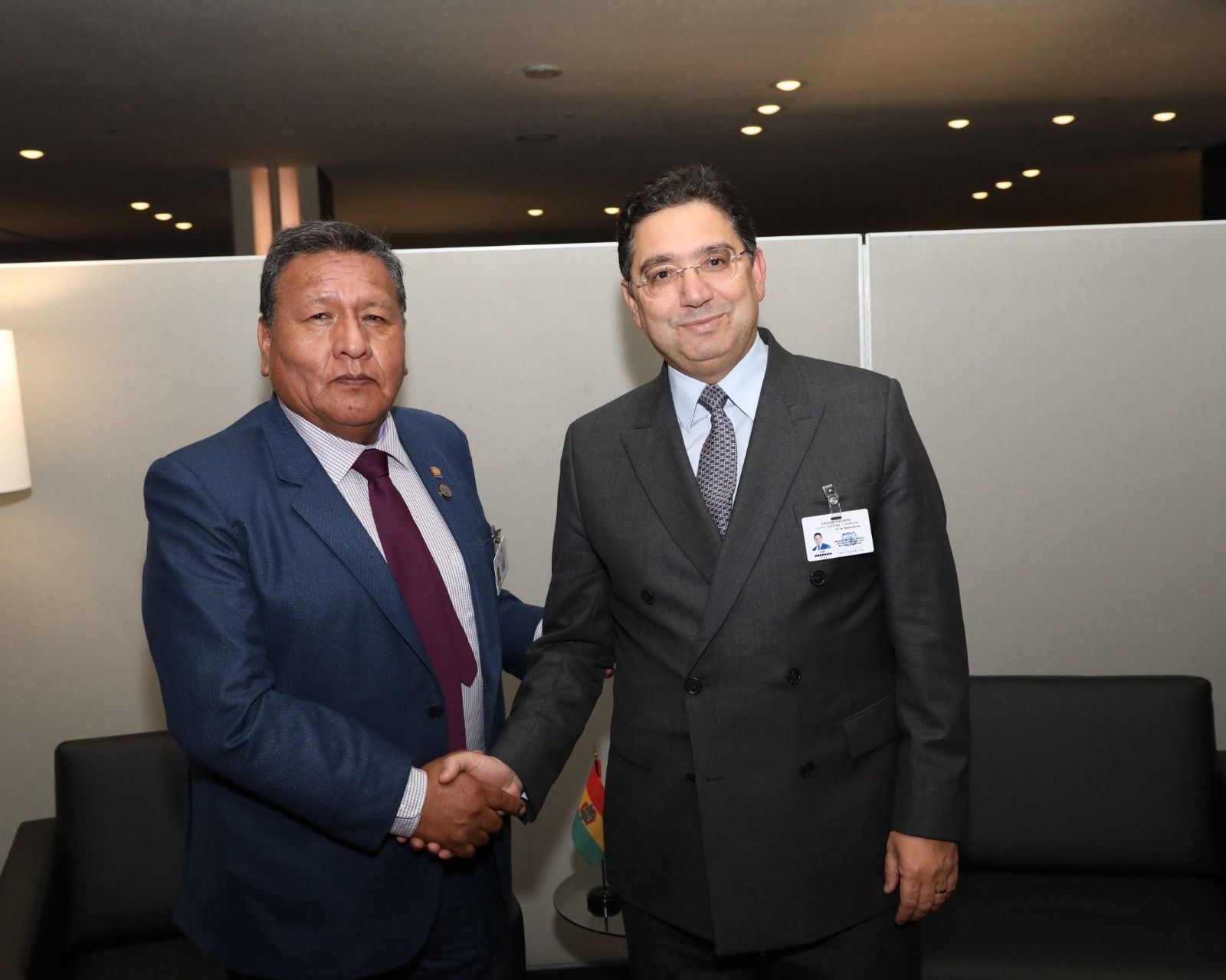
Marrakech – Bolivia has committed to opening a diplomatic representation in Rabat and a commercial office in Dakhla, cementing a decisive turn in its posture on Morocco’s Western Sahara.
The pledge came in a joint communiqué signed Wednesday in New York by Foreign Minister Nasser Bourita and his Bolivian counterpart, Héctor Francisco Huanca Gutiérrez, on the sidelines of the 81st session of the UN General Assembly (UNGA).
The Dakhla office, according to the two ministers, will serve as an access platform to African markets for Bolivian products, anchoring La Paz’s commercial ambitions in Morocco’s southern provinces.
In the same text, Bolivia took note of Morocco’s 2007 Autonomy Plan and judged that it can constitute a path toward a just, lasting, and mutually acceptable political solution. Both governments reaffirmed their attachment to sovereignty, territorial integrity, and non-interference in the internal affairs of states.
The two countries agreed to intensify high-level dialogue and to build a renewed institutional framework for their ties. They will convene the first session of the Bilateral Political Consultations Mechanism, a permanent politico-technical body they established in 1999 but never activated.
Bourita and Huanca Gutiérrez also signed a visa-waiver accord for holders of diplomatic, official, service, and special passports, along with a memorandum of understanding between their diplomatic academies.
Wednesday’s announcement caps a realignment that began in February. After a phone call between Bourita and then-foreign minister Fernando Aramayo, La Paz declared it had conducted a sovereign review of its foreign policy, acting in full conformity with Security Council resolution 2797 (2025).
Bolivia suspended its recognition of the self-proclaimed “Sahrawi Arab Democratic Republic,” severed all official contact with the separatist entity, and pointed out that it is not recognized as a member state of the United Nations. The move, La Paz added, reflected its will to advance a realistic, pragmatic, and durable political solution based on compromise.
That rupture flowed directly from Bolivia’s internal upheaval. The centrist Rodrigo Paz took office on November 8, 2025, ending nearly two decades of leftist rule under Evo Morales and Luis Arce.
Their Movement toward Socialism (MAS) had tethered La Paz to the Polisario and to Algeria’s theses, save for a brief suspension in 2019. A more pragmatic, pro-Western executive dismantled that inheritance.
Bolivia’s shift belongs to a wider Latin American reckoning. Bolivia’s shift belongs to a wider Latin American reckoning. Across the region, many states once recognized the separatist entity, a Cold War reflex that cast Polisario as a liberation movement and its recognition as an Algerian ideological export.
That consensus has crumbled. Recognitions have steadily fallen away since the late 1990s, and Washington’s December 2020 acknowledgment of Moroccan sovereignty triggered a fresh cascade across Europe and beyond.
The tempo has only quickened through 2026. Two months after Bolivia’s move, Honduras suspended its own recognition of the entity in April, invoking non-interference and respect for the internal affairs of states. In August, Colombia went further, withdrawing recognition outright and endorsing Moroccan sovereignty over the Sahara – a rupture that toppled one of Polisario’s last strongholds in Latin America and reversed the pro-separatist line held under Gustavo Petro.
Resolution 2797 now frames the Autonomy Plan as the basis for a settlement, rendering the region’s surviving recognitions increasingly obsolete. Diehards remain in Cuba and Venezuela, though Caracas has lost weight since the January capture of Nicolás Maduro.
Bolivia’s pivot, followed in quick succession by Tegucigalpa and Bogotá, confirms that the separatist camp’s Latin American foothold, built over decades, is crumbling stone by stone, with its collapse now firmly in sight.
Read also: After Suspending Ties With ‘SADR,’ Bolivia Eyes Embassy in Morocco