
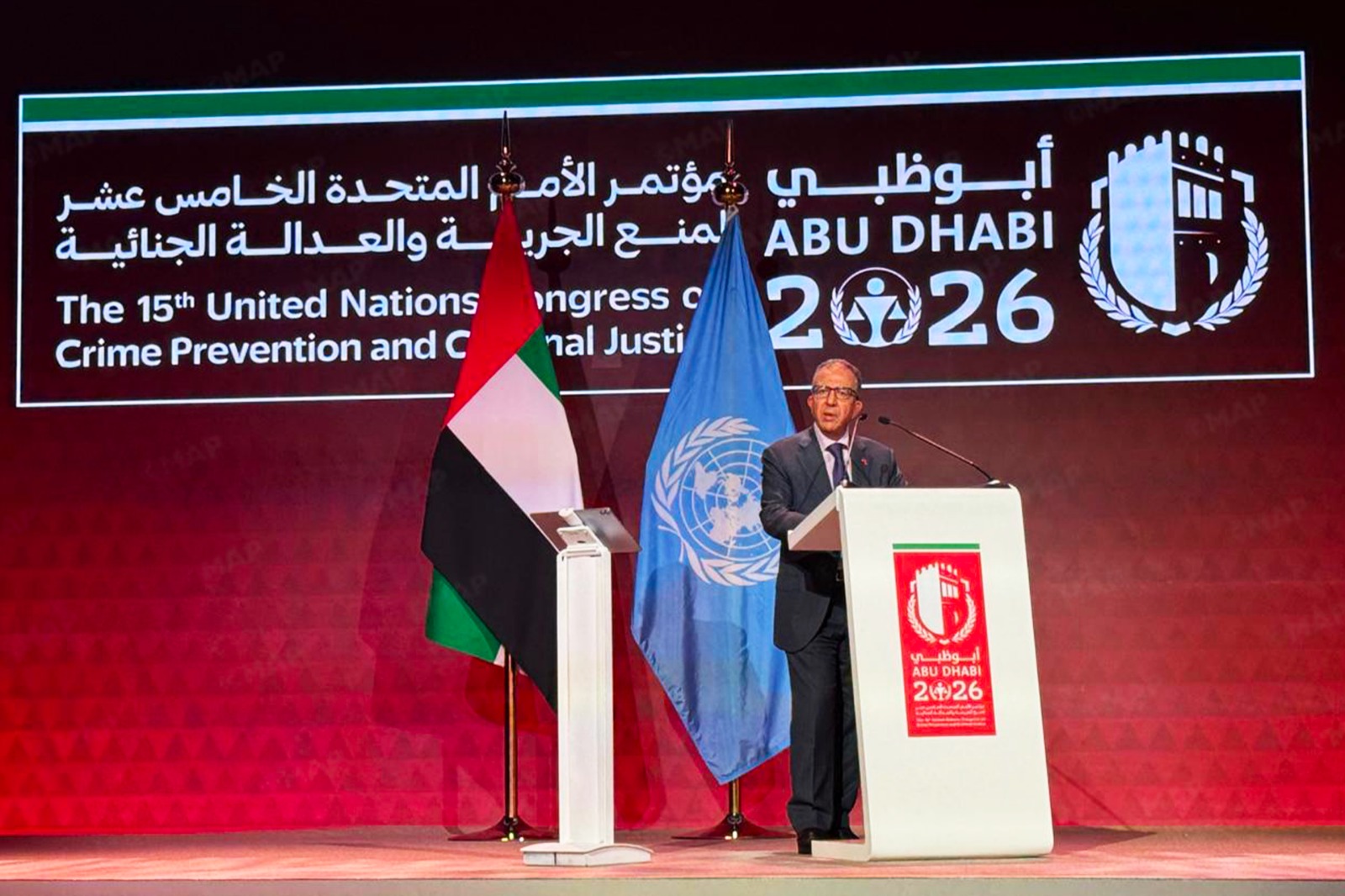
Casablanca – Morocco secured the vice presidency of the 15th United Nations Congress on Crime Prevention and Criminal Justice, with Ambassador Azzeddine Farhane taking the position on behalf of the African Group at the opening of the congress in Abu Dhabi today.
The congress runs through October 1 at the Abu Dhabi National Exhibition Centre and brings together governments, experts, academics and civil society representatives to discuss crime prevention, criminal justice and the rule of law.
The other members of the congress bureau, apart from the president, were also elected during the opening session.
The event follows the theme “Accelerating crime prevention, criminal justice and the rule of law, protecting people and planet and achieving the 2030 Agenda for Sustainable Development in the digital age.” The UAE said the congress brings together thousands of participants from governments, international organizations, civil society, academia and other sectors.
Speaking during the high-level segment, Farhane said Morocco had pursued legislative and institutional reforms that put human dignity at the center of its criminal policy.
He pointed to measures including stronger protections for children and women and girls who face violence, efforts to combat human trafficking and the entry into force of Morocco’s alternative sentencing law in 2025.
He also cited the new Code of Criminal Procedure, which he said strengthened fair trial guarantees, victims’ rights, restorative justice and the humanization of sentence enforcement. Morocco is also working on projects that include creating a national DNA database and a mechanism to manage seized and confiscated assets.
Morocco calls for stronger international coordination
Farhane said Morocco’s election as vice president reflected the country’s continued engagement with Africa and its view that security, justice and sustainable development remain interconnected.
“The question is no longer only how to fight crime, but also what kind of justice we want to build for the world of tomorrow,” he said.
He argued that justice should not focus only on punishment, but also on preventing crime, protecting victims, repairing harm, supporting reintegration and preventing recidivism.
On violent extremism, Farhane pointed to Morocco’s “Moussalaha” program, which has reached its 20th edition and benefited more than 436 people since its launch in 2017.
Morocco also called for stronger coordination among UN bodies working to combat transnational organized crime and terrorism. Farhane said the country wants stronger links between existing mechanisms through the exchange of expertise, capacity building, technical assistance, judicial cooperation and early action against emerging threats.
“We must move from multiple mechanisms to their complementarity, from occasional coordination to more regular cooperation, and from treating each threat in isolation to understanding the links between them,” he said.
Farhane also said Morocco signed the UN Convention against Cybercrime in October 2025 and continues to modernize its systems for digital evidence and digital criminal procedures.
He added that Morocco has concluded more than 130 judicial cooperation agreements with countries around the world, with additional agreements under negotiation.
Morocco may also seek to host a future edition of the UN crime congress, according to Farhane. He said such a move would help bring the forum closer to the realities and priorities of Africa.
The congress brings together more than 5,100 participants, including more than 40 justice ministers and 93 speakers representing states and regional groups, according to the Moroccan account of the event. The UAE separately said the opening drew around 5,000 participants from more than 97 countries.