
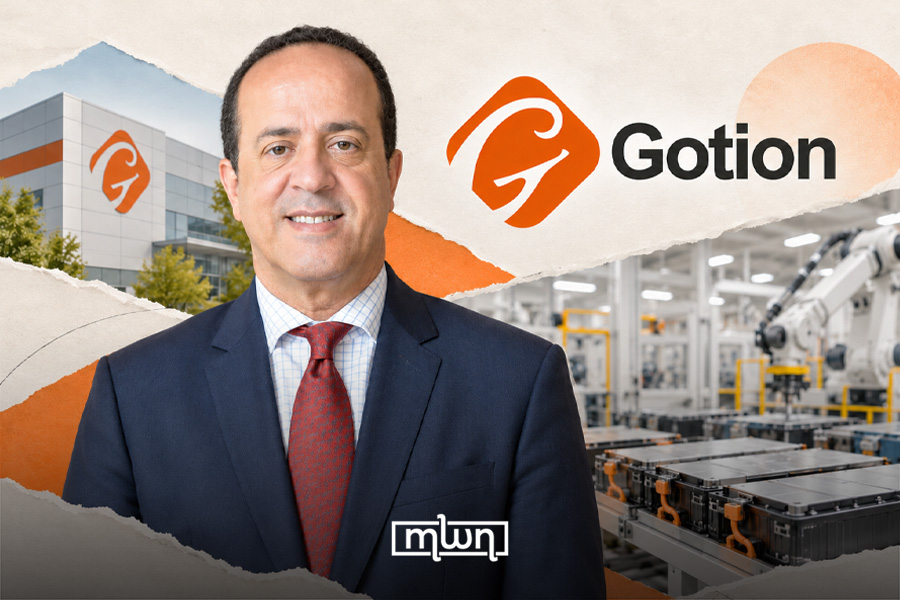
Marrakech – Gotion Power Morocco (GPM) will begin commissioning and starting up the production equipment at its battery gigafactory in Kenitra during the week of October 20. The subsidiary of Chinese group Gotion High-Tech announced the schedule in a statement, describing the plant as the first of its kind in Africa and the Middle East.
The startup opens the way to industrial production of lithium iron phosphate (LFP) cells, built from lithium, iron, and phosphate, within a first phase of 20 GWh. GPM president Khalid Qalam had earlier revealed that the first cell line would begin in October, with a second line following in November. He also pointed to a start of sales for assembled batteries by the end of the year.
The site sits inside the Atlantic Free Zone of Kenitra and drew MAD 13 billion ($1.3 billion) in investment for its first phase. It will produce cells and batteries for the automotive and energy storage sectors, serving the Moroccan market and the African continent, along with Europe, the Middle East, and the United States.
Construction began in September 2025 after earthworks, and the buildings and infrastructure of the cell plant were completed in 13 months.
According to GPM, that timeline ranks the project among the fastest industrial builds of its kind internationally. The work relied on a logistics operation of a scale new to Moroccan industry, with several thousand containers shipped from China to move production lines and high-technology equipment to Kenitra, backed by port and customs authorities.
“The startup of the equipment on October 20 is only a first step in the rollout of a unique and promising project, meant to durably structure Morocco’s battery industrial ecosystem,” Qalam noted. He tied the plant to “the kingdom’s sovereignty in the field of green energy.”
GPM has so far recruited more than 400 Moroccan employees, among them engineers, technicians, operators, and support staff. Most trained in China at Gotion High-Tech production sites, then worked alongside group experts in Kenitra. At full development, the gigafactory will create more than 2,300 direct jobs.
The first phase targets 20 GWh of cells, battery packs, and energy storage systems, plus 100,000 tons of cathode materials.
The project advanced further on September 28, when Volkswagen, a Gotion High-Tech shareholder, joined the Chinese group in announcing a Kenitra joint venture for cathode materials.
That venture forms part of a broader Gotion-Volkswagen plan to invest about €3.22 billion ($3.67 billion) across battery and materials projects in Europe and North Africa, split between roughly €1.6 billion from Gotion and €1.62 billion from PowerCo, Volkswagen’s battery unit.
The companies plan joint ventures in Spain, Slovakia, and Morocco, with the Kenitra cathode project set at about €480 million and 100,000 metric tons a year, prioritizing supplies to the two European battery plants. Gotion will control the Moroccan venture with a 51% stake, and PowerCo will hold 49%.
Financing arrived earlier in the year. On July 24, the African Development Bank (AfDB) approved a €100 million loan to GPM for the integrated LFP gigafactory, with plans to mobilize up to €141 million more from partners.
The bank described a first phase of 10 GWh scaling toward 100 GWh, and projected more than 600 direct jobs and a 70% local industrial integration rate.
Gotion ranked fifth among global EV battery makers over the first seven months of 2026, with installations of 34.0 GWh, up 44.2% from a year earlier.