Casablanca – The 17th Salon du Cheval d’El Jadida celebrates Morocco’s equestrian traditions while also recognizing the artisans whose skill and dedication keep the country’s traditional crafts alive.
Maison de l’Artisan recognized these crafts through awards for the best traditional saddle, traditional rifle, and textile.
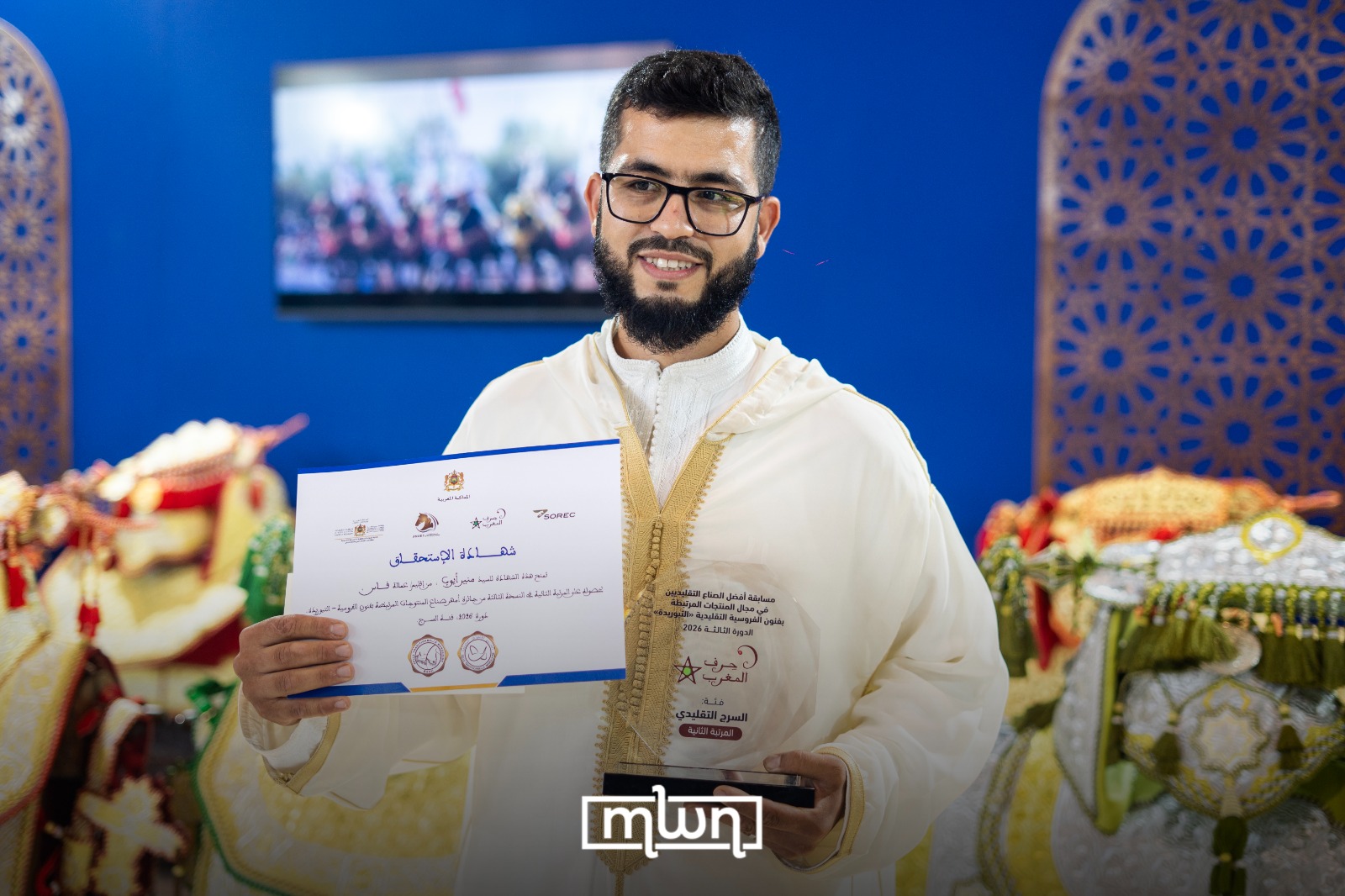
The awards went to Ahmed El Moufidi and Ayoub Mounir for saddle-making, Yassine Errahili and Hassan Amzil for traditional rifle-making, and Nabiha Hamami and Amina Saissi Hassani for textiles.
Celebrating the artisans behind these pieces gives long-standing skills the recognition they deserve and helps keep them alive for future generations.
Recognizing the skill behind the craft
Behind every traditional saddle, rifle, and embroidered textile lies a process that demands patience, precision, and years of experience. Maison de l’Artisan’s competition recognizes this work while encouraging artisans to preserve Moroccan craftsmanship and continue developing their skills.
Speaking to Morocco World News (MWN), Tarik Sadik, director general of Maison de l’Artisan, explained that the institution’s participation in the Salon du Cheval offers an opportunity to introduce visitors to the diversity of Moroccan handicrafts, particularly those connected to horses and Tbourida.
The competition also forms part of a broader effort to support artisans beyond the event itself. Sadik explained that the institution accompanies craftspeople throughout the year through training sessions, assessments, and a labeling program that recognizes products meeting established quality standards.
“This competition […] allows us to support a number of artisans throughout the year through a program that includes training sessions and assessments before they receive their labels,” Sadik told Morocco World News (MWN).
For him, the competition also plays an important role in encouraging younger generations to take an interest in traditional crafts.
“These competitions create momentum in the sector, especially among young people, and encourage them to keep innovating so we can pass these crafts from one generation to the next,” he said.
This year, partners in the traditional crafts sector awarded 171 labels to artisans. The competition then selected six winners across the three categories, recognizing the products that stood out for their quality and craftsmanship.
How the jury selected the winners
The selection process followed two stages. First, the relevant traditional crafts directorate and Maison de l’Artisan reviewed applicants’ administrative files to ensure they had submitted the required documents.
These included a signed application form, proof of registration in the National Register of Traditional Crafts or an artisan identification card, and the relevant product quality certification.
A specialized jury then assessed only complete applications using an established set of criteria. The judges considered the quality of the raw materials, the preservation of Moroccan identity and heritage, the product’s aesthetic appeal and functionality, the originality of the artisan’s creative approach, and compliance with the required standards.
Together, these criteria recognize more than a finished product. They also value the choices, techniques, and cultural knowledge that shape each piece.
Inside the craft of traditional saddle-making
In an interview with Morocco World News (MWN), Ayoub Mounir, a traditional saddle maker from Fez who secured second place in the saddle-making competition, offered insight into the time, precision, and teamwork required to produce a traditional Moroccan saddle.
Mounir explained that crafting a saddle involves several artisans, each responsible for a specific stage of the process. Completing a saddle independently can take five to six months, making coordination and the careful division of tasks essential to achieving the desired result.
Despite placing second this year, Mounir remains ambitious about the competition, expressing his hope of winning first place in the coming editions. His account offers a glimpse into the dedication behind a traditional craft that continues to hold a place in Morocco’s cultural heritage.