
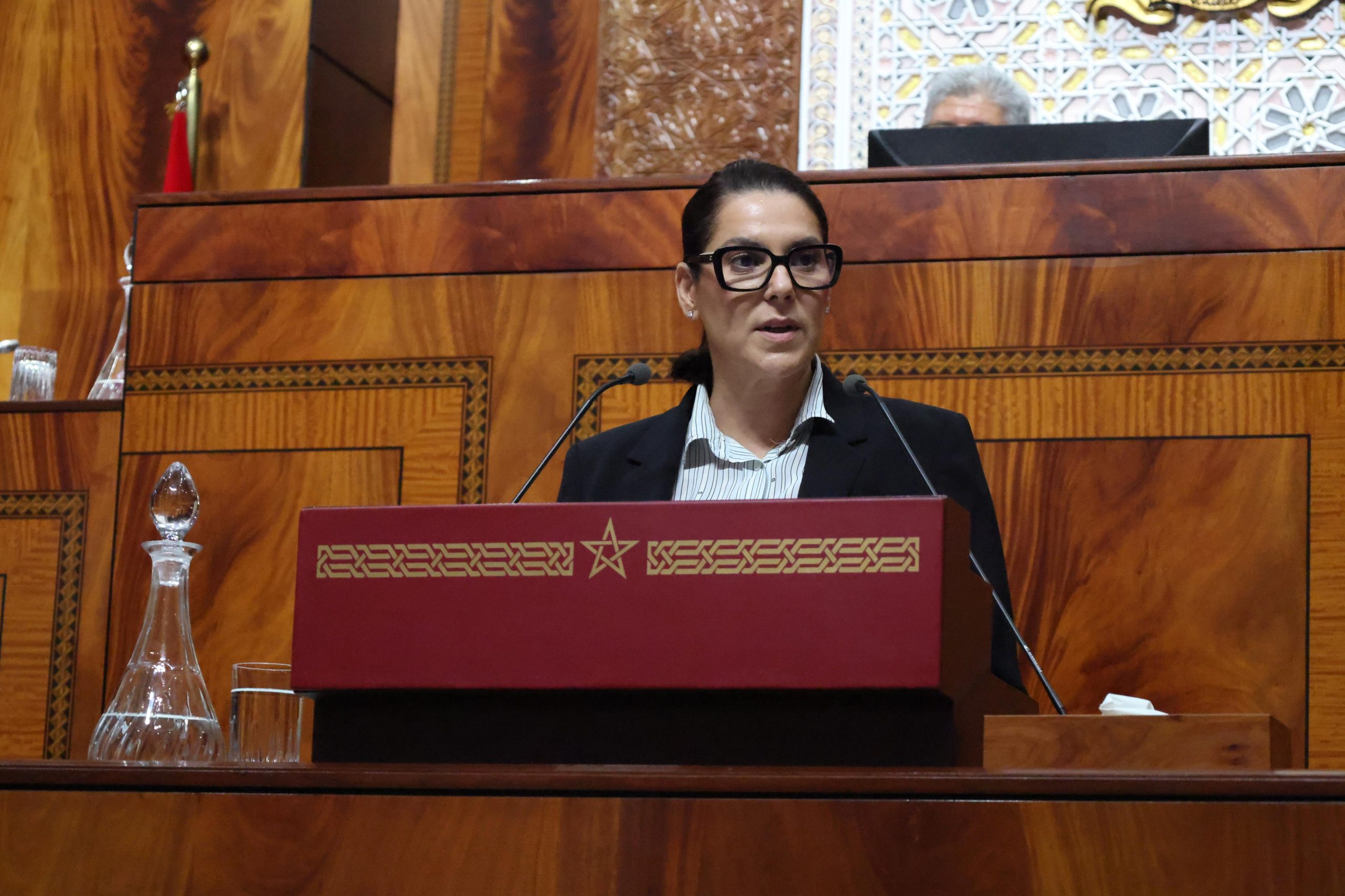
Marrakech – Head of Government Fatima Ezzahra El Mansouri presented her cabinet’s program for the 2026-2031 legislature before both chambers of parliament on Monday, placing a package of social spending commitments at its center. The most direct of these is a pledge to double the minimum direct social assistance from MAD 500 ($50) to MAD 1,000 ($100) per month by the end of the mandate.
El Mansouri framed the social measures as a response to the cost of living. She told lawmakers the government would confront rising prices with a strategy to “strengthen household income,” “control the causes of price increases,” “expand social protection,” and “guarantee good public services.” Each of those lines translates into a specific commitment in the text she laid out.
On the direct aid itself, the government will re-target the support on the basis of actual household income and turn it “into a lever for integration,” while widening access to unemployment compensation. The income-based approach replaces the socio-economic index of the Unified Social Registry (RSU) currently used to select beneficiaries.
The measure revives a proposal carried by the Authenticity and Modernity Party (PAM), which finished first in the September 23 legislative elections and had called for reforming the eligibility criteria for direct aid.
The increase builds on an already sizable commitment. According to the National Agency for Social Support (ANSS), lump-sum aid payments between December 2023 and December 2025 totaled MAD 18.2 billion ($1.82 billion) and went to nearly 1.47 million households.
That figure covers only households receiving the MAD 500 ($50) monthly lump sum, not other categories of direct aid. The agency’s 2025 annual report projects an envelope of MAD 9 billion ($900 million) for lump-sum aid alone in 2026.
Alongside the cash transfer, El Mansouri announced a new form of relief tied to utility bills. The government will introduce “automatic social compensation equal to the monthly electricity bill that does not exceed MAD 100 ($10)” for the main residence of eligible households, with “no paper request or administrative travel.”
Food prices form the other half of the purchasing-power agenda. To return them to reasonable levels, the program sets out supply plans for strategic products and a push to shorten the distance between producer and consumer through regional companies and professional aggregation and marketing platforms operating under a unified set of terms.
El Mansouri also committed to reforming the meat and fish distribution channels and to governing the relationship between exports and domestic market supply through “announced and stable rules.”
For wage earners, the government will launch a gradual reform of the income tax aimed at raising net pay and encouraging declared employment.
Pensions, health, and housing anchor the social state
Health coverage occupies a large part of the social program. El Mansouri pledged to accelerate the royal social protection project toward “comprehensive and effective” health coverage and to secure the financial sustainability of compulsory health insurance.
She described the next phase as a move from universalizing the right to coverage to guaranteeing “effective, fair and continuous access to quality health services.”
To that end, the program covers territorial gaps in health provision, institutionalizes the treatment pathway, reforms patient reception and emergency departments, generalizes the urgent medical assistance service, and establishes a unified national health information system, alongside added support for the public health workforce.
Pensions carry some of the program’s most specific figures. The government will open a comprehensive reform of the retirement systems in consultation with social and economic partners.
El Mansouri cautioned that reform “cannot be reduced to adjusting the retirement age or revising contribution rates and the method of calculating pensions,” defining the real challenge as rebuilding a coherent system that extends protection to those without any pension and preserves acquired rights through a just transition.
That reform ties to a concrete commitment on amounts: a gradual increase of the minimum for main pensions to MAD 3,000 ($300) per month across the different systems. The government will also raise the widow’s pension to 100% of the main pension due to the deceased spouse, up from 50% today, while preserving the rights of orphans and other beneficiaries.
Social equality runs through the same section of the program. The government will continue advancing women’s conditions, reinforce equality and equal opportunity, and work toward women’s economic empowerment through decent work and support for financial independence.
It also committed to combating violence against women, widening their presence in decision-making positions, and improving their access to education, health, and social protection, particularly in rural areas and among vulnerable groups.
The text pairs this with a continued reform of the Family Code (Moudawana), an integrated policy for childhood, youth, and the elderly, and protection for children and for the rights of persons with disabilities.
Housing forms another pillar of what El Mansouri called the social state. The 2026-2031 program moves from a logic centered on producing housing units to one aimed at providing adequate housing, lowering its cost for families, and bringing homes closer to jobs, transport, and services.
The government will continue support for ownership while creating a national supply of rental housing. In rural areas, it plans to build or rehabilitate 100,000 homes over the mandate, particularly in emerging rural centers, with direct support of MAD 40,000 ($4,000) per eligible family and free technical assistance.
A separate rural urbanism law is meant to simplify building procedures and allow the regularization of existing structures that meet safety conditions.
Education falls within the same priority. The program sets a target of raising the share of students who master basic learning and skills to at least 80% by 2031, and aims for “zero school dropout” by 2030 through early detection of at-risk students and individual tracking of their paths.
El Mansouri linked these commitments to the resources handed to local government, with financial transfers to the regions rising to at least MAD 12 billion ($1.2 billion) starting in 2027, tied to objectives on jobs, investment, and the reduction of territorial disparities.
The foundations of the social state “are not complete without ensuring dignified living conditions” for citizens, a goal she placed within a stated balance between economic growth and social justice.
Read also: El Mansouri Pledges to Criminalize Illicit Enrichment, Punish Conflicts of Interest in Morocco