Marrakech – A single sentence, lodged in the eighth paragraph of Secretary-General António Guterres’s October 1 report to the Security Council, has accomplished what decades of desert silence could not. It has dragged the phantom town of Lagouira back into the diplomatic arena.
The report records that during the second round of talks at Madrid on February 8 and 9, and in the sessions that followed, Mauritania pressed for a commission to clarify, by consensus, the “definitive and permanent international borders” of the contested territory. No locality was named.
Yet every practiced reader in Rabat, Algiers, and Nouakchott grasped the veiled referent at once: the sliver of land at the southern tip of Cap Blanc that the Mauritanian army has never quit since December 1975.
The demand surfaced as the four parties – Morocco, Algeria, Mauritania, and the Polisario – met in person at Madrid and again in Washington on February 23 and 24, their first gathering in that format since 2019, across three rounds held in the year’s opening quarter.
Jeune Afrique turned the whisper into a headline. Its October 18 dispatch cast Mauritania as a state now wishing to see its sovereignty recognized over the Moroccan city of Lagouira, and floated a supposed barter – Nouakchott’s recognition of Moroccan sovereignty over the Western Sahara against Rabat’s recognition of a Mauritanian title to Lagouira.
The magazine conceded it held no decisive proof of any such transaction. From the Moroccan vantage, the entertaining of the premise is itself the provocation, for the premise rests on a pretension that Mauritania extinguished, in writing, nearly half a century ago.
Nouakchott, for its part, has met the stir with studied evasion. Pressed on the border proposal on October 14, in the wake of a Council of Ministers, the new government’s spokesman and minister of vocational training, Maa El Ainine Ould Eyih, offered no denial. The pursuit of a settlement, he allowed, obliges his country to “propose everything that can contribute to advancing” the dossier, within a “positive neutrality” Nouakchott claims for itself and for the sake of its “national interests.” It is a non-answer that neither owns the demand nor disowns it – and from Rabat, a cultivated ambiguity draped over a neighbor’s territory is precisely the posture that unsettles.
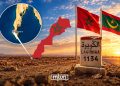
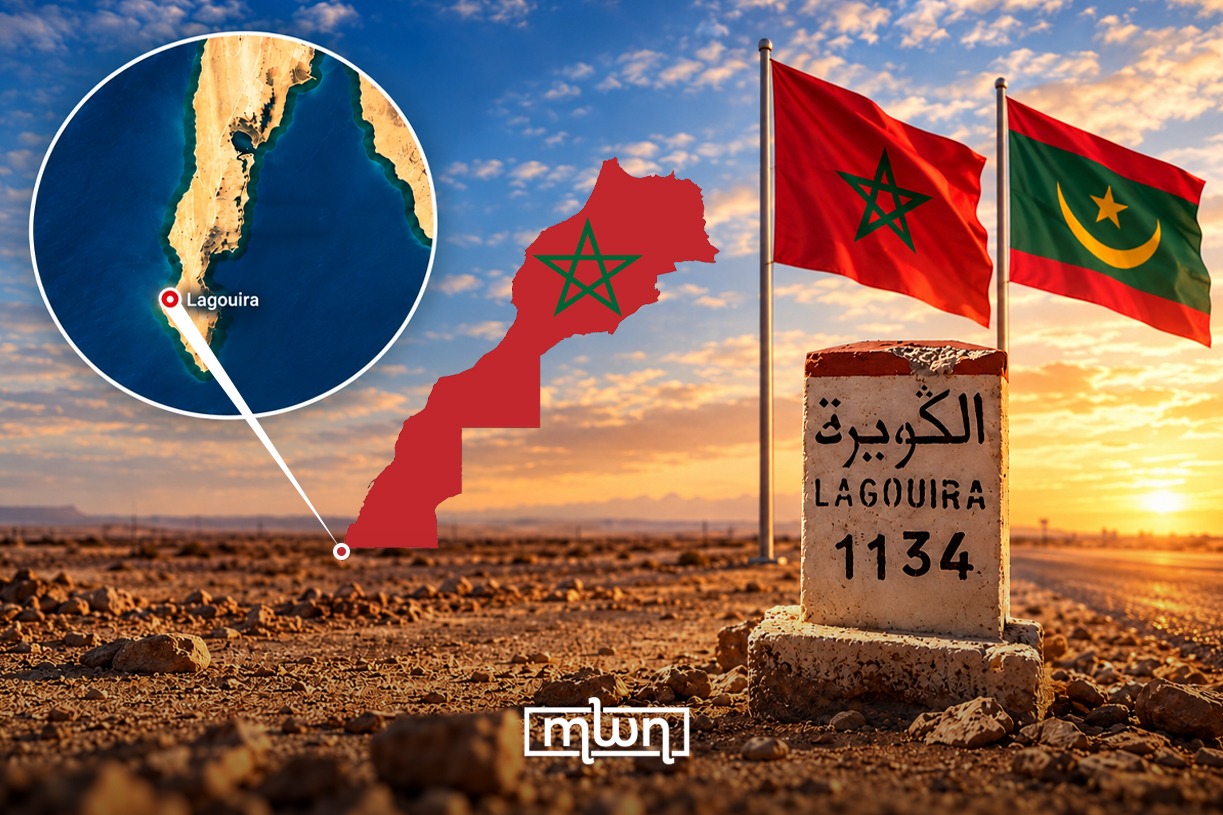
Begin with the words that every Moroccan carries: “from Tangier to Lagouira.” The formula is not sentimental ornamentation. It is a constitutional, historical, and legal shorthand for a territorial unity that admits neither bargaining nor barter. Lagouira – La Güera, in the Spanish of its founders – sits at the extremity of Ras Nouadhibou, the sixty-kilometer tongue of land that forms the southwestern cape of the historic Sahara.
The commune is real on paper: a council of sixteen elected members, presided over since the September 2021 local elections by the Istiqlalian Abdelfattah Ahl El Mekki. On the ground, it is a ruin, its colonial-era shells half-swallowed by sand, its only permanent presence a Mauritanian garrison installed after nine days of combat against the Polisario at the close of 1975.
A custodianship, not a conveyance
Here lies the essential distinction that Nouakchott’s current maneuver attempts to blur. Mauritanian boots in Lagouira are a custodianship, never a conveyance of title. The arrangement was sealed in the week after the Mauritanian-Sahrawi accord of August 10, 1979, when King Hassan II dispatched his foreign minister, M’hamed Boucetta, to Mauritania’s Mohamed Mahmoud Ould Ahmed Louly.
The understanding reached was narrow and explicit: to spare Nouadhibou – Mauritania’s economic lung, planted on the same cape – Lagouira would remain under Mauritanian military watch until the Sahara dispute found its resolution. Morocco surrendered nothing of its sovereignty. A temporary usufruct does not ripen into ownership by the mere passage of years.
The legal record is more unforgiving still. Under the tripartite Madrid Accords of November 14, 1975, Spain’s withdrawal assigned the administration of Rio de Oro to Mauritania – a grant, not a title, and one Nouakchott itself would soon disclaim. On August 10, 1979, at Algiers, Nouakchott signed a peace with the Polisario by which it renounced, unilaterally and without reservation, every claim it had ever advanced in the Sahara – Lagouira among them. The Madrid arrangement it had leaned on was thus undone by its own hand. That instrument buried any new pretension before it could be born.
Even Mauritania’s own leaders understood the town as something they did not hold outright: former president Mohamed Khouna Ould Haidalla would later recount that Nouakchott resolved to halt the war and withdraw, reserving Lagouira as a point to be ceded only “at the end of the conflict.” A matter deferred is not a matter owned.
And unlike Morocco, Mauritania ranks among the African states that embraced the intangibility of borders inherited from colonialism – the very principle that now binds it, since the frontiers of the ex-Spanish Sahara sit on maps deposited at the United Nations, delimiting the territory with no residue left to “clarify.”
From colonial line to phantom town
The colonial cartography seals the case. When France and Spain carved the cape between them in the conventions of 1900 and 1904, completed by special provisions for Cap Blanc and reaffirmed by the Madrid convention of 1912, they drew a line down the length of the peninsula. South of it, Nouadhibou – then Port-Étienne – fell to French Mauritania. North of it, La Güera belonged to the Spanish Sahara.
The Spanish arrived at Rio de Oro in 1884 on the heels of Emilio Bonelli’s expedition; Colonel Francisco Bens secured the La Güera trading post on November 30, 1920, around the Canarian fish cannery that gave the settlement its reason to exist. In 1924, the town was definitively attached to the colony of Rio de Oro; in 1958, Madrid elevated Rio de Oro and Seguiet el-Hamra to full Spanish provinces, seated in the Cortes.
By the 1974 census, La Güera was the colony’s principal fishing hub, home to some 250 Europeans and more than 1,600 Sahrawis. That Spanish Sahara – including the northern cape – was reintegrated into the kingdom. The Mauritanian presence on the Moroccan side of the old colonial line is the anomaly, not the norm.
The war that followed wrote the town’s modern fate in a matter of weeks. On November 8, 1975, Polisario fighters – some seventy of them ferried to Nouadhibou aboard Algerian trucks – seized La Güera and planted their flag, holding it for over a month until a Mauritanian offensive dislodged them at the close of December. When Mauritania quit the conflict in 1979, Morocco moved at once: the day after the Algiers accord, Moroccan C-130s set down at Dakhla and the Royal Armed Forces (FAR) took the city, and on August 14 more than 360 notables of the region pledged allegiance to King Hassan II in a televised ceremony, consecrating Tiris el-Gharbia’s reintegration as the province of Oued Eddahab.
Lagouira alone stayed outside that return – and Mauritania’s reasons were never proprietary. Nouakchott declared it held no claim on the territory yet would not evacuate the town before the “end of hostilities,” fearing that a Moroccan presence fifteen kilometers from Nouadhibou would draw the Polisario back onto its doorstep. So anxious was it for its economic capital that it denounced the stationing of Moroccan troops at Bir Mogrein before the United Nations and called in roughly a hundred French soldiers in late 1979 to shield Nouadhibou.
The custodianship, in plain terms, was always about protecting a Mauritanian port, never about owning a Moroccan one. And in 1984, in a gesture that lays bare the hollowness of any title it might now invoke, Mauritania recognized the self-proclaimed “Sahrawi republic” while its garrison still sat on Moroccan ground. The peninsula was then frozen by Morocco’s own hand: the last stretch of the defensive wall reached the Atlantic in 1987, and the 1991 ceasefire fixed a buffer zone, after which the FAR could no longer enter Ras Nouadhibou at all – leaving Lagouira suspended in a limbo that Mauritanian guns have merely outlasted.
The most sober dismantling of the current request comes not from a pamphleteer but from the Policy Center for the New South. In an analysis published October 15, the veteran diplomat Mohammed Loulichki parses Nouakchott’s language with a jurist’s scalpel. The demand is couched as a mere “clarification,” to be reached “consensually,” touching “definitive and permanent international borders” – phrasing he reads as extraordinarily deliberate.
By that very construction, Loulichki reasons, the request forecloses any pretension of sovereignty; it gestures instead toward guarantees of a political, security, or economic order that Mauritania would seek from Morocco, which alone will wield the regalian competences, the defense of the frontier among them.
The 1976 Rabat convention that once traced the line fell – signed that April by foreign ministers Ahmed Laraki and Hamdi Ould Mouknass, running the frontier from the Atlantic at the 24th parallel toward the meeting of the 23rd parallel and the 13th meridian west – into desuetude the moment Mauritania withdrew and Morocco recovered the south. Once autonomy takes effect, Rabat will, for the first time, demarcate land and maritime boundaries now common with its neighbor – a cadastral labor, not a surrender.
The real engine: Nouadhibou’s fear
Strip away the diplomatic couching and the true engine of the Mauritanian démarche appears, and it is economic. Lagouira lies roughly fifteen kilometers from Nouadhibou, Mauritania’s commercial capital, the terminus of the Zouérate iron-ore railway and the hub of its fisheries.
Rabat, meanwhile, has launched an ambitious opening of its Atlantic façade: the deep-water Dakhla Atlantic port – now past 74% complete, by the count its project-monitoring director, Nisrine Iouzzi, gave on October 9, with commissioning set for 2028 – the royal Atlantic Initiative extending seaboard access to the landlocked Sahel, and the long-cherished design – voiced by King Mohammed VI at the fortieth anniversary of the Green March in November 2015 – of a rail line binding Tangier to Lagouira and Morocco to the rest of Africa. Should the kingdom develop Lagouira as it is developing Dakhla, a rival Atlantic gateway would rise on the very cape that Nouadhibou commands.
The arithmetic for Mauritania is punishing. A modern port and free zone at Lagouira would draw transshipment, fisheries, and corridor traffic away from Nouadhibou, exposing it to an asymmetric competition it could not win. Emirati investors, quickened by the prospect of the 2030 FIFA World Cup, already eye the fishing hamlet as a potential “Dubai of the Maghreb.” As early as February, several outlets reported an Emirati-backed resort envisioned for Lagouira itself – marina, hotels, villas, and nautical amenities, one of them naming the Emaar group – though no official confirmation ever followed.
That is the specter haunting Nouakchott – not a lost deed, but a looming eclipse. Reviving a defunct claim becomes the lever by which Mauritania would either freeze Lagouira as a dead buffer or extract a stake in any cross-border development on Moroccan soil. Charitable Mauritanian voices dress this as a plea to be a partner rather than a bystander, to convert a regional dynamic it fears into one it helps shape. The ambition is comprehensible. It is also no title to another nation’s land.
Sovereignty is not for sale
Which returns the matter to the barter that Jeune Afrique dangled and could not substantiate. Moroccan analysts answer it without equivocation: sovereignty is fixed, and territorial unity is neither traded nor pawned. The Autonomy Plan, framed by Resolution 2797 (2025), reconciles self-administration with unitary sovereignty; it is no privilege dispensed to one party, and it cannot contradict the kingdom’s constitutional order.
The Personal Envoy’s process has moved past consultation toward serious negotiation, and that process does not place Moroccan sovereignty on the table – it offers autonomy as the sole exit. Should the talks succeed, the parties share much. Should they founder, sovereignty stands, and the heaviest losses fall to the camp that spurned 2797. The window is narrow: the MINURSO mandate runs out on October 31, lending these days a weight that Nouakchott’s timing can hardly have ignored.
This is not the first time the cape has been tested. In the month after King Mohammed VI spoke in 2015 of a Tangier-Lagouira railway, Mauritania’s then-president Mohamed Ould Abdel Aziz – an adversary of Rabat through most of his 2009-2019 tenure, later jailed for illicit enrichment – hoisted the Mauritanian flag over Lagouira. Rabat issued no public riposte and let its government spokesman deny any incident; but as Jeune Afrique would reveal, it answered through the back channel, dispatching foreign minister Salaheddine Mezouar, intelligence chief Mohamed Yassine Mansouri, and the inspector general of the FAR together to Nouakchott, after which the matter went quiet. The provocation was absorbed, the sovereignty reasserted, the record left intact.
Rabat has every reason to tend its rare entente with President Mohamed Ould Ghazouani, whose December 2024 visit to King Mohammed VI marked a genuine warming after the chill of the Abdel Aziz years. Good-neighborliness, mutual confidence, and shared development remain the Moroccan creed toward Nouakchott. But a cordial neighbor is not a creditor, and a custodian is not an owner. From Tangier to Lagouira, the line holds – closed dossier, settled frontier, and a word that remains, as it has always been, Moroccan.