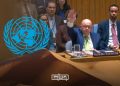

A diplomatic earthquake shook the U.N. Security Council on Oct. 30, ending three decades of the “suspended situation” in the Sahara. Through reciprocal U.S. and Russian vetoes, the death of the MINURSO mission and the collapse of its U.N. mandate were officially announced. The event was not a mere administrative step. It amounted to a Moroccan-American declaration that the era of gray maneuvering is over and a phase of imposing a fait accompli has begun, one that puts neighboring Algeria in confrontation with its political and military consequences.
Battle in New York: Pulling the rug out under the veto’s cover
Algerian diplomacy has long exploited the routine renewal of MINURSO to keep the file alive under the international spotlight and to entrench a “referendum” thesis that has outlived its time. But U.S. diplomats, coordinating with Rabat, submitted a draft resolution that would change the mission’s name by dropping the “R” for “referendum.” It also would have made the autonomy initiative under Moroccan sovereignty the sole basis for negotiations.
Russia chose to use its veto to protect the Algerian position, but the U.S. counter-veto followed, bringing down the Russian draft entirely. The result was a legal vacuum in which the mission’s mandate expired. For Algeria, this was not an ordinary loss. It demolished the U.N. umbrella it had sheltered under for decades. In practice, the case has left the Security Council’s procedural track, and Morocco’s opponents have lost the card of periodic pressure.
The 11-nation coalition: How did the Russian veto serve Morocco?
If Algerian media rushed to celebrate the Russian veto as a brake on Moroccan momentum, a deeper reading of the vote shows a decisive political victory for Rabat. The U.S.-Moroccan project won overwhelming support: 11 of the council’s 15 votes. The bloc was not limited to traditional allies such as the United States and France. It also included European, African and Asian powers that publicly sided with Morocco’s Sahara and the autonomy option.
Here the Russian veto became a “strategic gift” to Morocco, not the reverse. Without the veto that brought down the resolution and ended the mission’s existence, MINURSO would have remained bound by its old protocols restricting Moroccan movements.
Moscow delivered what Morocco had long awaited: the dismantling of the U.N. mission and the removal of international oversight from the territory. It also cast Algeria and Russia as the isolated minority, with only three votes, that sabotaged the international peace mechanism.
The battlefield: End of the ‘buffer zone’ and Rabat’s hands freed
On the ground, the absence of international observers represents a strategic shift in favor of the Royal Moroccan Armed Forces. With the future of Military Agreement No. 1 uncertain, Morocco may argue that the existing arrangements governing the area east of the sand wall can no longer be maintained in their previous form. Should Morocco come under armed attack, it would retain its right to defend itself under Article 51 of the U.N. Charter. With its growing reliance on drone technology and evolving rules of engagement, Rabat could be better positioned to respond to security threats. Any military response, however, would remain subject to the principles of necessity and proportionality under international law.
The legal trap: Algeria from ‘observer’ to ‘state sponsor of terrorism’
The most dangerous implication of the post-MINURSO phase lies in how Algeria’s position is characterized legally. For years, Algeria’s official propaganda tried to promote the idea that it is “merely a neighboring country and observer,” not a party to the conflict. But the collapse of U.N. mediation on the ground tests that mask.
If Algeria were to allow the Polisario Front to launch attacks from its territory, including Tindouf, following the collapse of the MINURSO mission, its role could come under serious international legal scrutiny. Such actions may raise questions about Algeria’s responsibilities under international law, including Article 51 of the U.N. Charter, while potentially strengthening Morocco’s argument for self-defense against attacks originating across the border.
Moreover, if Polisario acts militarily against civilians or infrastructure without a peacekeeping framework, it would be easier for Moroccan diplomacy and its Western allies, notably Washington, Paris and Madrid, to formally designate the Front as a terrorist group. That label would fall directly on Algiers, placing it before the world as a “harboring and sponsoring state of terrorism.” The risks include economic sanctions and suffocating political isolation.
Imposing the fait accompli
While Algeria’s media machine tries to portray the Russian veto as a brake on the Moroccan plan, a deeper reading of events confirms that Algeria has walked into a tight strategic trap. The era of hiding behind MINURSO’s reports is over. Its eastern neighbor now faces two bitter options. One is to rein in its protégé, the Polisario, and fully accept Moroccan sovereignty as exercised on the ground. The other is to risk bearing direct legal and military responsibility as a host state for cross-border armed operations, which could drag the region into catastrophic scenarios that Algerian diplomacy paid for in advance in New York.