
 Join on WhatsApp
 Join on Telegram
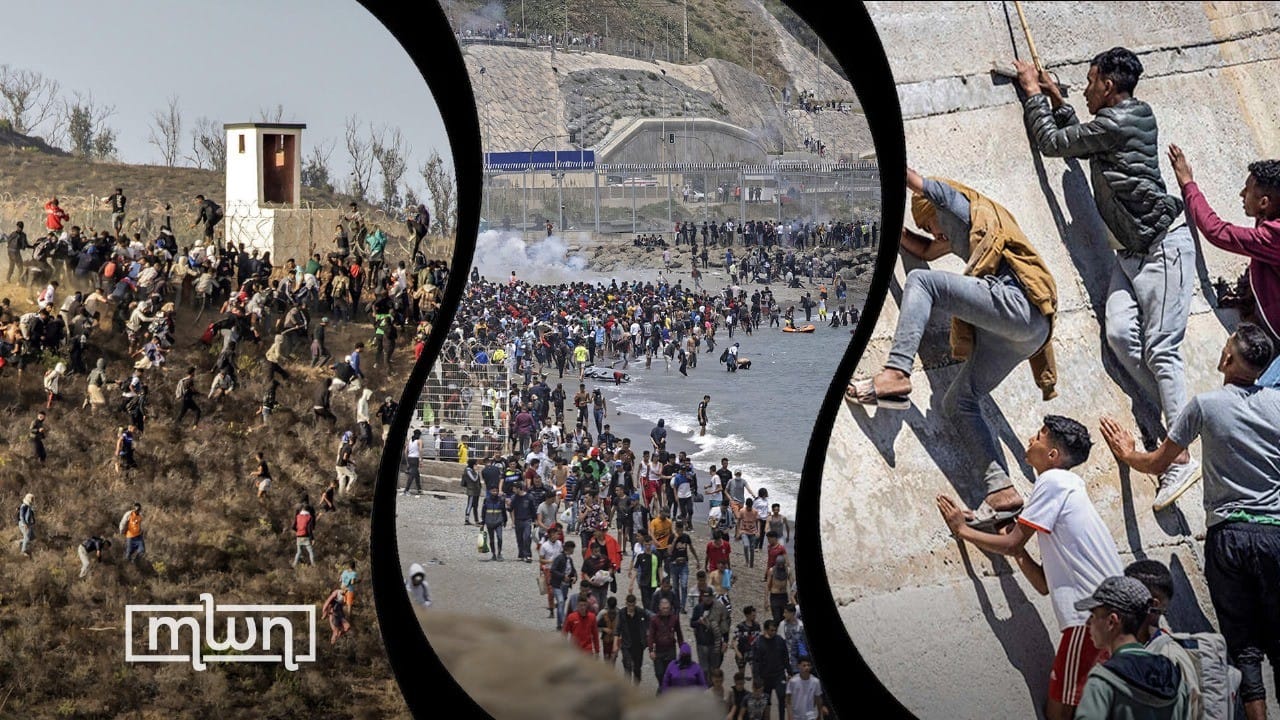
Young North Africans and sub-Saharan Africans repeatedly attempt to migrate illegally to Europe by any means — be it violent, organized, or reckless. The latest such incident involved a social media-fueled call to storm the city of Ceuta on September 15.
In response, Moroccan authorities deployed human and logistical resources to thwart the mass incursion, leading to the arrest of 4,455 individuals, including 3,597 Moroccans and 519 foreigners, 164 of whom were Algerians. Additionally, seventy individuals orchestrating this migration from Algeria and sub-Saharan Africa, including Moroccans, were apprehended.
Beyond the heated political debate this issue has sparked across North Africa, a more pressing question emerges: Why are so many young people from countries like Algeria, Mauritania, Morocco, Tunisia, and sub-Saharan Africa risking everything on a perilous journey that often leads to drowning and death? Are their prospects so bleak that “hrig” —a colloquial term for clandestine migration in Morocco and Algeria—has become the only option?
Inadequate school curricula
These youths are commonly labeled as NEETs —16 to 24-year-olds who are not in education, employment, or training. They constitute 29% of young people in Algeria (according to the International Labour Organisation), 25.2% in Morocco (as reported by the Moroccan Economic, Social and Environmental Council), and a staggering two-thirds in Niger, the highest percentage globally.
The reasons for dropping out of school are numerous and can be traced back to the inadequacies in curricula, teaching methods, and an education system that fails to align with the psychosocial needs, aspirations, and employability of the youth.
In most African countries, schools do not provide spaces for positive learning, achievement, excellence, and self-expression. The education systems lack a focus on developing essential psychological, social, and life skills such as crisis management, emotional intelligence, resilience, critical thinking, time management, effective communication, building healthy relationships, and self-care.
There are no initiatives to train teachers and parents in adopting this holistic approach. Instead, we are left with poorly designed programs and monotonous, difficult-to-understand teaching methods. Educators often find themselves preoccupied with managing overcrowding, violence, cheating, drug issues in schools, and low levels of motivation among teachers.
Many young people are disillusioned by this environment, which stifles learning and achievement. While parental support can sometimes help them through high school, poverty and family breakdown often thwart these efforts. When these youths leave school, they fall off the radar — untracked and unassisted, receiving no training or social care, and with no effort made to understand their dreams and ambitions.
Social workers are not deployed to guide them in their communities. Even vocational training centers lack the flexibility to offer accessible and aspirational opportunities.
Misguided hero complex
It is then the streets, with their counter-culture tendencies, that take in these disaffected youths. Organizers of clandestine migration prey on them, selling fantasies of easy success and Hollywood-style tales of European life.
The allure of adventure and the chance to escape an environment synonymous with failure and frustration compels sixteen- and seventeen-year-olds to envision a rosy path: cross over, succeed, and return as a hero.
This sense of heroism is seen as a way to erase the memories of past failures and frustrations. Migration becomes a collective dream, with groups forming around shared ambitions, resources, and strategies. When agitators incite these youths to confront security forces and attempt to breach borders violently, they exploit this yearning for heroic glory.
Government reports and plans are not enough
Faced with such an unending epidemic of youth fascination with easy success in Europe, Morocco needs to develop strategies to discourage or counter the popularization of longstanding myths about migration, while providing young Moroccans with valid reasons to stay at home. The Moroccan Prime Minister highlighted the urgent need for such strategies in his response to the Council of Economic Experts’ NEET study, but he insisted that more is needed to tackle such a deep-rooted social malaise.
In particular, authorities in the education sector need to adopt an innovative approach that focuses on equipping young people with essential life, psychological, social, and practical skills. Meanwhile, ministers in charge of professional training and youth employment should track school dropouts’ trajectories, deploying social workers to guide and support these youths in realizing their dreams and ambitions.
This approach will aid security officials in combating smugglers, human traffickers, and clandestine migration networks. The goal is not to close the door on migration entirely, but to frame, institutionalize, and rationalize it so that it benefits both European and African interests—while moving away from the tragedies of drownings, rescues, and the perilous journeys at sea.
Read also: The Torn Lives of Sub-Saharan Migrants in Morocco