 Join on WhatsApp
 Join on Telegram
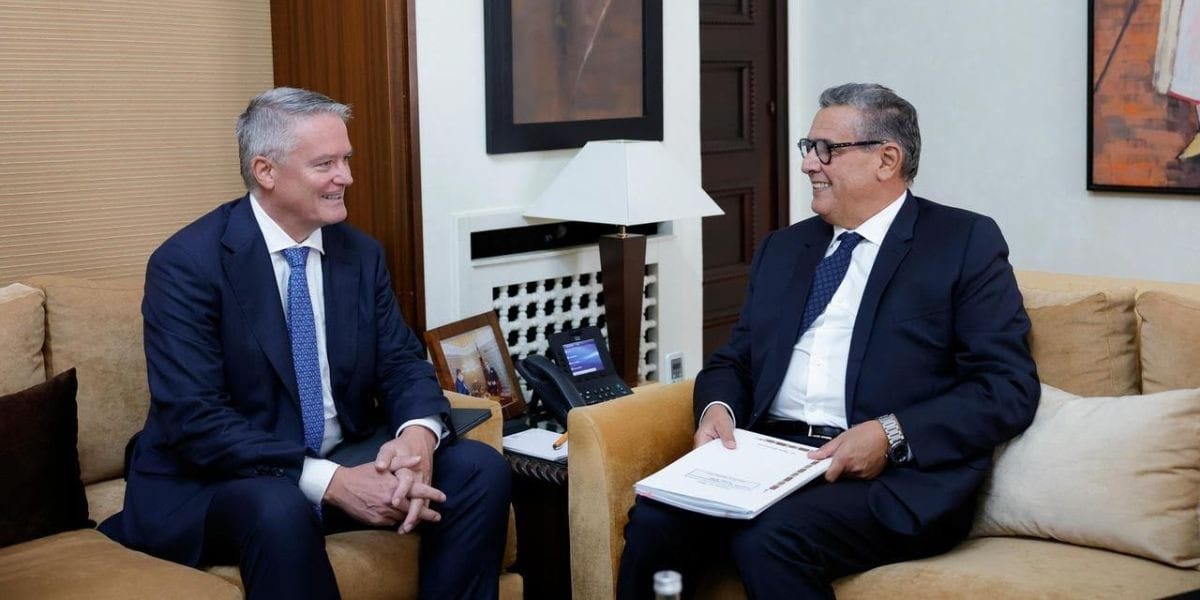
Rabat – Moroccan Head of Government Aziz Akhannouch and Mathias Cormann, Secretary-General of the Organisation for Economic Co-operation and Development (OECD), met in Rabat today to discuss the ongoing collaboration between Morocco and the international economic body.
The second phase of the “Country Program” between Morocco and the OECD has reached its zenith, Akhannouch’s office announced in a statement following the meeting.
According to the statement, the completion of this phase represents a key advancement in the strengthening of Morocco-OECD cooperation.
Morocco was the first country in the North Africa and Middle East region—and one of the first four in the world—to sign a memorandum of understanding for a country program with the OECD.
The initial phase of the program (2015-2018) had already played a major role in supporting Morocco’s major reforms across economic, social, and governance sectors.
The program also emphasized the integration of best practices advocated by the OECD, noted the statement from Akhnnouch’s office.
Read Also:
The Head of Government highlighted Morocco’s recent major socio-economic transformations, which have propelled the country to a position of regional economic prominence through strategies in sectors like renewable energy, green hydrogen, automotive, and aerospace.
He also commended the positive outcomes of the OECD’s inaugural economic study on Morocco, which assessed the nation’s economic landscape.
Both Akhannouch and Cormann expressed a strong commitment to maintaining the momentum of their partnership and pursuing new and promising avenues for cooperation.
“Today’s launch is a great occasion, marking three milestones in our cooperation: launch of the first OECD Economic Survey of Morocco, conclusion of the second phase of our OECD-Morocco country programme, and signature of a Memorandum of Understanding to continue supporting Morocco in achieving its economic growth and development objectives,” Cormann remarked.
“Morocco has embarked on an ambitious journey to improve living standards for its people and to foster economic development to accelerate the convergence with high-income economies. Boosting productivity through higher investment and private sector dynamism, tackling labor market challenges to enable more high-quality job creation, and advancing the climate transition are all policy priorities that will help Morocco on its journey,” he added.
The OECD’s latest report projects Morocco’s Gross Domestic Product (GDP) growth to be 3.5% in 2024, consistent with 3.4% in 2023, and rising to 4.0% in 2025, driven by increased investment and strong export performance.
As Morocco’s budget deficit narrows, its public debt-to-GDP ratio is expected to decrease from 69.5% in 2023 to 68.9% in 2024 and further to 68.2% in 2025.
And inflation, which has eased due to reduced global food price pressures, is anticipated to drop from 6.1% in 2023 to 2.3% in 2024, and further to 2.0% in 2025.