Rabat — 30-year-old Youness Guarmouti moves throughout his classes at Amideast, the language school for foreign students in Rabat, with a gentle confidence that appears to win over his students immediately. No mistake seems to be too much for him; no amount of American students mispronouncing the same word over and over again seems to throw him. He corrects them time and again with apparently endless patience. And this frustration-minimizing patience is critical: not only does he want his students to master the language — but he also wants them to learn to love Morocco.
And Guarmouti believes that loving Morocco comes from loving the language of its people. But he’s not talking about Morocco’s official languages, Arabic, and French.
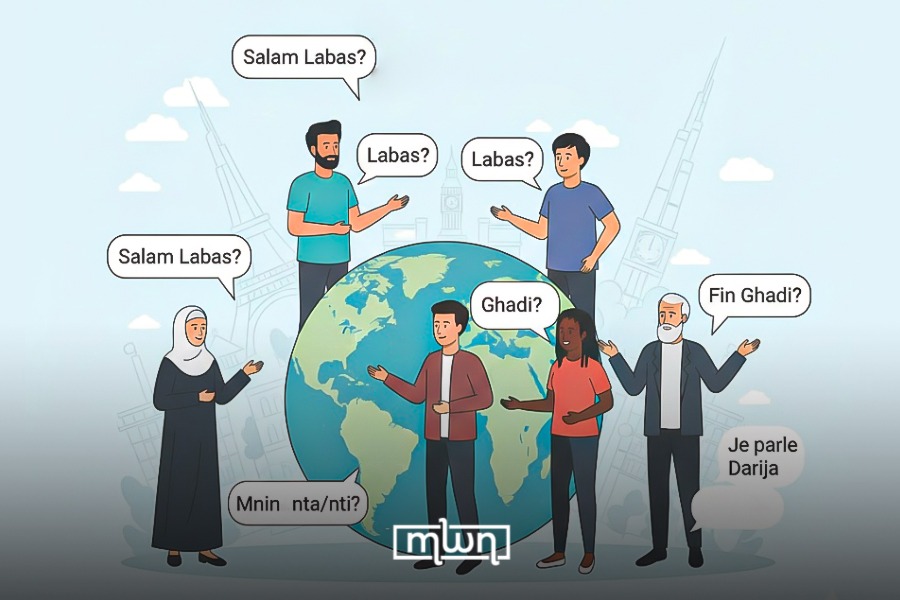
He’s talking instead about Darija. While not to be found in Google Translate’s database or in Western public schools, it teems from every city, village, and home in Morocco.
“You cannot understand the people [if you cannot understand the language], you cannot understand the culture,” said Guarmouti on a warm fall evening outside a Rabat café to Morocco World News (MWN).
Just at that moment, a crowd of his Amideast students walked by and enthusiastically hailed him. Though Guarmouti made sure to return his attention to the interview, he spent a moment greeting them and conversing with them in Darija.
It is those moments of connection that mean the most to Guarmouti’s work as an educator. It is also moments like that that propelled his career to where it is now. This gives him the confidence to bet on his current big project: a travel-friendly guide to Moroccan Darija, written for visitors and translated into multiple languages. “Speak As They Speak: Darija” is meant to serve as a kind of cheatsheet to Moroccan culture and language. It has been distributed to stores and museums in major cities across the country.
It is also one of the first of its kind. Prior to “Speak As They Speak: Darija,” only several Darija teaching courses existed on paper. There is the old Peace Corps manual — which Guarmouti, early in his career, quickly made obsolete when he himself taught in the Peace Corps — and several other books.
But Guarmouti’s travel guide is unique for its size and accessibility.
“The book was the idea of a tool that every single human… can reach out to, right?” said Guarmouti. “So not just people who really want to study because they want to learn Darija, but [also] people visiting Morocco for 10 days or something, and they want to throw words in here and there and create a really beautiful, enthusiastic atmosphere… like an authentic atmosphere living here.”
“Speak As They Speak: Darija” is also the first of its kind and highly emblematic of a fast-growing industry that Guarmouti himself has helped pioneer. A decade ago, the idea of teaching Darija formally — or foreigners learning it at all — seemed far-fetched.
The basics of Darija
Darija is Morocco’s unofficial official language. Though the Moroccan government website is only accessible in French or Arabic, neither of these languages id spoken in streets extending beyond Parliament in the capital city of Rabat. Neither are they spoken in smaller cities or villages. Many Moroccans, especially citizens living in remote areas, do not even know French or Arabic.
But Darija glues Moroccans together. It also glues together a messy collage of colonial influence and native tribes. Found in Darija is a smorgasbord of other languages.
“Some people who are not language-oriented will say, like, ‘this is nonsense,’” said Guarmouti to MWN. “But the beauty of this language is you have this mix of words from France, from Spain, from Portugal, from England. From different countries, different words. And then you have the structure of the Tamazigh language, not even classical Arabic.”
“When you combine all of those things and you create a language with it, it is just something that I admire,” he added. “[It] has a beauty that does not exist in other languages.”
Nevertheless, this same beauty contributes to the difficulty of learning Darija outside Morocco. According to Guarmouti, Darija is a language in constant evolution. Partly because few official guides exist to the language, there also exist very few rules that tamp it down in solid form. Because of this, modern slang, particularly many English words and phrases sourced from TikTok and Instagram, continue to alter Darija’s course.
Guarmouti confirmed that nowadays, young adults from Tangier to Agadir might pepper their speech with English slang, then add in a French noun followed by a Darija verb conjugated in the Tamazight fashion, then finally, round off their sentence with an Arabic “Inshallah” or “Alhamdullilah” — and all this could constitute a Darija sentence.
Guarmouti’s inspiration for his book
Many Moroccans are used to adapting their native tongue into international registers. Because of this, when tourists come to Morocco, it can be relatively easy for them to get by without Darija.
Perhaps for this reason, Moroccans are not used to foreigners learning their language. Many did not even believe it was possible as of a decade ago. Back then, many Moroccans thought it was entirely impossible to teach a non-native speaker their frequently evolving, quick-spoken tongue.
This was Guarmouti’s belief back when he was in university. But one day when he came home to his small city of Taza in the Rif, he found his parents at home, sitting with a friendly-looking American couple. These were Peace Corps volunteers on a mission to perform humanitarian service out in rural Morocco.
They knew that Youness spoke a little English – better than his family members – and offered to pay him to teach them.
“I started from there with no resources, with nothing,” he said.
The Peace Corps had few resources to teach Darija, usually something like an aging manual that volunteers often found confusing or insufficient. That American couple encouraged – “insisted,” in Guarmouti’s words – that he apply for a job with the Peace Corps in 2018. They eventually hired him as a language and cross-cultural facilitator.
“When I said that to my family… I swear… no one believed me,” said Guarmouti. “Every single person in the family [thought that] I wanted to escape home, and I just wanted to be outside… even my friends… didn’t believe.”
“Every single person said, ‘you can teach that? How do you do that?’” he recalled with a laugh.
Nevertheless, Guarmouti plunged into teaching Darija. He and several other Moroccans built their curriculum from pedagogical and linguistic scraps, fashioning their understanding into a teaching system that, though crafted by relative amateurs, got the job done.
Throughout months-long Peace Corps rotations, Guarmouti noticed something shift. He said that his students seemed to not only understand Darija, but to also love Morocco and its people to the point that they made real connections – with young and old, in service and in fun. One student learned how to rap in Darija and shared her song with the rural village she was stationed in, much to the inhabitants’ delight. Other students even decided to move to Morocco permanently.
Guarmouti recounted the deep impression this made on him.
“When you see people coming into this country, appreciating the country, appreciating the people, [their] love for your country, it does grow up [in you] somehow… You feel super proud when other people are thanking your country, thanking the people, appreciating life in Morocco,” he said.
“You start thinking, ‘wow, okay. Okay, well, that’s really a good country. What can I do to improve things,’ you know?”
Guarmouti eventually left the Peace Corps, but his desire to help Morocco stayed with him. He continued to use his language teaching skills in the budding branches of the Darija education system – testing out online tutoring in its early days, teaching in-person classes, and even engaging in administrative work in language schools like Amideast.
One of his students eventually mentioned to him that she was using an Arabic language instruction manual to supplement her learning; Guarmouti at first dismissed the book, saying that Arabic lessons would not help her, that Darija was too different.
“She was like, ‘Youness, that’s the only thing I found in libraries and stories… You should do something about it. You should do something in Darija.’”
From this industry gap came “Speak As They Speak: Darija,” the English version, published earlier this year. In rapid succession have followed editions in French, Spanish, Finnish, and Dutch. Japanese, Chinese, and Russian are forthcoming.
“I’m not saying you have to be fluent in Darija [to visit Morocco], but you should have the minimum. Because we don’t speak Arabic,” said Guarmouti. “[It is] not our language. Darija is our language… [Learning it is] a sign of respect. It’s a sign that you really want to get to know the people, you want to get to know the culture.”