“I would have so wanted, dear colleagues, that the moments that cross Morocco, the mourning of these families, the deaths, the thousands of dead, the thousands of wounded, of destruction would have prompted you to keep silent to respect the moment; and as you say, to be supportive. We cannot shed crocodile tears and at the same time attack a country that is still living in a drama. You show your solidarity, your support, but at the same time you inject your venom, you insult the dead, you insult the Moroccans,” said Omar Hilale, Permanent Representative of the Kingdom of Morocco to the United Nations in New York, during his first right to respond to the Algerian representative.
In the age of digital media, the representation of natural catastrophes has taken on a new dimension. The reporting of these events, regardless of their nature and magnitude, is often misleading. Stereotyping is common, and the scale of the disaster and the nature of humanitarian aid are difficult to assess from media coverage. More often than not, the numbers of casualties are exaggerated and the efforts to rescue are mitigated, particularly in developed countries. In the earthquake that struck Morocco on Friday, September 8, the agenda-setting of the Algerian media has been influenced by political agendas, as was the case with the French media.
In the context of the earthquake and the geopolitical relations between Morocco and Algeria, the latter’s Third National Television (ANT3) and AL24 use rhetoric and visuals in a way that aligns with the country’s official political stands. This involves using the event to advance the Algerian political agenda by highlighting Algeria’s “immediate offer of aid” and criticising “Morocco’s slow response to the crisis”.
As a neighboring country, Algeria was compelled to offer aid after the earthquake. Yet, their offers, as well as those from France, have not been accepted so far. As a consequence, Algerian media, like the French ones, reacted in retaliation against the decisions taken by the Moroccan government, which neither accepted nor refused their aid.
In this article, we contend that the portrayal of the Moroccan earthquake by the Algerian media, akin to our analysis of the French media, has sparked debates concerning the authenticity of solidarity and humanitarian aid. Moreover, the media campaign launched by ANT3 and AL24, with the intention of undermining Morocco’s composed management of the disaster, has added another facet to the situation.
This influence has metamorphosed a natural-social phenomenon into an emotionally-charged drama. The narratives that deviate from the aims of solidarity introduce an additional dimension of complexity to the situation.
Unmasking the Alternate Persona of the Algerian Regime: A Media Perspective
Since the terrible earthquake that struck Morocco on the evening of September 8, the Algerian press (ANT3 and AL24) has not ceased to multiply attacks and insinuations about a supposed refusal of Morocco to accept their aid, without which, it seems, the Kingdom would not be able to overcome this catastrophe. All this occurred at a time when Morocco was counting its dead and making considerable efforts to save lives. The timing and nature of these broadcasts have raised questions about the intentions of the Algerian regime and its media.
Rather than focusing on the terrible human drama that the country is experiencing, acknowledging the tremendous work accomplished on the ground, day and night, by the rescue teams in extremely difficult terrain, or highlighting the incredible surge of national solidarity that drives every Moroccan, Algerian official televisions have preferred to politicize this natural disaster since its onset.
The images broadcasted by ANT3 and AL24 (the international channel), misrepresent facts. It’s important to critically analyze the content (discours / visuals) of the two channels to understand the biased political inclinations of these media. For this purpose, the elements of “source”, “context”, “caption”, and “bias” are considered.
Source Analysis
In essence, while media plays a crucial role in disseminating information during natural disasters, negative representation can lead to misinformation that could potentially hinder disaster management efforts. As we delve deeper into this topic, we will explore these implications and their far-reaching effects.
The images under analysis are sourced from ANT3 and AL24, both of which are official media outlets in the country. These platforms are known for disseminating the country’s official stands against Morocco on various issues, including political, economic, cultural, and sporting issues.
In the context of the recent earthquake, it is important to consider how these sources have framed the event. Their coverage of the earthquake was not just about reporting the facts of the disaster, but also about shaping the narrative around it. Given the ongoing geopolitical tensions between Morocco and Algeria, these sources have used the earthquake as a new front to counter Morocco. This manifests in various ways, such as emphasizing Algeria’s humanitarian response to highlight its leadership and compassion, and at the same time critiquing Morocco’s response to the disaster, and bringing to the forefront the issue of the secession of the Moroccan Sahara.
Undoubtedly, the Algerian regime is using this as an opportunity to settle accounts with Morocco on political, economic, sporting and cultural issues. They believe that this is a moment of weakness for Morocco, and it seems that they should seize this opportunity to launch relentless attacks in an attempt to further weaken the Cherifian Kingdom. This was evident in the political debates on ANT3 broadcasts (Image 1). Reports were broadcast about Algerian rescuers preparing to go to Morocco following distorted statements of Abdellatif Ouahbi (Moroccan Minister of Justice), which were misinterpreted by Algerian officials to dispatch aid. Indeed, the department led by Nasser Bourita (Moroccan Minister of Foreign Affairs) categorically denied having asked for or authorized the assistance of the Algerian authorities. At the same time, talk shows on ANT3 hosted by separatists from the Polisario Front discussing the separation of Sahara from Morocco were also aired on AL24, along with fallacious broadcasts of military attacks by separatists on the Moroccan Sahara region.
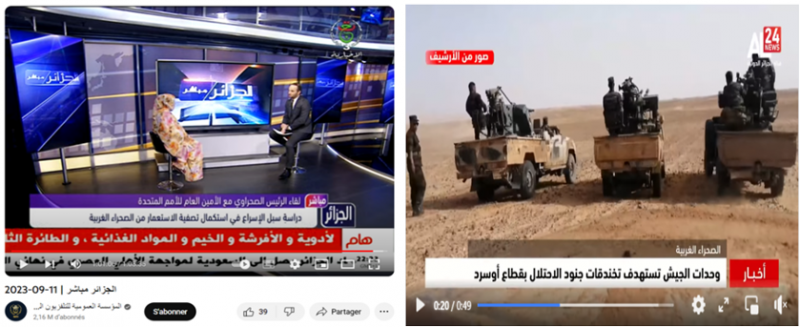
ANT3 hosting separatists discussing the separation of Sahara from Morocco with subtitle showing Algerian rescuers preparing to go to Morocco
Context Analysis
From the start, we assume that the images aired by the two channels were used in the context of critiquing Morocco’s response, and henceforth are intended to highlight perceived “shortcomings” or “failures” of Morocco to handle the earthquake.
It’s important to note that the context refers to the type of content (opinion piece) and the broader socio-political environment in which the content is produced and consumed. Therefore, understanding the context requires not just a close reading of the images and their accompanying text, but also an awareness of the larger dynamics at play.
We strongly believe that the socio-political context in which the images are used significantly influences their interpretation. In this case, we draw on the images used in news reports by ANT3 and AL24 to provide factual information about the earthquake, which are influenced by the editorial stance of the media outlets. Given that these sources are known to disseminate Algeria’s official positions, the media channels take advantage of the earthquake to convey specific messages aligned with the country’s political agenda.
The central issue under scrutiny is encapsulated in a singular inquiry: What were the underlying reasons for Morocco’s refusal of Algeria’s aid offer? The media outlets examined in this discourse, with a particular emphasis on AL24, have been strategically manipulated to serve a unified agenda: to cast defamation on the nation’s endeavors to preserve lives and provide assistance. To achieve this objective, AL24 resorted to unverified reports and testimonies to portray victims of the earthquake as living in abject conditions, remote regions as being neglected, and the proposed humanitarian aid from Algeria as a potential remedy for these adversities. In the ultimate assessment, mirroring the tactics employed by French media, the Algerian broadcasting channel has adopted a manipulative methodology, in flagrant disregard of journalistic ethics, to resolve political conflicts at the expense of the profound sorrow and hardship endured by a significant portion of Morocco.
Fallacious content on “Growing Public Outrage over Aid Scarcity” and “Survivors Desperate over Food and Water” following the earthquake
Caption Analysis
Captions are an integral part of the image and significantly influence how the images are interpreted. The caption or accompanying text with images in NAT3 and AL24 provides crucial context that helps interpret what is being shown. When analyzing the captions, we considered the principles of “accuracy”, “context”, “bias”, and “narrative”. Firstly, the accuracy of the captions is questionable as they do not accurately describe what is depicted in the image. This discrepancy between the image content and the caption indicates a potential bias and manipulation. Secondly, the captions provide important geopolitical context that is apparent in image 3 below, explaining when and where the image was taken, who is in the image, and what is happening. In this direction, the subtitle in red talks about the Algerian aid that awaits a green light from Moroccan officials, while the image shows separatists debating measures of separation and secession, with a second image on the left of the screen showing fallacious bombardments of Moroccan troops. Thirdly, the language used in the caption is not neutral and uses emotive and loaded language of war, revealing a certain bias intended to bewilder the audience’s perception of the event. This reflects the words of Omar Hilale: “Shedding Crocodile Tears and Injecting Venom”. Lastly, the caption fits into the larger narrative of the news reports that the Algerian media produces about Morocco, making the Kingdom its “first enemy”. It supports the official stands of Algeria as disseminated by these media outlets.
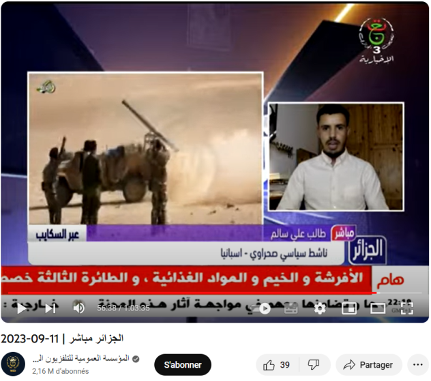
Caption of the ANT3 discusses separatism in the Moroccan Sahara and shows Algerian

Morocco: Growing Public Outrage over Aid Scarcity Following Earthquake
Bias Analysis
As previously noted, the language used in captions and accompanying text can serve as an indicator of bias. This is particularly evident in ANT3 and AL24 which consistently exhibit a political bias in their coverage of Moroccan issues. To elucidate the extent of this bias in the content used by these channels to report on the earthquake in Morocco, it is instructive to examine instances of loaded language and framing that support the Algerian perspective. These biases manifest themselves in the selection, presentation, and interpretation of images. Therefore, a comprehensive analysis of bias takes into account not only the content of the images but also the manner in which they are framed and contextualized.
The selection of images for the report reflects a certain bias. Specifically, images that depict only one aspect of the situation are chosen to elicit a particular response from viewers. This strategy further reinforces the narrative of Morocco as a state “incapable of adequately responding to the crisis on its own”, thus necessitating external intervention. This argument underscores the media’s power in shaping public perception and influencing international discourse.
Transitioning to the concept of framing, particularly in the context of image selection and cropping, it serves as a strong indicator of the inherent bias exhibited by ANT3 and AL24. The strategic presentation of visuals significantly influences the narrative, often accentuating specific elements (failure, inability, and abandon) while diminishing or entirely excluding others (preparedness, solidarity, and resilience). This selective portrayal not only shapes the viewer’s perception but also subtly reinforces the media outlets’ underlying political agenda of Algeria. The frequent use of framing thus emerges as a systematic instrument in the reports of ANT3 and AL24. The aim is to manipulate public sentiment in alignment with their objectives. This analysis depicts the pivotal role of framing in the Algerian media discourse and its malign aim to sway public opinion on both the local and global scales.
While French media have insinuated that Morocco is withholding aid and thereby endangering lives, the Algerian media’s coverage of the earthquake has echoed this sentiment, resulting in a negative depiction of the Moroccan government’s disaster management efforts. Amidst this cacophony of voices in the international media about Morocco’s efforts to deal with the earthquake that struck the Al Haouz region, other media outlets have displayed balanced and realistic reports about the efforts deployed by Morocco to handle the catastrophe.
For instance, Sam Kiley, CNN’s special envoy to Asni – a village severely impacted by the earthquake – opted to air his report from a military hospital established by the Royal Armed Forces (FAR) to accommodate earthquake victims. Walking through the hospital, Kiley conveyed that the facility bears witness to the superior services deployed in the devastated zone, a testament to the proficiency and expertise of the FAR in such circumstances. The American journalist proceeded to elucidate the situation on the ground, illuminating the challenges of rescue operations in remote areas. In adherence to the principles of balanced and impartial journalism, Kiley commendably acknowledged the advancements made, thereby depicting a rescue operation that poses significant challenges due to the intricate circumstances of the region and the complex strategies employed to deliver aid to populations in remote areas where the geographical landscape appears to be the sole obstacle for rescuers.
This contrast in media rhetoric brings to the front the critical role of journalistic integrity and objectivity in shaping public perception during times of crisis. The professionalism of journalists is often evaluated based on their adherence to ethical standards, objectivity, and balanced reporting. In this context, a stark contrast can be observed between the American journalist, Kiley, and the Algerian media in their coverage of the Moroccan earthquake.
To use Omar Hilaleʼs words “Shedding Crocodile Tears and Injecting Venom”, the Algerian media’s coverage of the Moroccan earthquake displayed apparent sympathy, akin to ‘crocodile tears’, while their reporting undermined Morocco’s disaster management efforts, metaphorically ‘injecting venom’.