
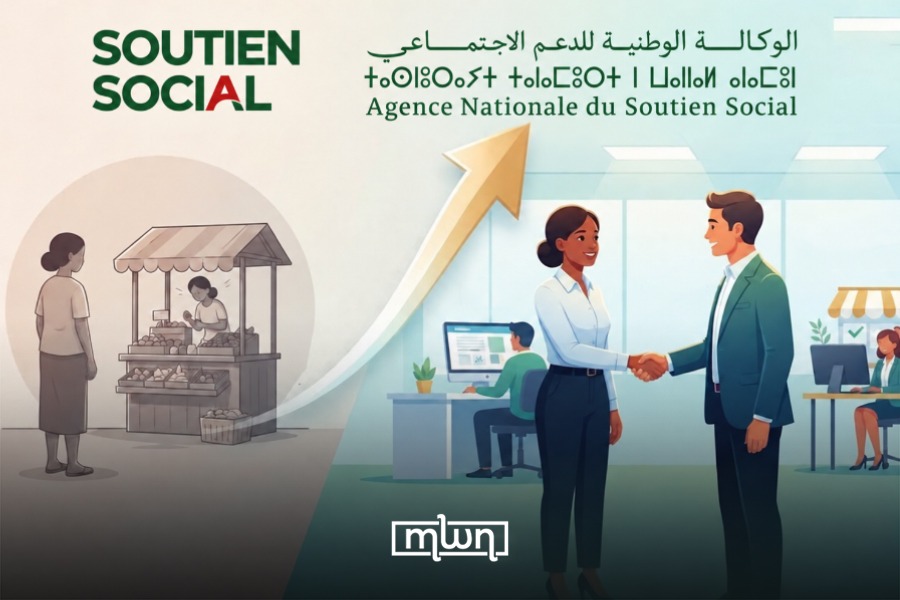
Casablanca – Morocco’s new social assistance rules create a temporary financial bridge for households that lose Direct Social Assistance (ASD) after the head of household or one spouse enters declared private-sector employment.
The mechanism was introduced through Law No. 041.26 and Decree No. 2.26.434, with the decree published in Official Bulletin No. 7530 on July 30, 2026.
How the 12-month allowance works
The new allowance targets active ASD households whose eligibility ends after the head of household or a spouse is registered in formal private-sector employment with the National Social Security Fund (CNSS).
The ASD program was launched in December 2023 as part of Morocco’s broader social protection reform and is administered by the National Agency for Social Support’s (ANSS). The scheme provides financial support to vulnerable households based on their socioeconomic situation, with eligibility determined through the National Population Register and the Unified Social Register.
The program was designed to provide a stable income floor for households facing economic hardship, while its implementation also gave the authorities a clearer picture of how social assistance interacts with employment. Formal work can change a household’s socioeconomic profile and, in turn, affect its eligibility for ASD. This affects workers taking temporary or probationary jobs, who could face the loss of regular assistance at the same time they were only beginning to earn a salary.
The payment corresponds to the household’s previous social assistance and is not separately fixed for all beneficiaries. The benefit can cover a maximum of 12 months for each household, and those months can be used continuously or across separate periods. The entitlement is granted only once per household.
Eligible households can submit claims through the ASD portal. The system uses information from the National Population Register, the Unified Social Register, and CNSS employment registration data to establish eligibility.
The reform addresses a gap that emerged during the implementation of the social assistance program. When a household member entered formal employment, the change in professional status could affect the household’s eligibility for ASD. For low-income workers entering temporary or probationary jobs, losing regular cash assistance at the start of employment created a financial risk.
The scale of the wider program is also substantial. By December 2025, ASD covered 12.56 million people across 3.92 million households, with MAD 51 billion ($5.27 billion) allocated to the program.
The ANSS 2025 survey of 1,800 beneficiary households found that ASD represented an average of 18% of household income. Some 60% of surveyed recipients said they would give up cash assistance in exchange for stable employment, while 40% wanted support for employment or income-generating activities.
What happens if the job is lost
The reform also changes what happens after the transition. If the declared job is subsequently lost involuntarily, the household can return to the Direct Social Assistance system without being subject to the previous waiting period.
The provision applies when the head of household or one of the spouses loses the declared job that had ended the household’s eligibility. The household can then be directly reinstated in the ASD cash-transfer system rather than going through the previous waiting process.
The new framework therefore links temporary support during the move into formal work with a route back into assistance if that employment ends involuntarily. The 12-month allowance can also be used across separate periods, a provision that covers households whose formal employment does not continue for a full year.
Why the reform was introduced
The Moroccan government has linked the reform to the need to reduce the financial uncertainty associated with moving into declared employment. The original system created a point at which formal employment could end a household’s eligibility, which presented a particular risk for people entering temporary work.
ANSS administrative data also show that employment-related changes were an important source of program exits. The agency reported that 42% of non-demographic program exits occurred when households became affiliated with formal family allowance schemes following employment.
The new rules form part of a broader ANSS focus on economic inclusion. The agency said around 2.3 million households, or about 60% of ASD beneficiaries, had the capacity to enter a productive-inclusion pathway.
The government has also established an evaluation framework for the transition mechanism. The assessment is intended to track declared job entry, household income retention, and job stability after the 12-month period. Law No. 041.26 requires the ANSS to submit a policy evaluation report to the government within two years of implementation.
For households moving from social assistance into formal employment, the new system creates two linked protections. The first is an exceptional allowance for up to 12 months after ASD eligibility ends because of declared employment. The second allows former beneficiaries to return to ASD without the previous waiting period if that employment is later lost involuntarily.