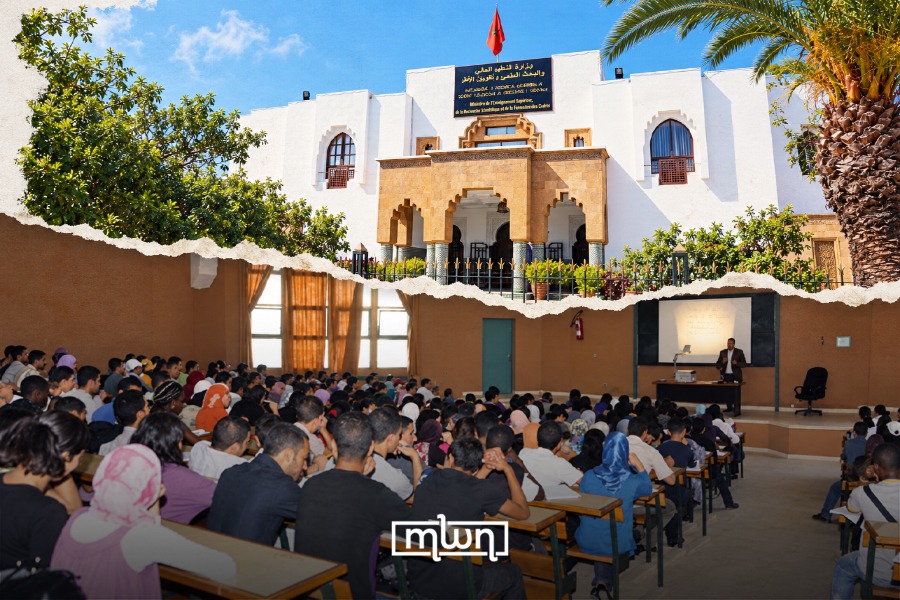
Marrakech – Morocco is easing the conditions under which international students can enroll in its public universities for the 2026-2027 academic year.
According to a ministerial memorandum that Higher Education Minister Azzedine El Midaoui sent to Morocco’s university presidents, newly admitted international students will no longer be required to obtain formal equivalence of their foreign diplomas. The same memo waives written and/or oral entrance examinations for the cycles that would normally require them.
The exemptions are not unconditional. For applicants to engineering, master’s, medical specialization, and doctoral programs, admission will rest on a review of the candidate’s academic record and the suitability of their qualifications for the requested field. Universities keep the task of verifying that a student’s prior training matches the program.
El Midaoui, who serves in the caretaker government, directed university heads to accelerate the processing of international applications and to adopt “a flexible approach” in studying and evaluating academic files.
The memo calls for “special attention” to the files of African students, whether new candidates or graduates of Moroccan universities and institutes who wish to continue their higher studies in the kingdom.
The memo also introduces a further change for medical specialization and PhD candidates. They will no longer need the prior agreement of a supervising professor before enrolling. Instead, the university itself will assign a specialized instructor to oversee their training or research.
Beyond admissions, El Midaoui pressed universities to activate an “International Student Office” on each campus, meant to diversify services, raise their quality, and accompany students through the stages of their academic path.
The memo ties the measures to broader integration, pointing to access to social services and parallel university activities that ease students’ stay in Morocco and strengthen the appeal of the Moroccan university.
The minister framed the push as part of a wider strategy toward the African continent. He called for strengthening partnerships with African universities and developing joint programs in higher education, research, and innovation, positioning the Moroccan university as a platform for academic cooperation across Africa.
The memo describes the effort as carrying “strong symbolic and strategic” weight, reflecting the country’s commitment to young African talent and to equipping it with knowledge that can serve the development of their home countries.
The new measures follow a separate step taken in July 2025, when the ministry granted automatic equivalence to bachelor’s, master’s, doctoral, and engineering degrees issued by public universities in Spain, Belgium, the United Kingdom, Germany, and France.
That recognition applies only to state-issued diplomas and requires proof that the holder resided in the country during their studies. Engineering degrees carry an additional condition of at least five years of post-baccalaureate study in a scientific or technical track.
The flexibility on equivalence sits uneasily beside a dispute that has festered all year and remains unresolved.
Thousands of Moroccan students and graduates of universities in Northern Cyprus remain blocked by a freeze on the recognition of their diplomas, which has left them unable to obtain equivalence and has prompted repeated sit-ins outside the Higher Education Ministry. Those affected link the freeze to political considerations tied to Morocco’s position on Northern Cyprus.
According to UNESCO Institute for Statistics data cited in a Campus France report, Morocco has become a regional destination for foreign students, hosting 22,000 in 2022, among the main host countries in the region after Saudi Arabia, Jordan, Egypt, and Iran.
Read also: Nigeria Ends ‘Unproductive’ Scholarship Funding That Sent Students to Morocco