
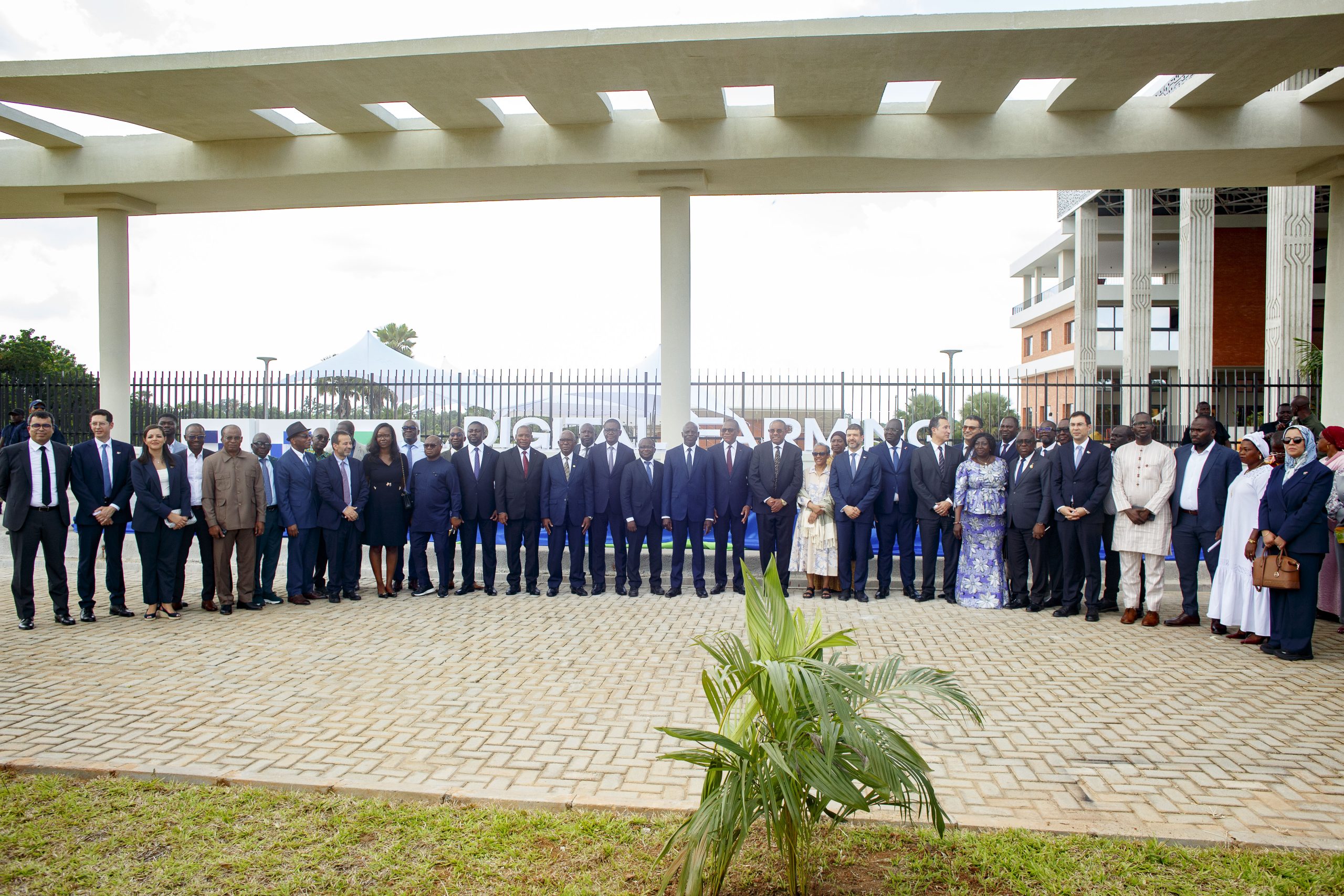
Rabat – Mohammed VI Polytechnic University (UM6P) and Côte d’Ivoire’s National Polytechnic Institute Félix Houphouët-Boigny (INP-HB) have launched a new school in Yamoussoukro to equip young African professionals with the technical and entrepreneurial skills needed to modernize agriculture.
The Digital Farming School (DFS), inaugurated on October 31 with support from OCP Africa and contributions from LEET Initiative, will welcome its first cohort of 50 students on November 9. The school received approximately 4,000 applications during its recruitment campaign.
The two-year program responds to a growing need for professionals who can connect agricultural expertise with digital technology. Rather than focus solely on theory, the school will train students to identify practical challenges on farms and develop technological solutions that respond to local conditions.
Côte d’Ivoire’s higher education, agriculture, and digital transition ministers attended the inauguration. The ceremony was presided over by Higher Education and Scientific Research Minister Adama Diawara, with Agriculture, Rural Development and Food Production Minister Bruno Nabagné Koné and Digital Transition and Technological Innovation Minister Djibril Ouattara as co-patrons.
The initiative comes at a time when African agriculture faces pressure to improve productivity, use natural resources more efficiently, and generate greater economic value from agricultural production. Meeting these challenges requires more than new equipment: farmers and agricultural businesses also need people who understand both the realities of the field and the technologies that can improve farm management.
UM6P President Hicham El Habti said Africa must invest in knowledge and technical expertise to make better use of its agricultural potential. He noted that the continent holds nearly 60% of the world’s uncultivated arable land and argued that the ability to turn this resource into economic value depends on stronger local capabilities.
The school reflects this approach by bringing agricultural sciences, computer programming, and entrepreneurship into a single curriculum.
A 170-hectare farm for hands-on learning
A central feature of the DFS is its 170-hectare experimental farm, where students will test their ideas against real agricultural conditions. The school’s practical approach will allow them to move beyond classroom exercises and assess whether their solutions can address problems faced by farmers.
Projects will cover several areas of digital agriculture, including drone-assisted field mapping, soil analysis, water management, and digital monitoring of farmland. Students will learn to take a project from the identification of a specific agricultural need to the design and testing of a technological response.
The program will also introduce students to entrepreneurship and provide access to incubation support. This component aims to help them assess the commercial potential of their ideas and develop solutions that could serve agricultural businesses and other users across the sector.
Companies and agricultural stakeholders are expected to contribute to the school’s curriculum by identifying market needs and proposing projects that reflect challenges across agricultural value chains.
For INP-HB Director General Moussa Abdoul Kader Diaby, the school demonstrates the importance of cooperation between institutions with complementary expertise. He said the project reflects a shared belief that major transformations require partnerships built on trust and collaboration.
A new chapter in Morocco-Côte d’Ivoire cooperation
The DFS grew out of cooperation established in 2023 between the Ivorian state and OCP Group. It also strengthens the academic and scientific ties between UM6P and INP-HB, which have already worked together on initiatives to develop research and technical expertise in Côte d’Ivoire.
In February, the partners inaugurated the Green Energy Park Morocco-Côte d’Ivoire in Yamoussoukro. The facility, like the new agricultural school, forms part of broader efforts to build local capacity in research, training, and technological innovation.
Together, the initiatives reflect a model of cooperation that links academic institutions and industry with national development priorities. For the agricultural sector, the immediate challenge will be to turn the skills developed at the DFS into solutions that farmers can use and that agricultural businesses can sustain.
The school’s first cohort will begin classes on November 9, marking the start of a program designed to bring digital expertise closer to the needs of African agriculture.