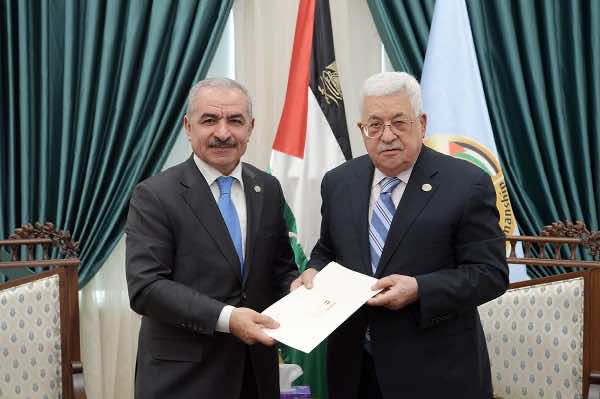
Rabat – Palestinian President Mahmoud Abbas appointed Mohammad Shtayeh as prime minister on Sunday, March 10, and tasked him with forming a new government, reported the Palestinian news agency Wafa.
After the Rami Hamdallah government resigned on January 29, Abbas received Shtayyeh in his office and urged him to form Palestine’s 18th government, according to the president’s spokesperson, Nabil Abu Rudeineh.
Shtayeh will have three weeks to form a new government. The time limit could be extended by two weeks if necessary.
The new team will be tasked with speeding up the reunification of the West Bank and Gaza Strip and forging ahead with parliamentary elections in the West Bank—including Jerusalem—and Gaza “to support democracy,” Abbas stressed in the appointment letter.
The new government must also “keep supporting financially the families of Palestinian prisoners in detention in Israeli prisons and those killed by the Israeli army,” he added.
The Shtayeh government should undertake “keeping the Palestinian people firm in their territory against Israeli settlement policies, defending Jerusalem and its Muslim and Christian holy sites against the Israeli efforts to change their status, and building a strong national economy,” Abbas continued.
Shtayeh served as minister of housing and construction and the director of the Palestinian Economic Council for Development and Reconstruction.
In 2009 and 2016, Shtayyeh was elected to Fatah’s Central Committee.
He holds a Ph.D. in economics from the University of Sussex.
He served as a professor and dean at Birzeit University in the West Bank from 1989 to 1993.
The new government will operate in a climate of anticipation, especially in the Arab political arena, of what is known as the “deal of the century.”
In January, doubts increased about the veracity of a US-brokered peace solution in the Middle East.
Israeli Channel 13 then claimed that the Trump administration’s peace initiative would propose establishing a Palestinian state on 85 to 90 percent of the West Bank, with the capital of Palestine being located in “most Arab neighborhoods” in East Jerusalem.
The White House dismissed an Israeli channel’s claim that the US wanted to propose creating a Palestinian state on most of the West Bank as “unfounded speculation.”