
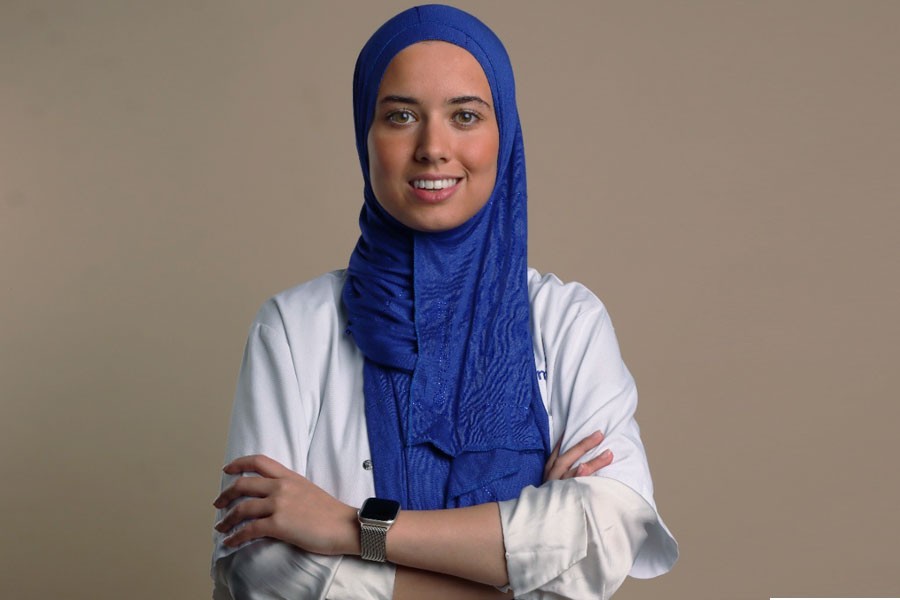
Rabat – Young Moroccan researcher Sara Ben Hmido made history in October by pilot testing the world’s first predictive AI model during live surgery at Amsterdam UMC. The technology is designed to predict complications such as anastomotic leaks in colorectal cancer patients.
This AI model uses real-time patient data, such as blood pressure and blood loss, to predict the risk of complications. Its ability to guide surgeons in making critical decisions, such as opting for a colostomy instead of intestinal repair in high-risk cases, can significantly reduce severe outcomes for patients. In addition, patients deemed low-risk can avoid unnecessary invasive procedures and often be discharged earlier.
Speaking with Morocco World News, Ben Hmido shared insights about the tool and her research. She explained that it focuses on developing a risk prediction model for postoperative complications following major colorectal surgery.
“When provided with a patient’s current pre-operative parameters, our model is tuned to generate an individualized risk prediction for that specific patient,” she added.
Fascinated with AI’s potential to revolutionize medicine
In addition to enhancing the quality of patient care through informed decision-making, the tool has broader implications for healthcare systems, including reducing complications, costs, and workload. “That’s a benefit that’s very welcome for the whole healthcare system,” Ben Hmido said.
She also shared how her passion for integrating machine learning into healthcare started. “My fascination with machine learning in healthcare stems from its transformative potential to revolutionize the field,” she explained.
For Sara, what is truly remarkable is its ability to transform the lives of people all over the world by enhancing patient care and outcomes.
A key focus of her research, she says, is how risk prediction influences the decision making process between a patient and their doctor. This is “quite a challenge” in the implementation, she said, stressing the need to ensure the model supports decision-making without compromising patient autonomy.
To address this, Ben Hmido and her team are working on drafting protocols and recommending legislation to regulate the model’s use. “This way the machine learning model can be used to the benefit of our patients and at the same time make sure their rights are protected,” she said.
Integrating AI into surgical practices comes with unique challenges, including maintaining patient autonomy and ensuring ethical usage. Ben Hmido noted the importance of responsible implementation as “one of the primary ethical considerations.”
“In medicine, decisions directly impact patient lives, requiring transparency and trust to ensure safety and accountability,” she said.
Ben Hmido also mentioned the challenges of handling data, as well as issues of privacy and ensuring the use of high-quality data for training models. “To address these complexities and effectively harness AI’s potential for patient care, a collaborative approach involving technologists, clinicians, and policy-makers is essential,” she said.
“Countries like Morocco have significant potential to play a key role in advancing AI-driven healthcare,” the young researcher said.
In her interview with MWN, Ben Hmido discussed the role of countries like Morocco in advancing AI-driven healthcare, saying that they have “significant potential to play a key role.”
She noted that the key to fully realizing this potential lies in enhancing the quality and reach of healthcare services while building robust digital infrastructure, such as electronic health record (EHR) systems.
“These foundational steps are essential to ensure that AI implementation is both effective and impactful. With these developments, Morocco could not only benefit from AI-driven solutions but also set an example for other healthcare systems,” Ben Hmido remarked.
AI as a complement, but not a replacement for human doctors
The young research addressed fears about AI replacing jobs, a concern that has been widely raised in recent years. She said that AI could complement human expertise, saying: “I firmly believe that AI will not take away any jobs in healthcare.”
“There is simply no replacement for the human touch of a nurse, the empathy and compassion that build trust with patients, or the nuanced decision-making and creativity of a surgeon,” she explained.
For Ben Hmido, medical practitioners should welcome the use of specialized AI as a decision-support tool that can help clinicians make evidence-based choices while ensuring they retain ultimate responsibility for patient outcomes.
AI, she concluded, is a tool that “streamlines processes, allowing healthcare professionals to focus on what they do best—delivering compassionate, personalized care.”