


 Join on WhatsApp
  Join on Telegram
 The social and legal obstacles that irregular migrants face in Morocco. To Read Part 1
“We do it because we have no choice…If you succeed, you will be someone tomorrow, once you enter Europe, it will be like you did not even suffer at all. You should not give up, fight until your prayers are answered, even if it’s not easy.”[1]
I have three primary objectives in this first section. First I look to give readers a human face to the political situation I am describing by adding as many personal testimonies as possible. While this paper does embark on a political investigation of the relations between civil society and the state, I want to emphasize first and foremost that the need to understand these political dynamics derives from my witnessing the immense tragedy and beauty that I have seen by working with sub-Saharan migrants. Yet, the second objective of describing the difficulties these individuals face revolves around the question of real political reform. In other words, one must locate the problems before attempting to grapple with how to solve them. Thirdly, I aim to offer a glimpse of the diversity in the sub-Saharan migrant community through personal testimonies, as well as with the support of a plethora of studies conducted by AMERM, which offers quantitative sustenance to many of my claims.
I will also address some common problems that many migrants encounter. I will first focus on the problems relating to their legal status in Morocco because, as many activists argue, this is the root cause of their vulnerability. Thus, special attention will be paid to the main law governing irregular and regular migration in the Kingdom of Morocco, Law 02-03, as well as the gap between theory and practice in terms of national legislation, the processes carried out by the relevant authorities, and the international conventions Morocco has signed relating to the rights of refugees and migrants workers. The problems that stem from their lack of legal protections provokes cases of police and military aggression, racial profiling by authorities, higher housing prices, lack of access to proper health care, worker exploitation, and, in some cases, aggression and racism from Moroccans.
Part 1: Common legal and social challenges throughout Morocco; the gap between legal theory and practice.
As many activists have highlighted, there are contradictory trends in terms of Morocco’s protection of migrant rights. Key activists from several Moroccan NGP’s, such as GADEM in Rabat and ABCDS in Oujda, as well as the two largest human rights associations, AMDH and OMDH, have often highlighted the conventions that Morocco has signed relating to the rights of refugees and the rights of migrants. Morocco ratified the international convention relative to the rights of migrant workers and the members of their families in 1993, largely thinking of its own emigrant population throughout the world. However, this is also a valuable asset in terms of sub-Saharan migration in Morocco and combatting exploitation and racism within Morocco.
Furthermore, Morocco was one of the first countries to ratify the convention relative to the status of refugees in 1951.[2] As GADEM affirms, the national legislation relative to regular and irregular migration in the Kingdom does adopt some progressive stipulations from these international conventions, such as the protection of pregnant women and unaccompanied minors, as well as the stipulation that no person may be deported to places where they could be in danger or threatened.[3] However, the central problem relates to the gap between theory and practice, especially vis-à-vis the international conventions that Morocco has ratified.
A representative of GADEM described the necessity to use the law as a positive weapon in the struggles of migrant workers:
Mais ce que je veux dire, c’est que dans le combat pour le respect des droits des travailleurs immigrés, le droit n’est pas en lui-même un obstacle supplémentaire. C’est déjà un élément favorable dans le rapport de force avec les employeurs et les administrations, et le simple fait de savoir—et de pouvoir convaincre—qu’on est dans son droit rend plus fort. Le combat, il est contre les autorités politiques et administratives qui refusent de faire respecter le droit du travail et contre les employeurs qui profitent de la vulnérabilité des travailleurs immigrés pour les surexploiter sans assumer leurs responsabilités.[4]
However, the other common practice of collective and massive deportations, which occurs throughout the Kingdom and with little to no oversight, is a practice that is not addressed in law 02-03, but it is explicitly forbidden in the international convention relating to the rights of migrant workers in Article 22.[5]
As the GADEM and Justice without Borders project affirms:
From the point of view of Moroccan legislation, Law 02-03 is far from being in accordance with the international texts signed by Morocco and in fact contains guarantees that fall quite short of those provided for in the Convention on Migrants’ Rights, and contains provisions, such as the criminalization of migrants, that violate the principle international texts on human rights. [6]
Furthermore, many activists and personal testimonies cite the lack of a translator, for example, access to a lawyer, and the stipulation that a migrant may appeal his/her expulsion decision within 48 hours of his/her expulsion notice. As an activist from OMDH argued, 48 hours is hardly sufficient time to prepare an appeal case, or even find a lawyer who could be involved.[7] Additionally, the massive deportations that take place throughout the Kingdom typically take on a racially charged character, based on various testimonies of sub-Saharan African immigrants who were arrested, irrespective of documentation. In other words, what many activists call the “chasse aux noirs,”[8] appears to be a reality in some cases.
These indiscriminate controls lead to the arrests of individuals who have not committed any infractions regarding their stay in Morocco, either because their request for asylum is still being processed or they were recognized as refugees by the UNHCR, or also because their passport and visa were in order or had an entry stamp allowing for less than three months for countries for which a visa is not required. According to various testimonies, the documents in question were at best ignored, and at worst torn up by security forces.[9]
Finally, the criminalization of any Moroccan who is seen helping a sub-Saharan immigrant (law 02-03) appears to play a role in the discrimination that many migrants experience, vis-à-vis the Moroccan population. However this seems especially true in terms of public transportation.[10] Yet, as the below section on divergent realities affirms, this discrimination seems to vary based on the migrant’s proximity to border areas. In other words, the closer one is to Nador, Tangier, and Oujda, the more likely there will be controls in terms of the authorities, and the more likely the Moroccan population is to shy away from supporting the sub-Saharan immigrant population due to the visibility of the police and border controls and the high number of collective deportations towards the border regions.[11]
Part 2: Divergent realities for sub-Saharan migrants in Morocco
The location of migrants throughout the Kingdom also affects their social realities. For example, the General Coordinator of MSF-Spain affirmed that, “access to health care has improved for migrants in Rabat, Casablanca, and even Oujda, however the most vulnerable migrants are those living in the woods and caves in Nador,” because there are currently no organizations providing humanitarian assistance in Nador, except for the occasional medical caravans organized by Medicines sans Frontieres.[12] Thus, special attention will be paid to the divergent realities faced by these individuals in the border cities such as Tangier, Nador, and Oujda, as compared to the key urban centers of Casablanca and Rabat.
The different experiences of immigrants living throughout the Kingdom will demonstrate other challenges. For example, potential asylum seekers living in Oujda have a difficult time traveling to the UNHCR in Rabat because they are afraid of taking the train and getting caught or simply because they do not know about the UNHCR. In other words, immigrants and asylum seekers living far away from Rabat face particular challenges if they want to seek assistance from the International Organization for Migration(IOM) or the United Nations High Commission for Refugees(UNHCR) in Rabat.
Diachari Poudiougo, a Ph.D candidate at Mohammed I University in Oujda, also stressed a differentiation in terms of working in the diverse urban areas in Morocco. He is Malian in origin and has lived in Oujda for ten years. He argues that:
“A l’exception de quelques grandes metropoles du Royaume dont Casablanca et Rabat où les travailleurs migrants arrivent souvent à travailler dans le secteur de l’informel, la situation professionnelle des migrants subsahariens reste très critique dans les villes comme Fes, Oujda, et Nador. S’il est vrai qu’il existe une minorité qui arrive à se débrouiller dans l’informel au Maroc, il faut reconnaitre que des milliers de migrants sont souvent obligés de mendier pour survivre. »[13]
Furthermore interviews with activists and my own personal experience in Oujda hinted at intensified discrimination around the border areas, as compared to the urban areas of Rabat and Casablanca. In other words, there are specific red zones, as one approaches the Moroccan-Algeria border and especially as one nears any border crossing into Spanish territory, such as near the enclaves of Ceuta and Melilla.
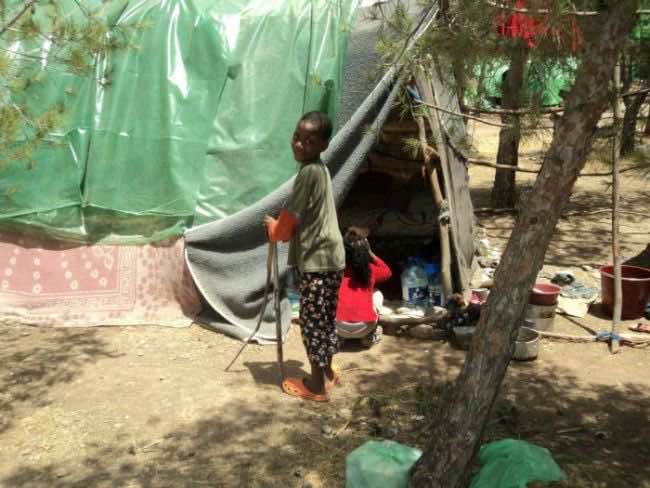
The most sensitive area remains those points of departure near Nador, where raids occur regularly and with marked police violence. I was told many times to be extremely careful in Nador, especially if I want to interview sub-Saharan immigrants there. The former president of the Council of sub-Saharan Migrants in Morocco warned me that it is impossible for foreigners to even hail a taxi, especially if they are accompanied by “des noirs.” He has traveled many times to Nador and has personally experienced this discrimination. There are two NGO’s in Nador that document police aggression, as well as other NGO’s in Oujda who follow suit. These groups typically run into issues with the authorities.[14]
The preliminary findings of the EU study also suggest a different experience among sub-Saharan immigrants and the Moroccan authorities based on geographic location throughout the Kingdom. After interviewing fifty sub-Saharan immigrants in an irregular situation in Rabat, Casablanca, and Oujda (note the exclusion of Nador, the most sensitive area), they conclude that: “On rapporte des cas de répression et de violence excessive aux frontières et puis une attitude de “laissez-faire” à l’intérieur du pays et dans certain grandes villes.”[15] While this assertion is not always the case, as many raids occurred in Rabat throughout 2012, it appears that the authorities are more severe along the border areas. Furthermore this study did not interview immigrants in Nador, probably due to the extreme repression and police violence in this urban area.
Additionally, Mr. Cantero of Medecins Sans Frontieres (MSF) stressed at the conference where these findings were presented that “in terms of access to health services and police aggression towards migrants, it is the absolute worst in Nador. The police sometimes don’t even ask to see documentation…”[16] He did state that there were improvements, in terms of access to health care in Oujda. While Oujda remains the key point of deportation and aggression, it seems that the high number of Moroccan and international NGO’s that work there do indeed play a role in protecting and providing essential services to sub-Saharan migrants. I have inserted here, a very personal account of my experience on June 21, when I was able to travel to the forest for the first time. I have left it as I wrote it right after I returned.
[1] Interview with Nigerian migrant in Takadoum, April 25, 2012.
[2] Information Document for the Conference on “Migration irreguliere sub-saharienne au Maroc: Reponses politiques actuelles et defies a relever,” section 1.2 International Conventions as instruments to guarantee legal rights, July 4, 2012.
[3] “The Human Rights of Sub-Saharan Migrants in Morocco,” report prepared by GADEM in the Justice without Borders Project, 2010.
[4] Julinet, Stephane, Charged with the programs of the rights of foreigners and advocacy in GADEM; “Droits des travailleurs immigrés entre les conventions internationals et la legislation marocaine(code du travail marocain)”; speech given at the first national congress of the Syndicate collective of Immigrant Workers in Morocco, July 1, 2012.
[5] “The Human Rights of Sub-Saharan Migrants in Morocco,” report prepared by GADEM in the Justice without Borders Project, 2010. P 14.
[6] Ibid, 15.
[7] Abdelaziz El Aatiki speech in the conference, “Les migrants en situation irreguliere au Maroc: Entre droits et justice,” July 4, 2012, section “Acces aux droits fondamentaux. »
[8] Cited by Camara Laye and Marcel Amiyoto of the Council of sub-Saharan Migrants in Morocco at the AMDH press conference, at the AMDH Rabat Office, June 14, 2012.
[9] “The Human Rights of Sub-Saharan Migrants in Morocco,” report prepared by GADEM in the Justice without Borders Project, 2010. P 16.
[10] Interview with Youssouf Chemlal of OMDH at the OMDH office in Oujda, June 20, 2012.
[11] Ibid.
[12] Interview with David Cantero, Chief Coordinator of MSF-Spain in Morocco, January 24, 2012 at the MSF Office in Rabat.
[13] Poudiougo, Diachari, “L’immigration subsaharienne et la protection des droits des travailleurs migrants : le Maroc « entre le marteau et l’enclume. » Phd thesis in International Law, University of Oujda. P.4
[14] Interview with Camara Laye, former president of the Council of sub-Saharan Migrants in Morocco, November 20, 2012. Both ABCDS and the Rif Association for Human Rights tend to have the most contentious relationship with authorities.
[15] IPPR, CCME, PICUM project, « Au-dela de l’irregularité, » preliminary findings shared at the Conference, « Les migrants en situation irreguliere au Maroc ; Entre droits et justice, » July 4, 2012.
[16] Quotation from David Cantero, General Coordinator of MSF-Spain in Morocco, at the IPPR, CCME, PICUM Conference in workshop 1, “Lutter contre la discrimination en matiere de droits des migrants en situation irreguliere,” July 4, 2012.
The views expressed in this article are the author’s own and do not necessarily reflect those of the Fulbright Program , Morocco World News, nor other affiliated organizations


