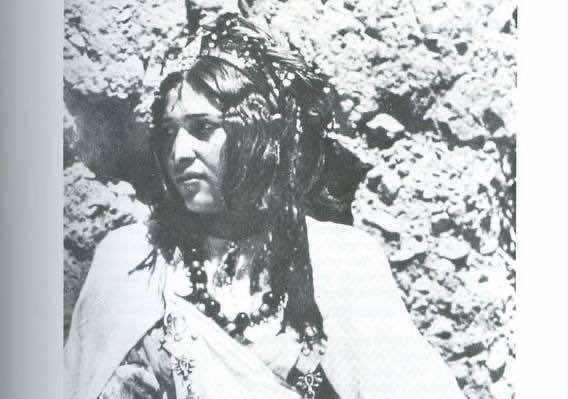
Goulmima – When language is the only weapon a Berber woman possesses in a time when a woman’s voice can travel the vast valleys of the High Atlas pleading the echo to free her from society and from herself, Mririda rises from a failed marriage and poverty and chooses to defy the norms that characterized the Valley of Tassaout (the region of Marrakech).
Language has been a major characteristic defining generations of cultures and communities. It evolved as people developed new means of communication. However, it has become a rare thing to find a community that celebrates its linguistic diversity without favoritism. Language is not a mere block of words that favors one culture over another. Some languages are celebrated over others when a written system is established to maintain them. Other languages were fated to be transmitted through the word of mouth; as is the case with the Berber language.
Berbers in North Africa have been circulating a language that dates centuries back. They claim to have a written system called Tifinagh, but this alphabetic script, though widely used at an early age, has been preserved and presented to the modern world by a Berber population in northern Mali called Touareg.
Oral language has always been a significant trait in the preservation of Berber culture in Morocco. Fatima Sadiqi emphasizes this issue in her book “Women, Gender and Language in Morocco,” she states:
Given the place that orality occupies in the Moroccan socio-cultural context, and given the high rate of female illiteracy in Morocco, Moroccan women usually use oral communicative strategies for self-expression and self-assertion. These strategies include oral genres (poems, folktales, etc.) and code-switching (mixing of two languages)… in both strategies, Moroccan women exhibit a typical and creative use of language(s) and deeply female ways of expressing the self and resisting patriarchy.
Had Berber women known of the suffragists and the women liberation movements that ultimately granted women a sophisticated status in societies around the globe, they would not have been interested to join the feminist wave. Unknowingly, Berber women have been the custodians of their language. Thanks to illiteracy and limited exposure to the external world that Moroccan Berber women carried Tamazight and protected it by resisting time, and invading patriarchal thought control.
Berber women excelled in celebrating their language—not as a matter of choice, but rather a lack of options. Though this idea incarcerated the Berber woman in her own cultural and linguistic shell, it has given her an opportunity to focus on how to maintain her culture internally and decorate the shell from within. She does so by expressing herself in different literary genres on the one hand, and on the other hand enjoying the credit of transmitting it from one generation to the next.
Mririda: a controversial Berber poetess whose poetic talent has engraved her name in Berber’s memory
Her name is Mririda N’Ait Atiq; an illiterate woman with an incredible ability to improvise poetry. Her story was the focus of one of Rene Euloge’s works on Berbers in Morocco in 1927, called “Mririda n’Ait Attik. Les Chants de Tassaout: Traduits du dialecte Tachelhait par Rene Euloge”. Euloge arrived to Demnat in 1923 where he worked as a teacher and gradually immersed himself in the culture of the Atlas Mountains’ Berber tribes.
“In the Moroccan High-Atlas Mountains, Tassaout River penetrates Eastern Marrakesh, and there lays a very vast valley ended on one side by Irhil M’Goun Mountain (4070 m). The story of Mririda goes back to the 20th century. She underwent the fate of many Berber women in that region. She married at a very early age, then fled the hardship of the valley to engage in one of the famous professions of Atlas Mountains’ Berber women: becoming a pop-artist or Sheikha “dancer, singer and poet.”
Taneddamt-poetess-Mririda toured from market to market and performed her poetic acts like a female troubadour. Fatima Sadiqi adds in her book that “Mririda N’Ait Atiq was monolingual and used only Berber as a form of self-expression. The first poem is called “Mririda” and was translated from Berber into French by Rene Euloge (1959) and from French into English by Moha Ennaji (2001).
Mririda
People called me Mririda, Mririda,
Mririda, the agile rennet of meadows…
…
He who takes me will feel
My heart beating in his hand
As I often felt under my fingers
The crazy heart-beats of the rennet,
In the nights bathed by the moon
He will call me Mririda, Mririda,
The soft nickname that is so dear to me
For him I will release my sharp “zrarit” -cries of joy-
My strident, prolonged “zrarit”,
That men admire and women envy,
And such that the valley has never witnessed …
As indicated in her poem, Mririda is just a stage name; her real name remains a mystery. Mririda depicts the tender Berber woman who lives in the distant villages whose strong personality gives her confidence in mesmerizing the man she chooses and to whom she will offer her voice through “zrarit” to please only him.
It is clear that Mririda is on a quest to settle with the right man. However, her journey does not give her the credit she deserves for her contribution to Berber poetry. In fact, Rene Euloge “could not trace her when people in the region abstained from talking about her; a situation that Dr. Maxime Rousselle attributed to Mririda’s reputation.”
She wrote about love, divorce, trouble in the household where the new bride has to live with the mother and sisters in law. She expressed herself in a way that women at the time rarely dared. She freed herself from within and exposed her mind to the public. Mririda, did not graduate from renowned schools with higher degrees, but she was a graduate of Life where she openly voiced her inner thoughts as a means of resistance and rebellion.
© Morocco World News. All Rights Reserved. This material may not be published, rewritten or redistributed