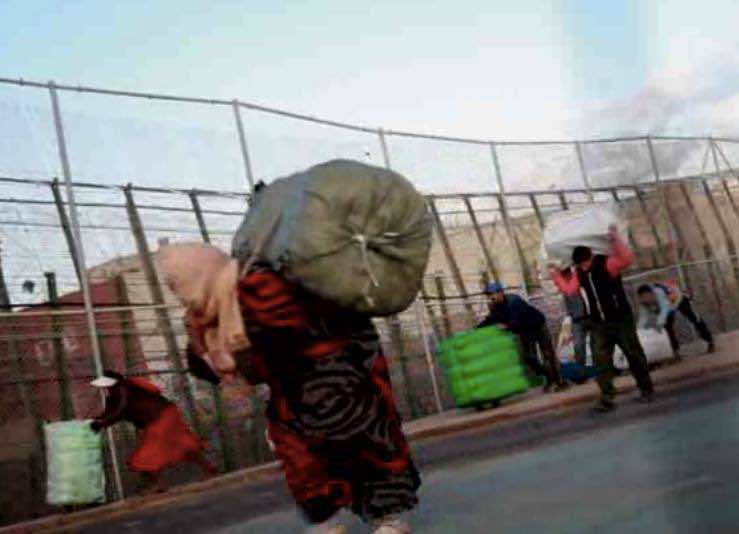
Goulmima – Watching the scene from a bird-eye view gives the impression that it is a caravan of animals carrying goods. A little closer up features mopeds loaded with large bundles traveling back and forth a fence.
To understand the complete picture, it is necessary to examine the relationship between Morocco and Melilla and Ceuta, the two Spanish enclaves in the African continent.
Business transactions generally take place within luxurious hotel rooms or offices in a skyscraper or perhaps in an office downtown. However, the fences that divide Morocco and Spain redefine this fixed image and reveal an overwhelming atmosphere of covert deals at the expense of lower-income Moroccans, a great majority of them women. In addition to their financial difficulties, these women are often dehumanized because of their employment.
Porteadoras, “mule ladies” or “bale workers,” carry duty-free goods from Spain ranging from clothes to electronics. In most cases, they haul the goods on their backs, or when the load is too heavy they roll them up the hill from Melilla towards Moroccan territories.
In a video released by the New York Times this past week, “A Borderline Where Women Bear the Weight,” Moroccan carriers disclose their suffering to the world. One of the women in the video goes as far to state, “This job is a prison without being in prison.”
Melilla’s “Barrio Chino” border crossing has always occupied the minds of Africans who fantasize about Europe. Every day, thousands of young and old Moroccans, line up and wait hours before the door of the fence opens to embark on the journey towards the unknown. There is a saying in Morocco: “Whoever enters the sea is lost until he returns.” In other words, these women risk their lives by transporting the heavy bundles that wait on the other side, full of hope, only to be carried on tired backs that struggle to find their way through the crowd.
Poverty, widowhood, divorce, disabled husbands are common stories that connect these women, filled with smiles of both gratitude and remorse. Zehra Khechach, is a 65-year old asthmatic, and earns $12 a day for carrying a bundle as big as a fridge on her fragile body, often failing her so that she must roll her packs instead. She is a mother of eight children. “After marrying, my husband lost his sight, so I had to start working to feed my family,” she said.
Another woman who is Zehra’s daughter is a victim of ignorance. After a marriage that lasted 16 years, Maria, 37-years old, felt a lump in her left breast and was forced into divorce by her in-laws who feared that she would contaminate them with her illness. She felt obliged to feed her daughters by working hauling bales for four to seven dollars per trip. Her only wish is that her daughters “finish school, so it helps them find a good job. I pray to God that the men they marry can offer everything, so they don’t have to work where I do. This workplace is sure death.”
Lately, these women have been facing male competition at the fences. In addition to the Darwinian competition that allows for only the strongest to succeed, male labor has made it much harder, and consequently, the trips have become much more dangerous for women.
The regional governor of Melilla, Abdel Malik El Barkani said in the video, “There some people who say borders divide, I say borders unite. Any decision regarding this border crossing has to be a matter for Morocco and Spain.”
The New York Times reported that Juan Jose Omborda, Melilla’s chief executive, says that he “has offered to create a bigger border crossing to relieve the pressure, but the Moroccan government has not agreed.” Right now, he said, “the Moroccan government is in control, opening the borders to this activity and closing it at will, fueling the need to hurry through the turnstiles while they are open and creating dangers.”
The last two decades witnessed smooth traffic at the borders until Spain addition to the European Union, after which control measures became stricter. Moroccan and Spanish governments interfere from time to time in order to stop this illegal practice; until an official step to grant these women a means to make money with dignity, the story of bale workers continues to remind the world that some women in Morocco are still called “mules.”
Edited By Monica O’Hearn
© Morocco World News. All Rights Reserved. This material may not be published, rewritten or redistributed