 Join on WhatsApp
 Join on Telegram
By Jamal Saidi
Morocco World News
Casablanca, March 12, 2013
I assume that the hadiths that discriminate against Berbers cannot be authentic due to the fact that they do not reflect the spirit of equality conveyed in the Quran, where faith in Islam is the main criterion, not race. There are many “Hadiths” where the prophet allegedly talked about the “evil” of the Berbers.
A strange Hadith is narrated by Abu hurayra in which he cited that a stranger came and stayed near the prophet. “Where are you from?” the prophet allegedly said. “I am Berber,” answered the man. “Get away from me!” the prophet allegedly replied. Once the stranger left, the messenger of God allegedly said, “Their (the Berbers) faith does not exceed their throat.”1
In another Hadith, the prophet is allegedly reported to have said that “those who wish to give Sadaka or alms but do not find anyone but a Berber, do not give it.”2
Three years ago, amidst the tension that arose between Egyptians and Algerians over a football match, similar Hadiths were quoted. An Egyptian cited the aforementioned sayings and many more, in a bid to prove the inferiority of the Berber ethnicity in reference to Algerians. Berbers are spread throughout the entire region of North Africa.
Islam does not discriminate against its followers based on their race or language. It can, therefore, reach people from different countries and continents. It started as a religion of minority in the Arab peninsula and now it is one of the largest religions in the world. Though Arabic is the language of the Muslim holy book, Arabs are not the majority of Muslims. Indonesia remains home to the largest Muslim population, with around 250 million.
Islam, I believe, abhors racism among its disciples, and this is reflected in a number of religious texts. Yet, some of what I call false scripts which stigmatize Amazigh (Berber) people are still quoted.
Allah almighty said, “O Mankind, We created you from a single (pair) of a male and a female and made you into nations and tribes, that you may know each other. Verily the most honored of you in the sight of God is he who is the most righteous of you” (Quran 49:13).
This is a universal verse that goes beyond race and language to reach the notion of mankind in its broadest sense. The color of one’s skin and one’s tribe and nations are not of great weight in the sight of God. What matters is one’s good deeds and intentions. There is no room for prejudice and stereotype. Racial differences are God’s manifestation on earth, and no superiority of a race over another is meant to take place. In this regard, it is stated in the Quran “of His signs is the creation of the heavens and earth, and diversity of your tongues and colors.” (Quaran 30: 22).
Prophet Muhammed (PBUH) took similar stance in his Revealed Divine Book, saying “(O people! Your God is one and your forefather (Adam) is one. An Arab is not better than a non-Arab and a non-Arab is not better than an Arab, and a red (i.e. white tinged with red) person is not better than a black person and a black person is not better than a red person, except in piety.”3
Disregarding racial differences is, therefore, an Islamic virtue, a virtue that was highlighted back in 1948 by historian Professor A.J. Toynbee. The latter said:
The extinction of race consciousness between Muslims is one of the outstanding achievements of Islam, and in the contemporary world there is, as it happens, a crying need for the propagation of this Islamic virtue.4
Yet, this virtue sometimes suddenly disappear in some “Islamic sources,” precisely some of the Hadiths or the sayings that were ascribed to the prophet of Islam. Unlike the Quran, not all the Hadiths were written during the Prophet’s life; it took almost a century and half after his death to be fully written. The period is very long and, therefore, human’s memory may not always be accurate. Hence Islamic scholars drew distinction between Hadiths, depending on their validity. They can be authentic (Sahih), good and reliable (Hassan), or weak and of doubtful origin (Daeef).”
Unfortunately, there are many other religious reports of the sort. Muslim Scholars should highlight the non-validity of similar Hadiths or give some logical arguments to reject any form of discrimination towards the Amazigh people. In a country where the Amazigh are not a minority, it is advisable to ban the circulation of such fake Hadiths.
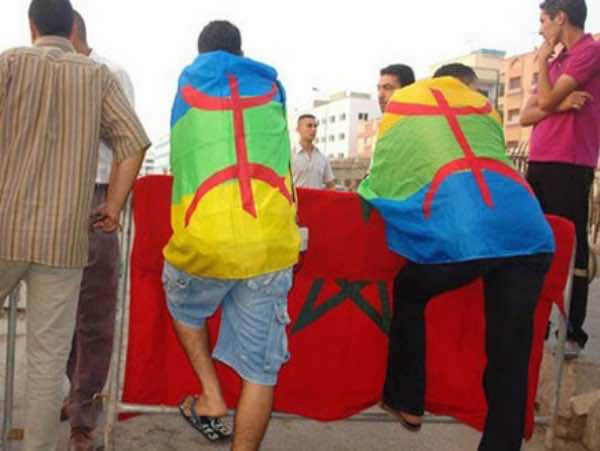
Morocco still has a long way to go in the journey of rehabilitating the Amazigh language and civilization as a component of the country’s identity, from teaching the language in school, to giving the pre-Islamic history of Imazighen its due, to rejecting fake religious texts that discriminate Berbers because of their ethnicity.
Sources:
1. Narrated in Mosnad Ahmad
2. Ibid
3. Ibid
4. A.J. Toynbee, CIVILIZATION ON TRIAL, New York, p. 205
The views expressed in this article are the author’s own and do not necessarily reflect Morocco World News’ editorial policy
© Morocco World News. All Rights Reserved. This material may not be published, rewritten or redistributed