Rabat – With its numerous ongoing intra and inter-states conflicts, the MENA region is generally seen as a highly unstable hub of wars and confrontations, demonstrated by its ranking as the world’s most violent region by the Institute for Economics and Peace in its most recent Global Peace Index.
Such a climate of instability requires that governments engage in deep military investments to defend disputed territorial integrity, sustain national security, deter increasing terrorist threats, and maintain a strong image, in the face of power rivalries among many of the region’s states.
Despite mounting security challenges and constant insurgencies, the MENA region is still home to some of the best armies in the world, as evidenced by the increasingly powerful military forces in Turkey, Israel, and Iran.
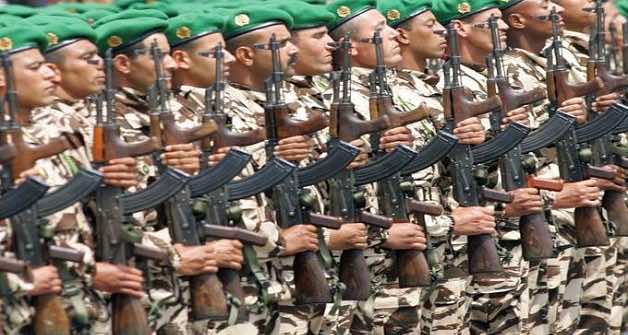
According to the most recent Global Firepower (GFP) index, Morocco can take pride in its military power, which is among the strongest in the MENA region.
The GFP, which provides a comprehensive assessment of countries “military might, as it entails criteria such as military budget, home-based security industry, active manpower, quality of military equipment, sailors and pilots that can be relied on in case of emergency, diverse range in the defense arsenal, etc, has ranked Morocco 54th strongest army in the world, and 8th in the MENA region.
Morocco, whose active personnel is estimated at 195,000 (175,000 army personnel, 13,000 in the Royal Air Force and 7,800 in the navy) also possesses the 5th largest armed forces in the MENA region.
Moreover, the kingdom’s GFP score at 0.8702 (with low scores indicating military might) illustrates its undisputed experience in securing stability and security in an otherwise conflict-torn region, observers.
However, Morocco’s one weakness remains its small military budget. With a current defense budget of USD3.5 billion, Morocco is one of the lowest spenders in the region; comparatively,Saudi Arabia spends USD76.7 billion on its military, a number greater than that of the next five largest MENA spenders combined.
According to recent reports, Morocco is planning to engage in a comprehensive program of military equipment recapitalisation.
The defense budget is set to increase to $3.9 bn by 2022, while a number of surface-to-air missiles, fighters, and other state-of-the art military equipment were recently purchased, as demonstrated by the kingdom’s acquisition of the China-made Sky Dragon 50–the latest generation of air defense system.
“In the next five years, Morocco’s goal is to acquire eight GM radars, 16 stations for long-range radars, and several other stations for medium and low-range radars,” military expert Abdelhamid Harifi recently told the press, underlining that Morocco possesses some of the best-performing F16s in the region.
Here is Forbes’ ranking based on the GFP index:
10) United Arab Emirates
Active Personnel: 63,000. 2017 budget: unknown. GFP score: 0.9087
9) Iraq
Active Personnel: 64,000. 2017 budget: $19.3bn. GFP score: 0.8961
8) Morocco
Active Personnel: 195,000. 2017 Budget: $3.5bn. GFP score: 0.8702
7) Syria
Active Personnel: 142,500. 2017 budget: unknown. GFP score: 0.7603.
6) Algeria:
Active personnel: 130,000. 2017 Budget: $10bn. GFP score: 0.4366
5) Saudi Arabia
Active personnel: 227,000. 2017 Budget: $76.7bn. GFP: 0.4302
4) Iran
Active personnel: 523,000. 2017 budget: $16bn. GFP: 0.3933
3) Israel:
Active personnel: 176,500. 2017 budget: $18.5bn. GFP: 0.3476
2) Egypt:
Active personnel: 438,500. 2017 budget: $2.7bn. GFP: 0.2676
Turkey
Active Personnel: 355,800. 2017 budget: $8bn. GFP: 0.2491