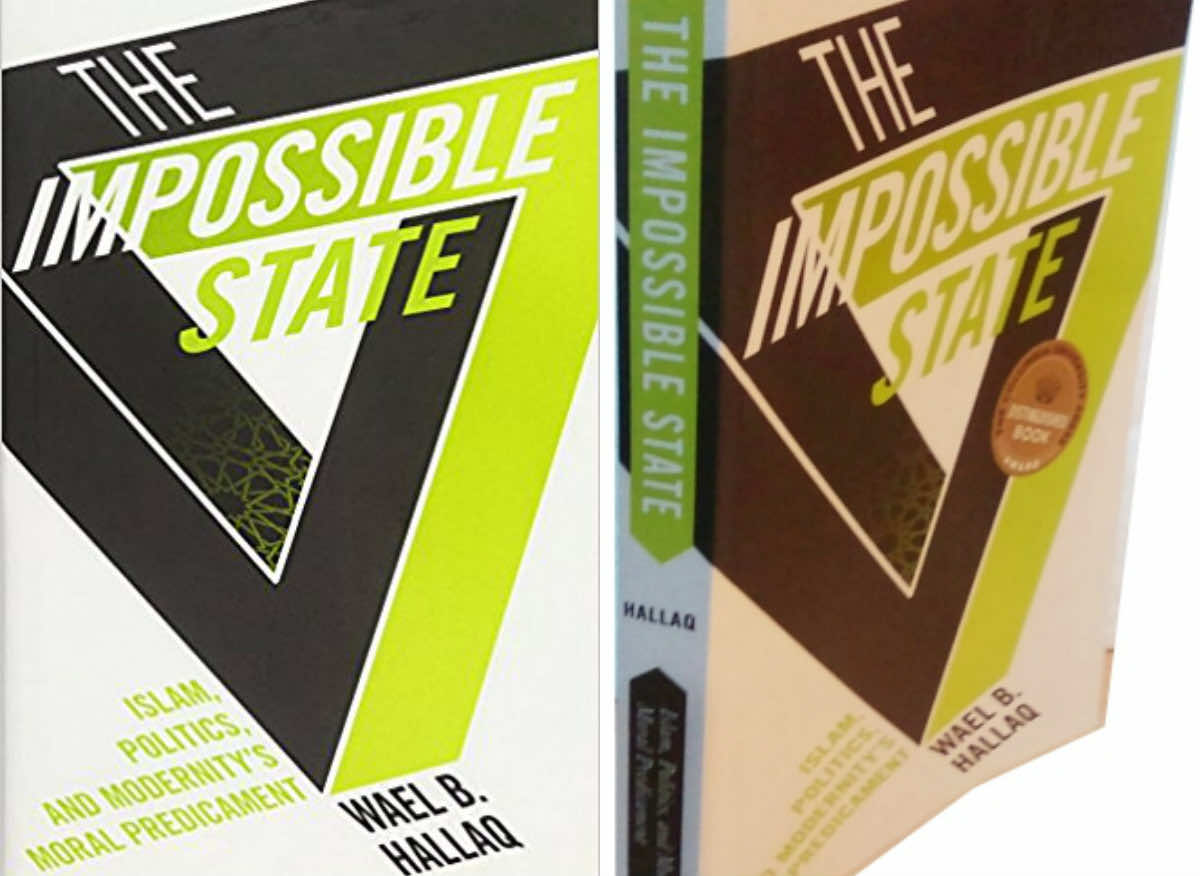
New York – Professor Wael Hallaq’s The Impossible State is one of the most important, groundbreaking and erudite books on the subject of “modernity and Islam.” It should be read, indeed studied carefully, by every person who is even slightly concerned with the calamitous situation that our global community and planet are undergoing and have been suffering from for centuries.
The fact that this disease called modernity is getting exponentially more lethal with the passage of time is hardly a controversial statement. We can readily observe evidence for this claim in the symptoms this illness continues to exhibit, such as the massacre of the Palestinian people, a genocide which large segments of the “human” population, patently devoid of our last shreds of humanity, witness in silence (another symptom). As I have written before here and elsewhere, we are all accountable for this genocide. Cowardice and silence are not an option.
Although The Impossible State does not specifically address the tragic situation of the Palestinians, it does elucidate its cause, which is also the source of the discontent, emptiness and fragmentation most modern subjects experience on a daily basis. Professor Hallaq takes a multidisciplinary approach to diagnose the problems of modernity and, grounded in his unparalleled knowledge of Islamic history in general and the Sharia in particular, produces a unique critique of modernity from out
side modernity.
By seriously engaging epistemes different from the one it assesses, Professor Hallaq shows us that alternative, more ethical ways of life, and different political formations existed for millennia and can exist again. By looking outside the assumptions that created the dire situation the world is in and using Islamic premodernity and its postulations, Professor Hallaq analyzes the problems of modernity. He asserts, among many other things, that the present Muslim crisis is not actually “Muslim:” It does not arise from modern Islam but from modernity itself.
The Impossible State successfully escapes the thought-prisons of the liberal state and looks for viable ideas elsewhere. Professor Hallaq proposes capitalizing on Islamic history as “a resource to face the challenges of the modern project, a project that has proved incapable of solving even those problems of its own making.”
Although the Sharia is institutionally defunct and the desire to restore it as such would be absurd and impossible, “much that is psychologically and spiritually latent has survived” and can be used as a moral resource (p. 13). Indeed, many Muslims attempt, to the best of their ability, to orient their lives according to the guidance and wisdom derived from the Islamic tradition, albeit constrained as they necessarily are by the all-penetrating mechanisms of the state.
Using the moral Sharia-centered paradigm as an example and challenging the liberalist universalizing theory of progress, Professor Hallaq demonstrates that the modern state is neither the pinnacle of human development nor will it be everlasting. Alternative modes of thinking may lead us to healthier results.
The ideas in this book are not only intellectually stimulating, bold and highly original, but also profoundly necessary and urgent. If we are to change course and prevent further destruction and genocides, which are direct results of a utilitarian worldview and the split between fact and value that took place during the Enlightenment, we must acknowledge that the thought-processes that led us to our present dilemmas will not lead us out of them.
Throughout the book, Professor Hallaq capitalizes on the concept of paradigm as a tool to capture the essence of different systems, to refer to their sine qua non aspects, those features without which a thing would no longer be that thing. Building on Carl Schmitt’s notion of a central domain, Professor Hallaq explains that when a domain becomes central, all the problems of the peripheral domains are solved in terms of the central one. For example, European technical progress in the nineteenth century was paradigmatic.
All other areas, whether moral, political, social, and economic, were impacted by progress and any problems in those areas were solved through technical progress. It was a “religion of technical miracles, human achievements, and the domination of nature” (Impossible State, p. 7). Whereas in the age of traditional religion, the moral development of the individual was the central domain, in the technical age, material progress is valued above all other achievements.
The concept of paradigm is extremely useful to distinguish the aspects of a tradition that make it what it is, those things that are representative of it rather than outliers. Certain scholars, for instance, are paradigmatic, (for example, Abu Hamid al-Ghazali), whereas other peripheral figures, famous as they may have become in “history” cannot stand as representatives of the tradition.
Sixty-four years ago, Muhammad Asad perceptively recognized this occurrence, this shift towards a “theology of progress,” which has only gotten more pronounced: “The average European – whether democrat or communist, manual worker or intellectual – seemed to know only one positive faith: the worship of material progress, the belief that there could be no other goal in life than to make that very life continually easier or, as the current expression went, ‘independent of nature’.
The temples of that faith were the gigantic factories, cinemas, chemical laboratories, dance-halls, hydroelectric works; and its priests were the bankers, engineers, politicians, film stars, statisticians, captains of industry, record airmen, and commissars. Ethical frustration was evident in the all-round lack of agreement about the meaning of Good and Evil and in the submission of all social and economic issues to the rule of ‘expediency’… The insatiable craving after power and pleasure had, of necessity, led to the break-up of Western society into hostile into hostile groups armed to the teeth and determined to destroy each other whenever and wherever their respective interests clashed.” (The Road to Mecca, Louisville, KY: Fons Vitae Publishing, 2005, pp. 70-71).
Back to The Impossible State: It begins by stating its conclusion, with which I fully agree, that the “Islamic state” is an impossibility and a contradiction in terms. Although Muslims (and non-Muslims) take the modern state for granted, accepting it as a natural reality and a timeless phenomenon, the state is in fact a modern event, one that was born out of European history and has specific characteristics.
Although some Muslim scholars think the state is neutral and even compatible with the Sharia, they fail to realize the inherent contradictions between the two systems, which are grounded primarily in modernity’s moral predicament. All political and economic problems derive from this moral predicament.
The state has fundamental properties without which it would not be a state, although the content of the state can change. Of course, every state is different, “just as every snake or hawk is a unique creature.” However, “snakes and hawks, by their nature, live and perform certain functions that are particular to them, however much their individual members may differ in strength, shape or aggressiveness. And the state is a particular modern creature that fulfills fairly well-defined functions of governance and dominance…A state is a state, just as a hawk is a hawk, and not, say, a sparrow” (See, Wael Hallaq’s Shari’a, p. 361).
The state is a historical product grounded in specific metaphysics and has the capacity to thoroughly penetrate culture and society, shaping them in ways conducive to forming state subjects. There are five essential characteristics of the state: (1) It is a specific historical product and is distinctly European in origin. It arose organically out of European conditions and because of this, “the state has been possible only in the West;”(p. 25, citing Carl Schmitt); (2) Sovereignty and its metaphysics: the state is the sole author of its own will and destiny.
Nothing higher that the state and its laws exists; (3) The law represents the will of the state and it is the most paradigmatic manifestation of sovereignty. Sovereignty is essential to the state and the capacity to produce law is a related essential attribute; (4) A rational bureaucratic machine, which is an extension of the legal order and shows a rational type of domination. The central features of this domination are “voluntarism and systematization”(p. 31); (5) Cultural hegemony and making all things, including culture, political. Society is not separate from the state as the state permeates all or most aspects of existence.
By merely reflecting on the characteristics of the state, it is quite apparent that they are in direct conflict with the metaphysics, value system and worldview of the Sharia. The book demonstrates in detail that the state is not value free or a blank canvas with the capacity to become “Islamic” as many scholars seem to think.
By accepting and using the state and giving it an Islamic veneer, claiming that it implements the Sharia, all we have is still a modern-state, a theocracy, not the Islamic system of governance that existed in premodernity (i.e., the content has changed but the form has not and unless the form changes, we will always have a state).
The Sharia and the state are indeed antithetical. Among the many reasons for this is the fact that the subjects produced by the modern state are inherently of a different “species” from the ones produced by the Islamic premodernity. Premodern Muslims were self-accountable, self-regulated subjects, intrinsically motivated to follow the divine laws, which bound everyone, including rulers.
They had an “inner moral-compass” that was the result of practices they engaged in daily, which included the five pillars of Islam, and were meant to train the soul. In contrast, modern state subjects are formed to submit to the state and follow its laws. The laws and the state subjects are both created by the state to ensure its survival. These laws must be obeyed to avoid punishment and imprisonment: “The population had to be educated in the ways of good conduct, which meant…the ability to work and produce.”
The spiritual or moral well-being of subjects is of no concern to the state and in fact may be troublesome to it. The ultimate sovereign is the state itself. In Islam, in contrast, the moral is anchored in a metaphysic of divine sovereignty. The premodern Muslim subject was formed in a world where the is and the ought existed symbiotically. The modern state subject, in contrast, cannot conceive of a world where the legal and the moral are intertwined, on where something is or is not legal because it is or is not moral.
The premodern Sharia was a way of seeing and understanding the world and of living in it, an ethical orientation, a spiritual foundation. It was a holistic moral practice that enveloped the world around it. It was a way or a path, which is perhaps the most accurate translation of the word Shari’a into English.
The Sharia represented in general terms an enchanted universe, a moral worldview, and an ethical way of life. All of life, including political and governmental institutions were bound by the Sharia, not by the laws of the “ruler.” We cannot imagine a state that is not its own sovereign and does not issue its own laws for should that happen, it would cease being a state.
In addition to its groundbreaking and desperately needed ideas, which are most urgent, The Impossible State is also dexterously written in beautiful, vivid, and precise language, making it a pleasure to read just from a literary perspective. I cannot recommend this book enough. There are superb passages that describe the purpose and meaning of Islamic rituals with such beauty, depth and understanding that the reader cannot help but be deeply moved. In sum: Please read The Impossible State as soon as possible, as carefully as possible, and as many times as possible.
*The Impossible State was published by Columbia University Press and won the prestigious “Columbia University Press Distinguished Book Award” in 2015.